Finnish Architecture
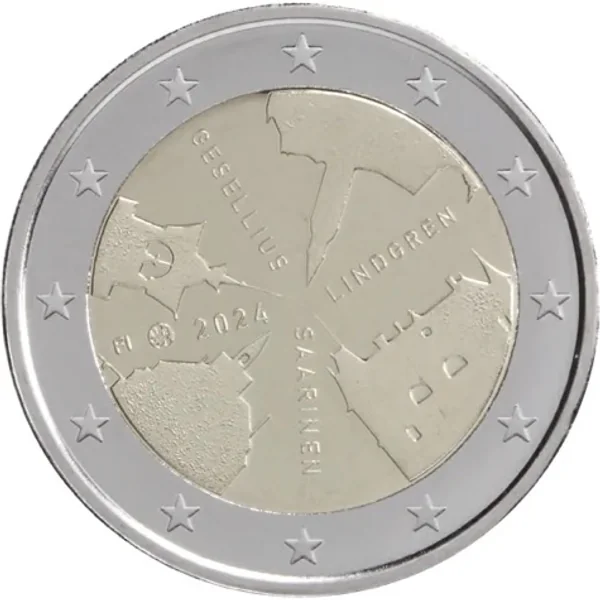 ©Image credit: Numismatische Sammlung der Deutschen Bundesbank + Add to collection In collection ★ Wanted
 At a glance
| Country | Finland |
|---|---|
| Year | 2024 |
| Issue date | 30 August 2024 |
| Coin type | Commemorative coin |
| Mintage | 400.000 (2.000 / 4.800) |
| Catalogue number | FI-24 G2 |
| Designer | Aimo Katajamäki |
| Rarity | €€€€€ what does this mean? |
| Edge lettering |  |
| Market value (approx.) | 3,5 € · guide price, uncirculated Unlock · for members |
Coin description
Silhouettes of four buildings: the Finnish National Museum (1905–1910), the Hvitträsk residential complex (1901–1903), Tallberg House (1898), and the Finnish Pavilion at the 1900 Paris World Exhibition. The towers of the buildings converge towards the centre of the design. The names "GESELLIUS", "LINDGREN", "SAARINEN", the country abbreviation "FI", the mintmark, and the year "2024" run diagonally between the buildings, forming a clock-like composition within the circular field.
Further information on the topic
The firm Gesellius, Lindgren & Saarinen decisively shaped Finnish Art Nouveau around 1900 — an architecture that deliberately appealed to national distinctiveness. Herman Gesellius, Armas Lindgren, and Eliel Saarinen founded their joint studio in Helsinki in 1896 and, within a few years, created buildings that attracted international attention. Their design for the Finnish pavilion at the 1900 Paris World's Fair is still regarded as a key work of National Romanticism: the façade combined medieval-looking granite blocks with ornamental reliefs drawn from Karelian folklore, demonstrating that Finland — then still part of the Russian Empire — possessed a distinctive cultural identity. The National Museum in Helsinki, which the three architects designed after winning a competition in 1902 and which was built between 1905 and 1910, continued this line: medieval church architecture and Nordic folk art merge there into a distinctive national style.
The communal residential project Hvitträsk on the lakeshore near Kirkkonummi, which the three architects built for themselves starting in 1901, reveals the second dimension of their work: the fusion of architecture, craft, and landscape into a total design. Eliel Saarinen, who continued the firm after the partnership dissolved in 1905, became an internationally influential figure — first with his design for Helsinki Central Railway Station (inaugurated 1919), later through his emigration to the United States, where he founded the Cranbrook Academy of Art and influenced an entire generation of American designers. Finland honored the trio with a 2-euro commemorative coin in 2024, recalling this architectural era that was so formative for Finnish identity.
Technical data
| Face value | 2 euro |
|---|---|
| Material | Bimetallic – outer ring: cupronickel; centre: three layers (nickel-brass / nickel / nickel-brass) |
| Weight | 8.5 g |
| Diameter | 25.75 mm |
| Thickness | 2.20 mm |
More 2-euro coins from Finland
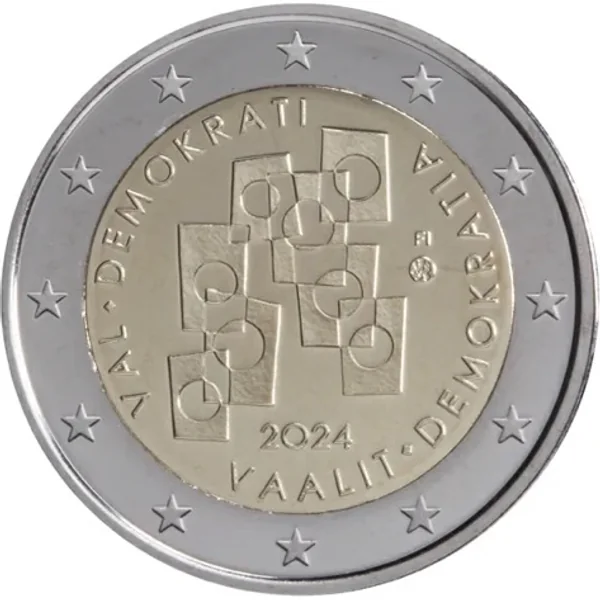
Elections and Democracy
Commemorative coin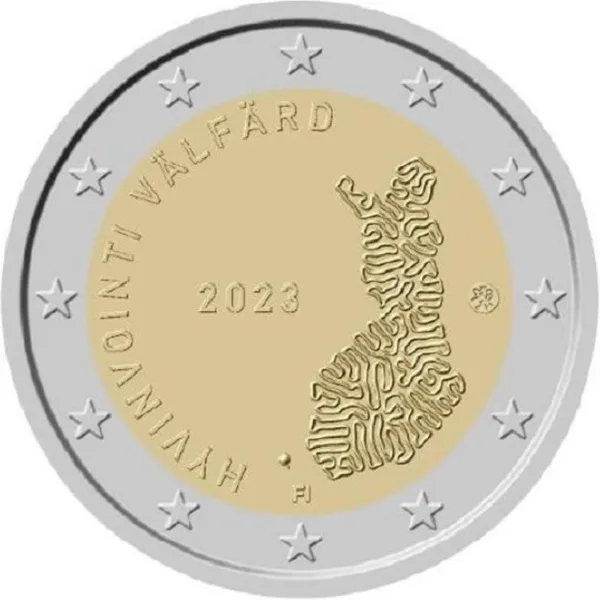
Social and Health Services
Commemorative coin
State Visits – Finnish Diplomacy and Foreign Policy
Commemorative coin
100 Years of the Finland–Sweden Athletics Match
Commemorative coin