10 Years of Euro Banknotes and Coins
 + Add to collection In collection ★ Wanted
 At a glance
| Country | Greece |
|---|---|
| Year | 2012 |
| Issue date | 2 January 2012 |
| Coin type | Commemorative coin |
| Mintage | 1.000.000 (5.000 / 2.500) |
| Catalogue number | GR-12 G1 |
| Designer | Helmut Andexlinger |
| Rarity | €€€€€ what does this mean? |
| Edge lettering |  |
| Market value (approx.) | 4 € · guide price, uncirculated Unlock · for members |
Coin description
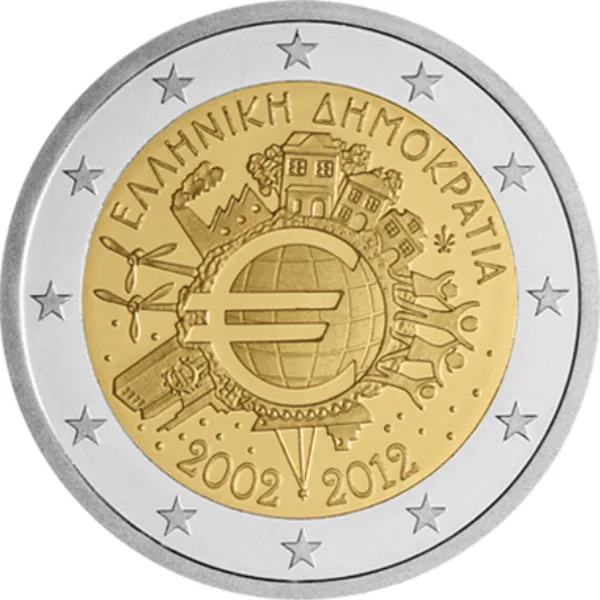
The euro has grown into a major factor across Europe and worldwide, establishing itself as a global player in the international monetary system. The elements arranged around the euro sign symbolise the currency's significance for everyday citizens, the financial world (the ECB tower), trade (ships), industry (factories), the energy sector, and research and development (wind turbines). The coin designer Helmut Andexlinger's initials appear below the ECB tower. The names of the issuing states in their national languages are engraved centrally above the design, with the dates 2002–2012 below.
Note on the coin
Third joint issue of the European Union. All 17 euro-area states issued a coin with the same design on the anniversary date of 1 January 2012. The coins differ only in the inscription, which appears in each country's national language. San Marino also issued a coin with the same design, which is not officially part of the joint issue.
Further information on the topic
On 1 January 2002, the euro entered circulation as cash — in twelve countries simultaneously, including Greece, the only one of the then participating countries that had not been part of the first wave of introduction in 1999, having joined the eurozone only in 2001. The changeover affected more than 300 million people and was the largest coordinated currency changeover in history. Within a few weeks, national currencies disappeared from circulation: the Greek drachma, the German mark, the French franc, the Italian lira and seven other currencies, some of which had been in use for centuries. The logistical challenge was enormous — for the launch date alone, around 15 billion banknotes and 52 billion coins were made available across Europe.
For Greece, the introduction of the euro carried special significance: it marked the provisional conclusion of a long process of economic modernisation and full integration into the European single market. The euro quickly developed into the world's second most important reserve currency and has since shaped trade, financial policy and everyday life across the entire eurozone. To mark the tenth anniversary of euro cash, all euro states jointly issued a commemorative coin in 2012 — one of the rare European joint issues in which the same design was minted by every member state.
Official issues of the coin
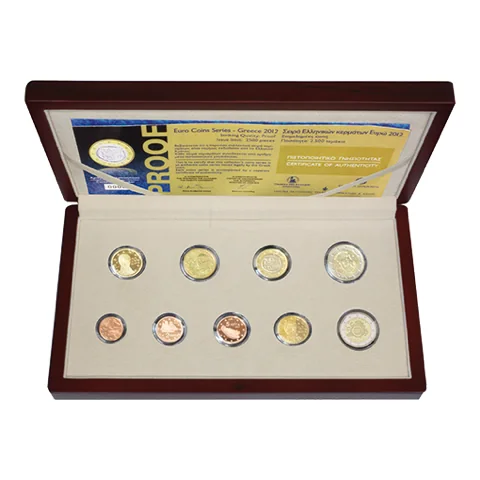 ©Image credit: Νομισματοκοπείο - IETA
Technical data
| Face value | 2 euro |
|---|---|
| Material | Bimetallic – outer ring: cupronickel; centre: three layers (nickel-brass / nickel / nickel-brass) |
| Weight | 8.5 g |
| Diameter | 25.75 mm |
| Thickness | 2.20 mm |
More 2-euro coins from Greece
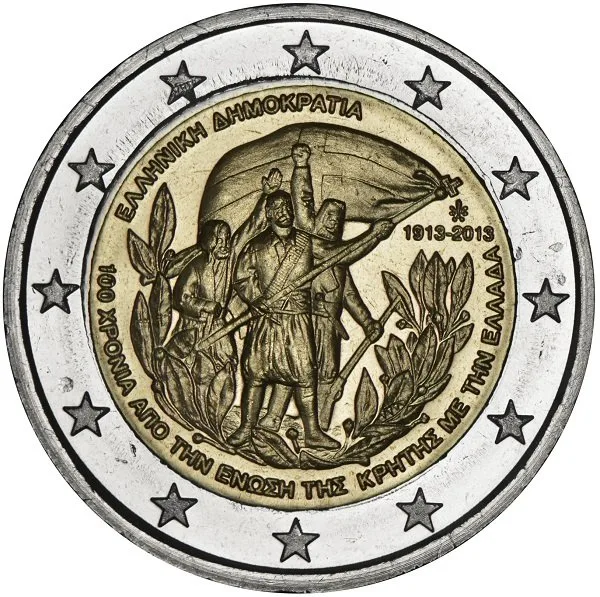
100th Anniversary of the Union with Crete
Commemorative coin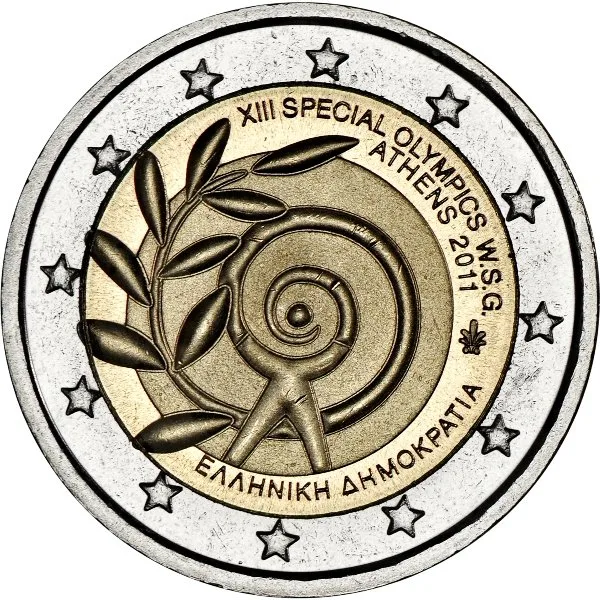
2011 Special Olympics in Athens
Commemorative coin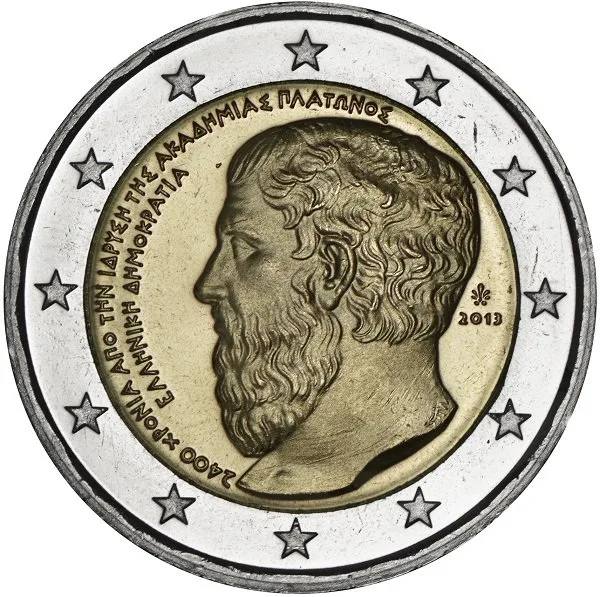
2,400 Years of the Platonic Academy
Commemorative coin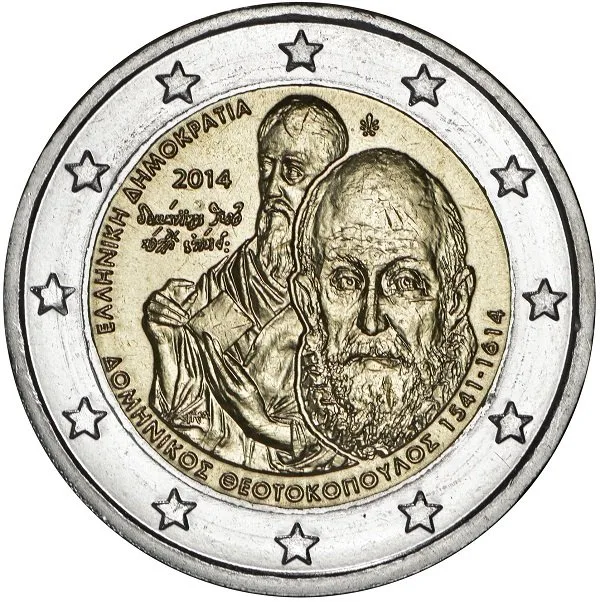
400th Anniversary of the Death of Domínikos Theotokópoulos
Commemorative coin