Archaeological Site of Philippi
 + Add to collection In collection ★ Wanted
 At a glance
| Country | Greece |
|---|---|
| Year | 2017 |
| Issue date | 12 October 2017 |
| Coin type | Commemorative coin |
| Mintage | 750.000 (4.500 / 1.500) |
| Catalogue number | GR-17 G2 |
| Designer | Georgios Stamatopoulos |
| Rarity | €€€€€ what does this mean? |
| Edge lettering |  |
| Market value (approx.) | 5 € · guide price, uncirculated Unlock · for members |
Coin description
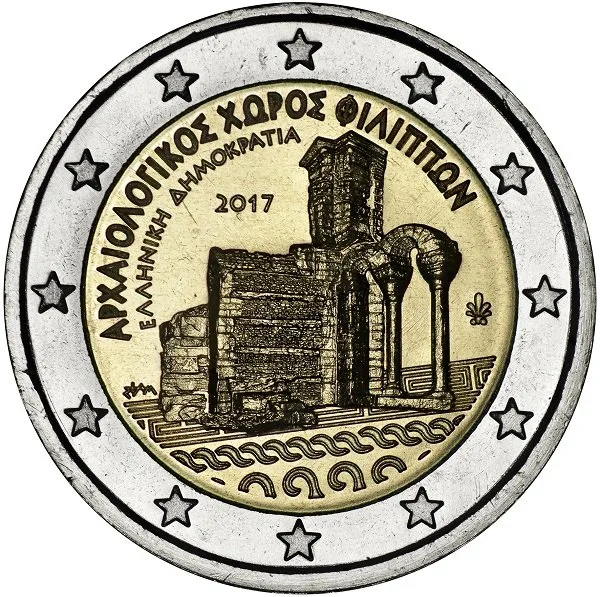
Part of Basilica B, together with linear motifs drawn from the border pattern of an ancient Greek mosaic discovered at the site. Along the inner circle, the inscriptions "ARCHAEOLOGICAL SITE OF PHILIPPI" and "HELLENIC REPUBLIC" (in Greek) are engraved. The issue year 2017 and a palmette — the Greek mint's mark — are also present in the background to the right. The monogram of coin designer Georgios Stamatopoulos appears at lower left.
Further information on the topic
In north-eastern Greece, in the region of East Macedonia and Thrace, lies the ancient city of Philippi — named after the Macedonian king Philip II, who founded and developed it around 356 BC. Its position on a strategically important trade and military road, the later Via Egnatia, made Philippi for centuries a hub between Europe and Asia. In 42 BC, the Battle of Philippi on the fields outside the city decided the fate of the Roman Republic: the forces of Octavian and Mark Antony defeated Brutus and Cassius, the last defenders of the old senatorial order. Philippi subsequently developed into a flourishing Roman colony with a forum, theatres and temples, whose remains survive to this day.
Philippi also gained world-historical significance as an early Christian site: around 49 AD, the Apostle Paul founded here the first Christian community on European soil and later wrote his Epistle to the Philippians. The archaeological site of Philippi — forum, basilicas, baptistery, theatre and remains of several early Byzantine church buildings — reflects this layering of Macedonian, Roman and early Christian history. UNESCO added the site to the World Heritage List in 2016, recognising its outstanding universal value. On the occasion of this inscription, Greece issued a 2-euro commemorative coin in 2017, bringing the archaeological site of Philippi to wider public awareness.
Official issues of the coin
 ©Image credit: Νομισματοκοπείο - IETA
Technical data
| Face value | 2 euro |
|---|---|
| Material | Bimetallic – outer ring: cupronickel; centre: three layers (nickel-brass / nickel / nickel-brass) |
| Weight | 8.5 g |
| Diameter | 25.75 mm |
| Thickness | 2.20 mm |
More 2-euro coins from Greece
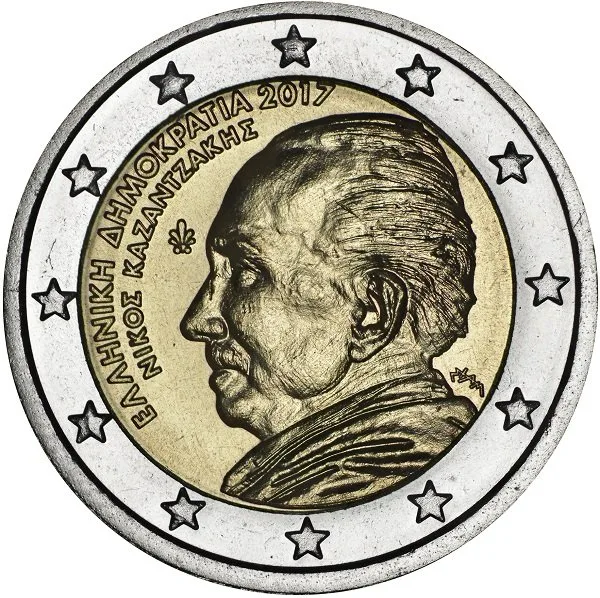
60th Anniversary of the Death of Nikos Kazantzakis
Commemorative coin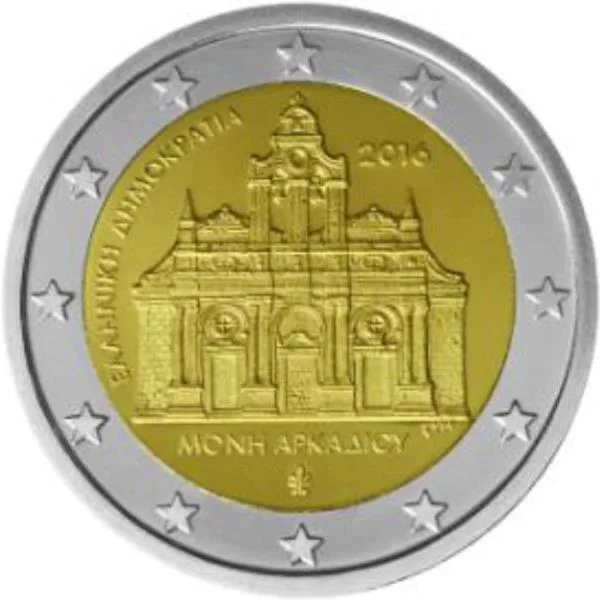
150th Anniversary of the Burning of Arkadi Monastery
Commemorative coin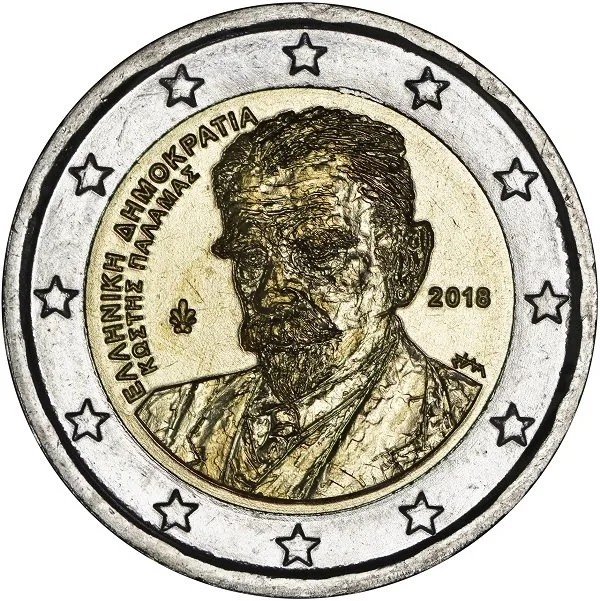
75th Anniversary of the Death of Kostis Palamas
Commemorative coin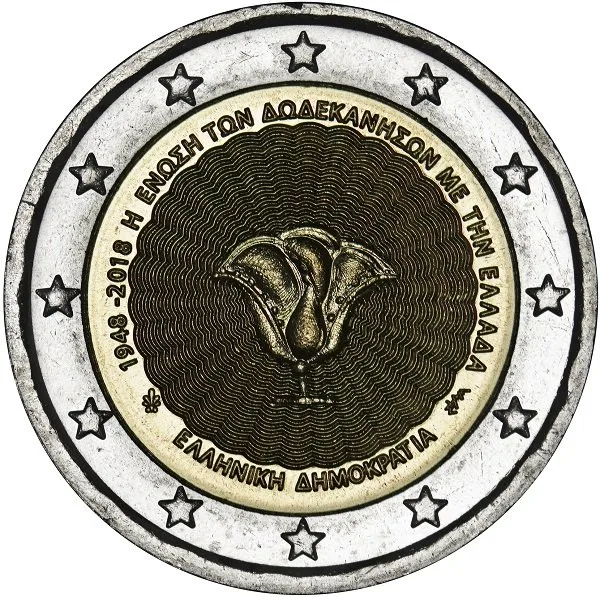
70th Anniversary of the Union of the Dodecanese with Greece
Commemorative coin