10 Years of Economic and Monetary Union
 + Add to collection In collection ★ Wanted
 At a glance
| Country | Italy |
|---|---|
| Year | 2009 |
| Issue date | 26 March 2009 |
| Coin type | Commemorative coin |
| Mintage | 2.000.000 (40.600 / 5.500) |
| Catalogue number | IT-09 G1 |
| Designer | Georgios Stamatopoulos |
| Rarity | €€€€€ what does this mean? |
| Edge lettering |  |
| Market value (approx.) | 3,5 € · guide price, uncirculated Unlock · for members |
Coin description
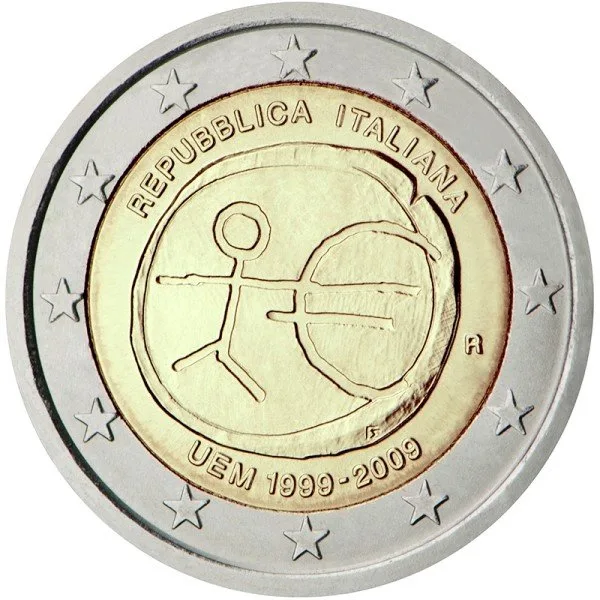
At the centre, a stylised human figure drawn from an ancient coin, with its left arm extended into the euro symbol. The artist's initials appear below the euro symbol. The issuing state's name in the national language runs along the upper edge of the design, while the dates 1999–2009 and the acronym UEM in the national language(s) appear along the lower edge.
Note on the coin
Second joint issue of the European Union. All 16 euro-area states issued a coin with the same design on the anniversary date of 1 January 2009. The coins differ only in the inscription, which appears in each country's national language.
Further information on the topic
On 1 January 1999, the Economic and Monetary Union entered its third and decisive phase: eleven EU member states, including Italy, irrevocably fixed their exchange rates and transferred monetary policy to the newly established European Central Bank in Frankfurt. For Italy, this step represented a profound break with national economic sovereignty — the lira, a symbol of state unity since the Risorgimento, gradually lost its function. With the introduction of euro banknotes and coins on 1 January 2002, it disappeared entirely from everyday life. Italy was thus part of the founding group of a currency zone that, at the time, comprised around 300 million people and has since grown into the world's second-largest economy.
The eurozone's first ten years were anything but smooth: inflation differentials between northern and southern Europe, debates over the Stability Pact, and the onset of the financial crisis emerging in 2008 accompanied the anniversary. Nevertheless, the European Commission drew an overall positive conclusion in 2009 — the euro had proven itself a stable means of payment, had lowered transaction costs within the internal market, and had given participating states a unified monetary-policy foundation. For the tenth anniversary of the Economic and Monetary Union, all eurozone states, including Italy, jointly issued a commemorative coin in 2009 honouring this milestone in European integration.
Technical data
| Face value | 2 euro |
|---|---|
| Material | Bimetallic – outer ring: cupronickel; centre: three layers (nickel-brass / nickel / nickel-brass) |
| Weight | 8.5 g |
| Diameter | 25.75 mm |
| Thickness | 2.20 mm |