Walled Cities – Valletta
 + Add to collection In collection ★ Wanted
 At a glance
| Country | Malta |
|---|---|
| Year | 2026 |
| Issue date | 14 April 2026 |
| Coin type | Commemorative coin |
| Mintage | 145,000 (37,000 / 3,000) |
| Catalogue number | MT-26 G1 |
| Designer | Noel Galea Bason |
| Rarity | €€€€€ what does this mean? |
| Edge lettering |  |
| Market value (approx.) | €12 · guide price, uncirculated Unlock · for members |
Coin description
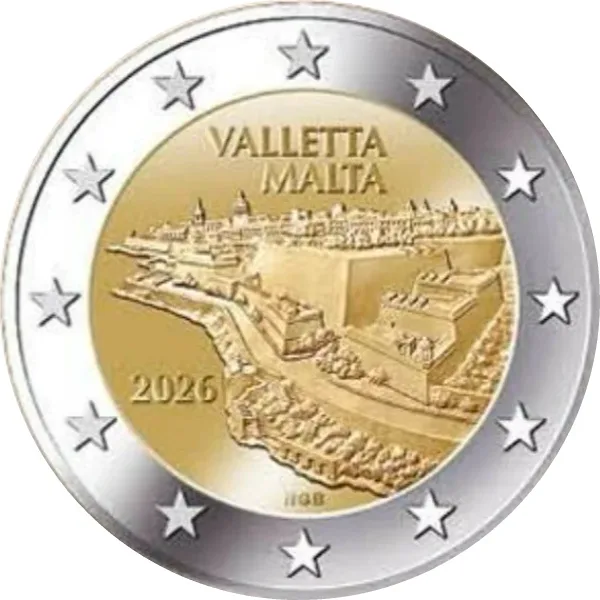
The Grand Harbour in the historic heart of the Maltese capital. Above the design: the inscription "VALLETTA" and the issuing state "MALTA". To the left: the year "2026". Along the lower edge: the designer Noel Galea Bason's initials "NGB".
Further information on the topic
The Grand Harbour off Valletta is regarded as one of the deepest and most strategically important natural harbors in the Mediterranean — a fact that has profoundly shaped the history of Malta's capital. Jean Parisot de Valette, Grand Master of the Order of St John, had the city built as a planned fortress town following the victory over the Ottoman siege of 1565. From 1566, a strictly geometric street grid arose on the Xiberras peninsula, enclosed by massive bastions of the islands' pale Globigerina limestone. The outstanding defensive architecture — curtain walls, ravelins, casemated gun galleries — made Valletta one of the most densely fortified city layouts in Europe of its time. Today the city covers only about 0.8 square kilometers but houses an extraordinary density of baroque architecture: the Co-Cathedral of St John with Caravaggio's paintings, the Grand Master's Palace, and dozens of churches and auberges of the Order's various langues.
Valletta was declared a UNESCO World Heritage Site in 1980 and European Capital of Culture in 2018 — two international recognitions that highlight the urban and cultural integrity of the site. As a small island state, Malta invests specifically in preserving this heritage: restoration of the fortifications, the Upper Barrakka Gardens as a vantage point over the Grand Harbour, and the redesigned City Gate entrance area based on plans by Renzo Piano all show how Valletta navigates between heritage conservation and modern urban renewal. Malta's city walls are no museum relic but remain the structuring element of urban life in the historic core. With a 2-euro commemorative coin from 2026, as part of the Maltese Walled Cities series, Malta honors the historic fortifications and urban heritage of its capital.
Technical data
| Face value | 2 euro |
|---|---|
| Material | Bimetallic – outer ring: cupronickel; centre: three layers (nickel-brass / nickel / nickel-brass) |
| Weight | 8.5 g |
| Diameter | 25.75 mm |
| Thickness | 2.20 mm |