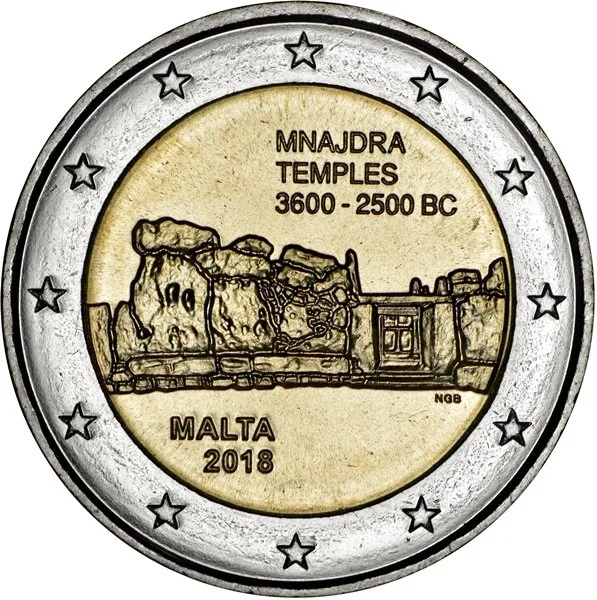
Prehistoric Sites of Malta – Mnajdra
 + Add to collection In collection ★ Wanted
 At a glance
| Country | Malta |
|---|---|
| Year | 2018 |
| Issue date | 21 June 2018 |
| Coin type | Commemorative coin |
| Mintage | 335.000 (35.000 / – ) |
| Catalogue number | MT-18 G1 |
| Designer | Noel Galea Bason |
| Rarity | €€€€€ what does this mean? |
| Edge lettering |  |
| Market value (approx.) | 5 € · guide price, uncirculated Unlock · for members |
Coin description
Prehistoric temple of Mnajdra. In the upper right area are the inscriptions "MNAJDRA", "TEMPLES" and the years "3600-2500 BC". In the lower left area, the name of the issuing country "MALTA" is engraved, with the year of issue "2018" below it.
Note on the coin
This 2 euro commemorative coin exists in 3 variants. The ones in the brilliant uncirculated coincard were struck in Pessac and bear the mintmark of the mint and of mint master Yves Sampo (MT-18 G2). The coins in the brilliant uncirculated coin set feature an "F" in the lower star (MT-18 G3). The coins from the rolls carry no mintmark (MT-18 G1).
Further information on the topic
Mnajdra is one of the best-preserved megalithic temple complexes in the world, located in southwestern Malta near the cliffs at Qrendi. The site was built between roughly 3600 and 2500 BC, making it one of the oldest freestanding stone structures in human history — older than Stonehenge and the Egyptian pyramids. Its three interconnected temples were built from coralline limestone and follow the trefoil layout with apse-shaped chambers typical of Maltese temple architecture. Especially notable is its astronomical alignment: at the solstices and equinoxes, light falls through doorways and stone blocks in such a way that specific areas inside the temple are precisely illuminated — evidence of the builders' advanced calendrical knowledge.
Malta's prehistoric sites, which alongside Mnajdra include Ġgantija on Gozo and Ħaġar Qim, have jointly been recognised as a UNESCO World Heritage Site since 1980. They attest to a distinct temple culture that arose on the Maltese islands without any demonstrable direct models elsewhere in the Mediterranean, and which ended abruptly after several centuries. Mnajdra is thus not only archaeological evidence of early construction technique but also an open field of research: questions about the builders' beliefs, social organisation, and the end of this culture remain unanswered to this day. Malta honoured Mnajdra in 2018 as part of its series on the prehistoric sites of Malta.
Technical data
| Face value | 2 euro |
|---|---|
| Material | Bimetallic – outer ring: cupronickel; centre: three layers (nickel-brass / nickel / nickel-brass) |
| Weight | 8.5 g |
| Diameter | 25.75 mm |
| Thickness | 2.20 mm |
More 2-euro coins from Malta
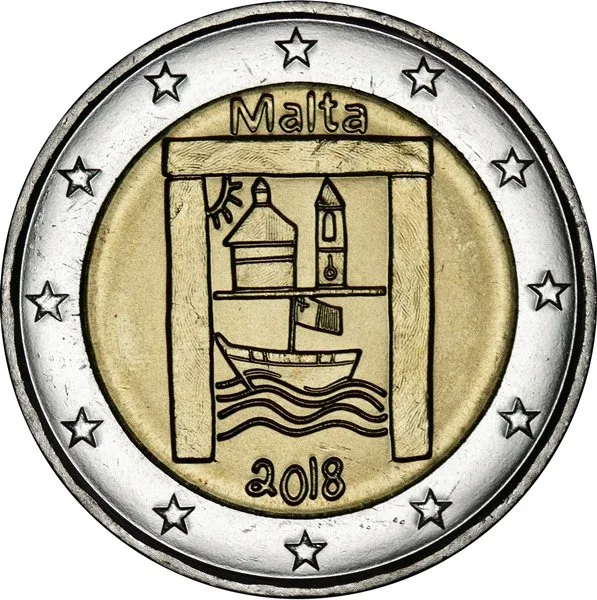
From Children with Solidarity – Cultural Heritage
Commemorative coin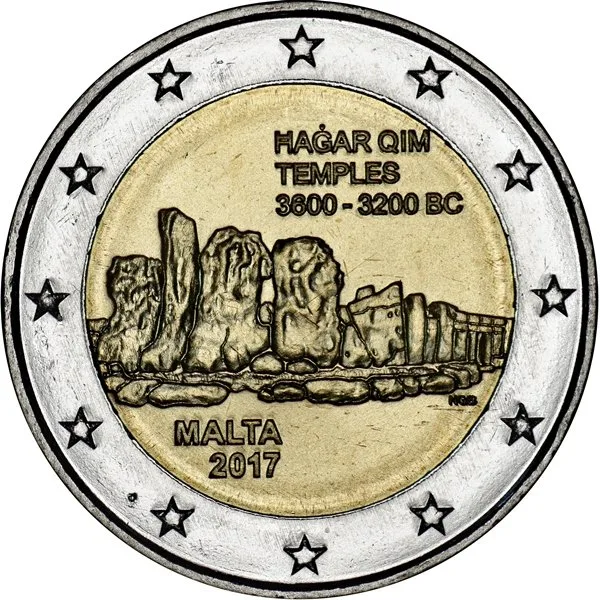
Prehistoric Sites of Malta – Ħaġar Qim
Commemorative coin
Prehistoric Sites of Malta – Ta' Ħaġrat
Commemorative coin
From Children with Solidarity – Peace
Commemorative coin