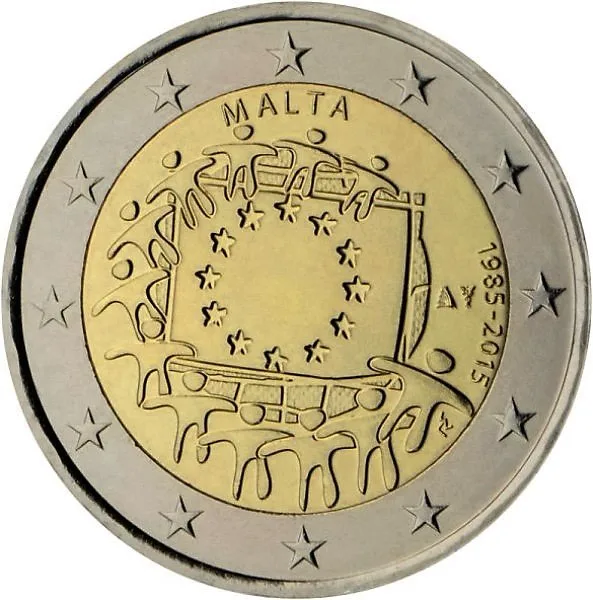
30 Years of the European Flag
 + Add to collection In collection ★ Wanted
 At a glance
| Country | Malta |
|---|---|
| Year | 2015 |
| Issue date | 18 December 2015 |
| Coin type | Commemorative coin |
| Mintage | 300.000 ( – / – ) |
| Catalogue number | MT-15 G5 |
| Designer | Georgios Stamatopoulos |
| Rarity | €€€€€ what does this mean? |
| Edge lettering |  |
| Market value (approx.) | 6 € · guide price, uncirculated Unlock · for members |
Coin description
The EU flag as a symbol bringing peoples and cultures together in pursuit of shared ideals and a better future. Twelve stars take on human form, welcoming the birth of a new Europe. In the upper field: the issuing state "MALTA" and, to the right, the dates "1985–2015". To the lower right: the designer Georgios Stamatopoulos's initials.
Note on the coin
Fourth joint issue of the European Union. All 19 eurozone states issue a coin with the same design on varying dates. The coins differ only in the inscription, which appears in the respective national language.
Further information on the topic
Malta did not join the European Union until 2004, yet its connection to the European project runs deeper than the formal accession date might suggest. The island state, situated at the geographic centre of the Mediterranean, has always navigated between great powers throughout its history — Phoenicians, Romans, Arabs, Normans, the Knights of St John, and the British have all left their mark on the small country. For Malta, turning toward Europe was therefore less a break than a continuity: a choice for political stability, economic integration, and cultural belonging within a larger framework. The European flag, whose history dates back to 1955, when the Council of Europe introduced it as the first European symbol, represents this coming together of diverse traditions under shared principles — human dignity, democracy, the rule of law.
The twelve stars of the European flag have been interpreted in many ways since its introduction; the number twelve does not represent a specific number of members but is regarded as a symbol of completeness and unity. In 1985, the European Community adopted the flag as its official emblem — a step that extended its significance far beyond the Council of Europe and made it the most widely recognised symbol of European integration. To mark the 30th anniversary of this adoption, all euro states, Malta included, issued a joint commemorative coin in 2015. It was the first major Europe-wide joint issue in which Malta took part as a euro member since 2008 — a visible sign of its full integration into Europe's monetary and symbolic system.
Technical data
| Face value | 2 euro |
|---|---|
| Material | Bimetallic – outer ring: cupronickel; centre: three layers (nickel-brass / nickel / nickel-brass) |
| Weight | 8.5 g |
| Diameter | 25.75 mm |
| Thickness | 2.20 mm |
More 2-euro coins from Malta
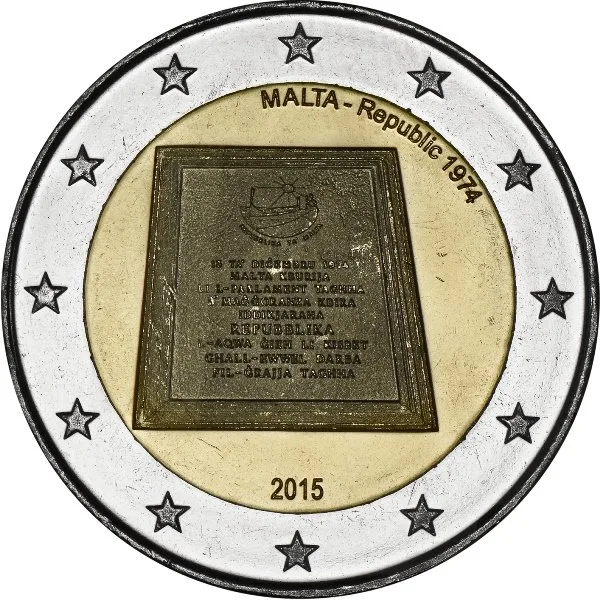
Proclamation of the Republic of Malta, 1974
Commemorative coin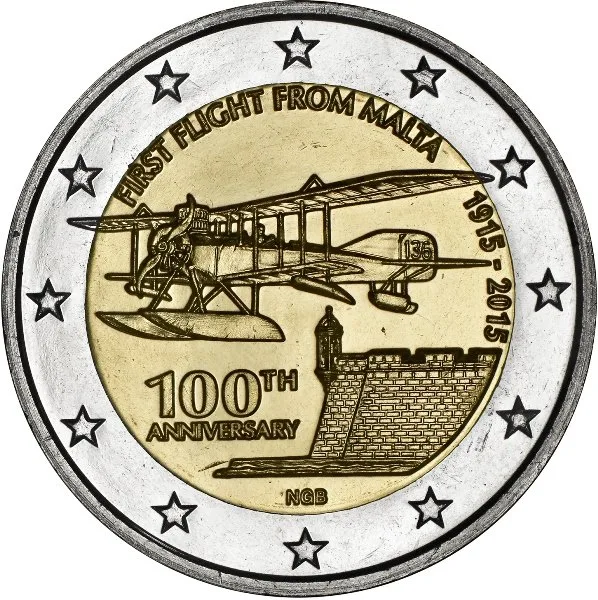
100th Anniversary of the First Flight from Malta
Commemorative coin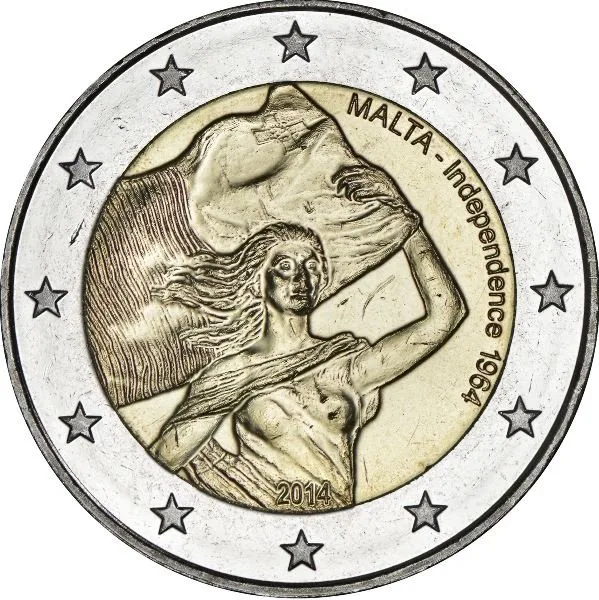
Independence from Great Britain 1964
Commemorative coin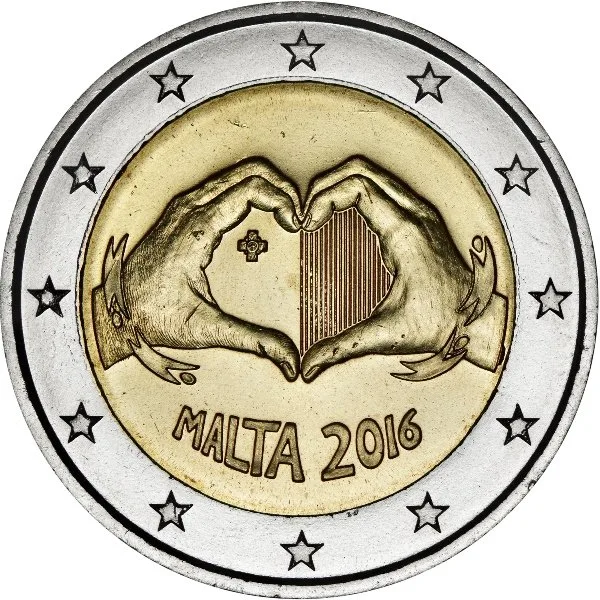
From Children with Solidarity – Love
Commemorative coin