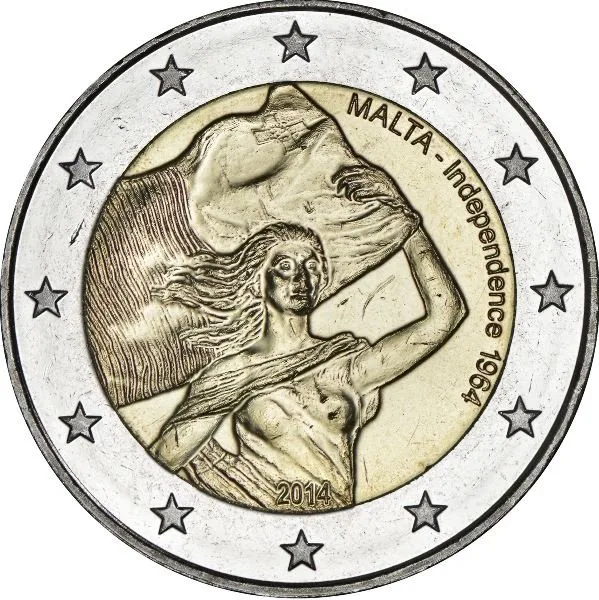
Independence from Great Britain 1964
 + Add to collection In collection ★ Wanted
 At a glance
| Country | Malta |
|---|---|
| Year | 2014 |
| Issue date | 3 June 2014 |
| Coin type | Commemorative coin |
| Mintage | 432.500 (25.000 / 7.500) |
| Catalogue number | MT-14 G1 |
| Designer | Ganni Bonnici |
| Rarity | €€€€€ what does this mean? |
| Edge lettering |  |
| Market value (approx.) | 4,5 € · guide price, uncirculated Unlock · for members |
Coin description
Part of the bronze statue designed by Ganni Bonnici in 1989, symbolizing independence. It depicts a young woman representing Malta, carrying the Maltese flag. On the right side, arranged in a semicircle, is the inscription "MALTA – Independence 1964", and the issue year "2014" is engraved at the bottom.
Note on the coin
This 2 euro commemorative coin exists in 2 variants. The 2 euro commemorative coins in the brilliant uncirculated coin set were struck at the Dutch mint in Utrecht and therefore bear the mint's mintmark (MT-14 G2). The other coins carry no mintmark (MT-14 G1).
Further information on the topic
On 21 September 1964, Malta's status as a British crown colony, which the island state had held since the Congress of Vienna in 1815, came to an end. Independence was the result of decades of struggle: after the Second World War, during which Malta's strategic position in the Mediterranean brought it heavy bombardment and earned it the epithet "island of the George Cross", independence negotiations gained momentum. Prime Minister Giorgio Borg Olivier led the Maltese delegation that negotiated a constitutional treaty in London in 1964. Malta joined the Commonwealth as a sovereign state, initially retained the British Crown as head of state, and became a member of the United Nations. The new constitution guaranteed fundamental rights, parliamentary democracy and state neutrality - foundations that still apply today.
The constitutional significance of this step reaches beyond the date itself. Malta went through further stages of state development after 1964: the republic was proclaimed in 1974, the last British forces left the island in 1979, and in 2004 Malta became the first Mediterranean island nation to join the European Union. The Maltese commemorative coin of 2014, issued to mark the 50th anniversary of independence from Britain, is part of the series on Malta's constitutional history, through which the country keeps alive the formative milestones of its national identity. The independence of 1964 is regarded as the founding moment of modern Malta - a turning point that permanently redefined the island state's political standing in the Mediterranean.
Technical data
| Face value | 2 euro |
|---|---|
| Material | Bimetallic – outer ring: cupronickel; centre: three layers (nickel-brass / nickel / nickel-brass) |
| Weight | 8.5 g |
| Diameter | 25.75 mm |
| Thickness | 2.20 mm |
More 2-euro coins from Malta
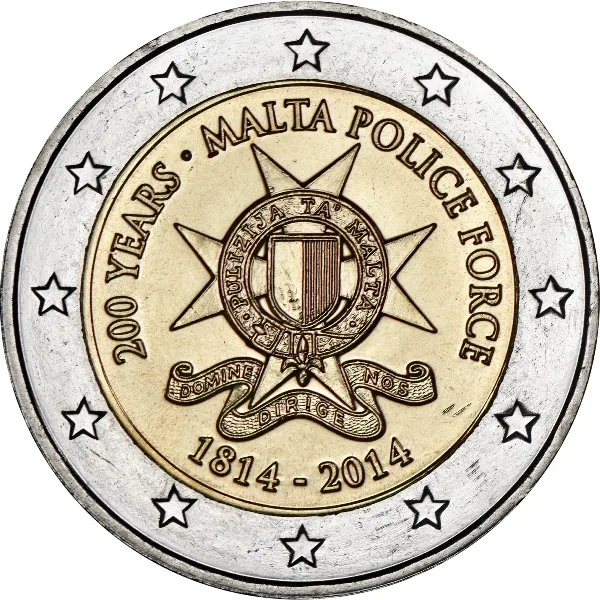
200 Years of the National Police of Malta
Commemorative coin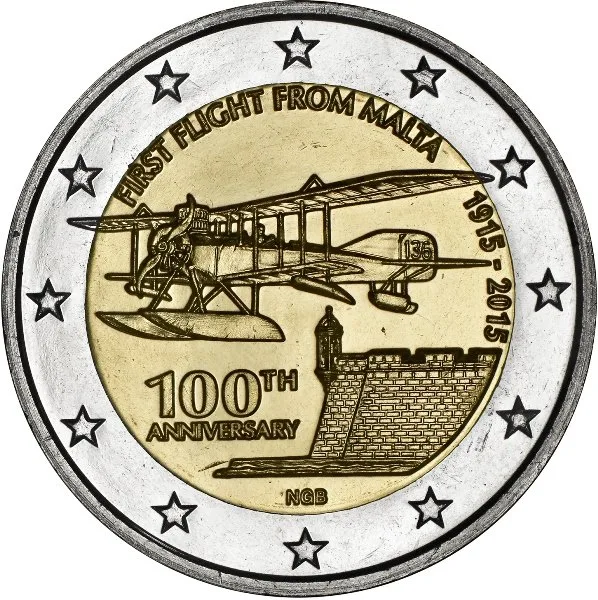
100th Anniversary of the First Flight from Malta
Commemorative coin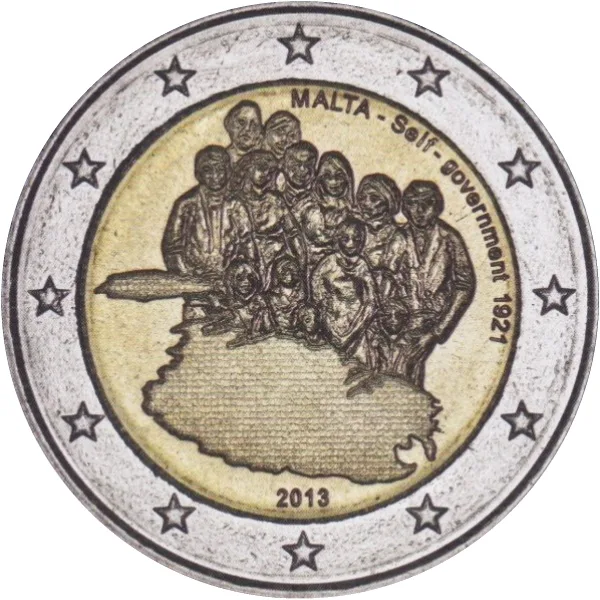
Self-Government 1921
Commemorative coin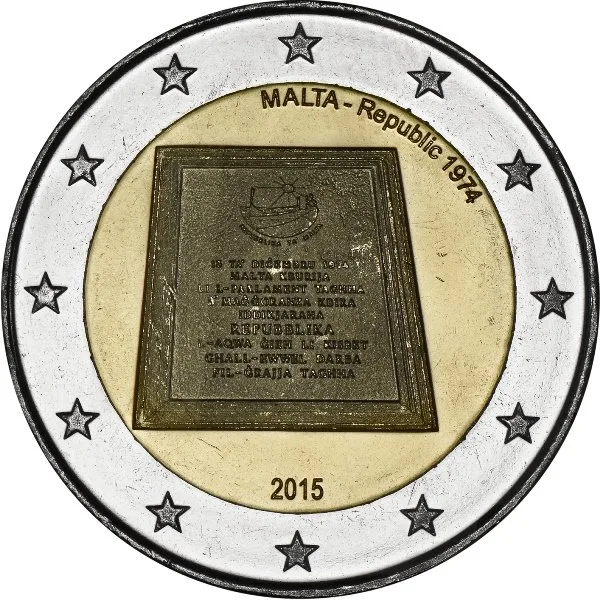
Proclamation of the Republic of Malta, 1974
Commemorative coin