10 Years of Economic and Monetary Union
 + Add to collection In collection ★ Wanted
 At a glance
| Country | Belgium |
|---|---|
| Year | 2009 |
| Issue date | 27 January 2009 |
| Coin type | Commemorative coin |
| Mintage | 5.012.000 (6.000 / 6.000) |
| Catalogue number | BE-09 G1 |
| Designer | Georgios Stamatopoulos |
| Rarity | €€€€€ what does this mean? |
| Edge lettering |  |
| Market value (approx.) | 3,5 € · guide price, uncirculated Unlock · for members |
Coin description
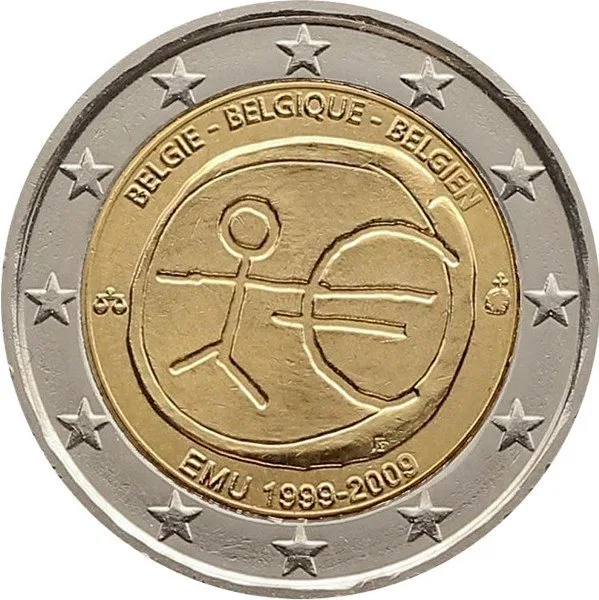
At the centre, a stylised human figure on an ancient coin, whose left arm extends into the euro symbol. The artist's initials appear beneath the euro symbol. The name of the issuing state in its national language(s) appears at the top of the design, with the dates 1999–2009 and the acronym EMU (rendered in the national language) at the bottom.
Note on the coin
Second joint issue of the European Union. All 16 eurozone states issued a coin with the same design on the anniversary date of 1 January 2009. The coins differ only in the legend, which appears in the respective national language.
Further information on the topic
The European Union's Economic and Monetary Union has its roots in the Maastricht Treaty of 1992, which set out a binding roadmap towards a common currency. Decades of monetary instability in Europe preceded it: exchange-rate fluctuations burdened intra-European trade, and the collapse of the Bretton Woods system in 1973 had made the need for closer coordination clear. The European exchange-rate mechanism of the 1980s was a first step but foundered on tensions such as the British pound crisis of 1992. The actual monetary union began on 1 January 1999, when eleven states — including Belgium as a founding member — introduced the euro as scriptural money and irrevocably fixed the exchange rates of their currencies. The European Central Bank thereby took over monetary policy for an economic area that, measured by GDP, ranked among the largest in the world.
Belgium occupies a special place in this history: Brussels is home to central EU institutions and has consistently been an advocate of deep integration in economic policy. As a small, export-dependent open economy, Belgium benefited early on from stable exchange rates against its most important trading partners — Germany, France and the Netherlands. The Belgian economy is closely interwoven with the European internal market, a key reason why the country was among the staunchest supporters of the EMU. Ten years after the introduction of the euro as scriptural money, the eurozone and the ECB's common monetary policy still had their first serious test ahead of them; the financial crisis from 2008 onward would expose the system's limits. The joint European commemorative issue by all eurozone states for the tenth anniversary of the Economic and Monetary Union appeared in 2009 and marks this historic milestone.
Official announcement (EU Official Journal): ABl. C 315 vom 10.12.2008, S. 8 (2008/C 315/04)
Technical data
| Face value | 2 euro |
|---|---|
| Material | Bimetallic – outer ring: cupronickel; centre: three layers (nickel-brass / nickel / nickel-brass) |
| Weight | 8.5 g |
| Diameter | 25.75 mm |
| Thickness | 2.20 mm |