10 Years of Euro Banknotes and Coins
 + Add to collection In collection ★ Wanted
 At a glance
| Country | France |
|---|---|
| Year | 2012 |
| Issue date | 7 January 2012 |
| Coin type | Commemorative coin |
| Mintage | 10.020.000 (10.000 / 10.000) |
| Catalogue number | FR-12 G1 |
| Designer | Helmut Andexlinger |
| Rarity | €€€€€ what does this mean? |
| Edge lettering |  |
| Market value (approx.) | 4 € · guide price, uncirculated Unlock · for members |
Coin description
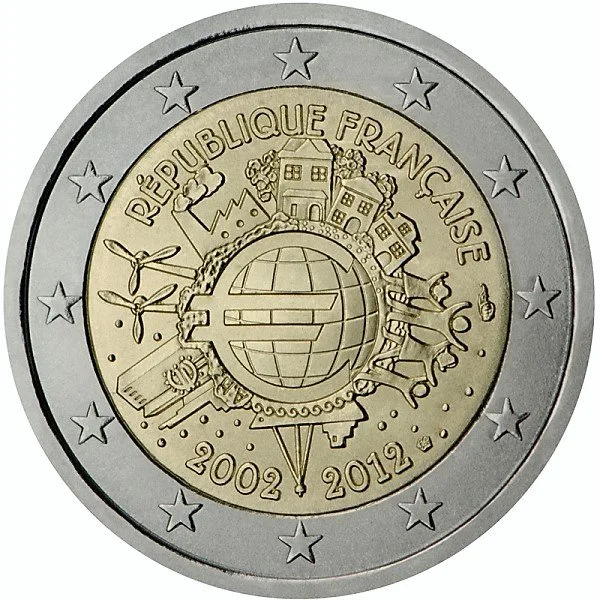
The euro has grown into a major factor in Europe and around the world, and a global player in the international monetary system. The design elements arranged around the euro sign symbolise the currency's significance for citizens, the financial world (the ECB tower), trade (ships), industry (factories), the energy sector, and research and development (wind turbines). The artist's initials “AH” appear below the ECB tower. The names of the issuing states in their national languages are inscribed centrally above the design, with the dates 2002–2012 below.
Note on the coin
Third European Union joint issue. All 17 eurozone states issued a coin with the same design on the anniversary date of 1 January 2012. The coins differ only in their inscriptions, which appear in the respective national language. San Marino also issued a coin with the same design, though it is not officially part of the joint issue.
Further information on the topic
On 1 January 2002, euro cash was introduced simultaneously in twelve countries of the European Union — a logistical feat without precedent in monetary history: around 7.4 billion banknotes and 38.2 billion coins entered circulation within a matter of weeks. France was among the founding states of the eurozone and had already introduced the euro as book money in 1999; the physical introduction of cash meant, for the population, the definitive end of the franc, which had served as a means of payment since the Middle Ages. The European Central Bank, headquartered in Frankfurt am Main, coordinated the transition, ensuring the new coins and notes carried uniform security features while the national sides of the coins preserved the identity of each member state.
In the ten years following the cash introduction, the euro established itself as the world's second most important reserve currency and shaped the daily life of hundreds of millions of people in a growing eurozone. France, as one of the monetary union's largest economies, played a central role in this — both in trade within the EU and in the international monetary system. The elimination of exchange-rate risk noticeably strengthened economic ties among member states, even as the debt crisis from 2010 put the resilience of the common currency to a hard test. To mark the tenth anniversary of euro cash, all euro states issued a joint commemorative coin in 2012 — the first European joint issue of its kind.
Technical data
| Face value | 2 euro |
|---|---|
| Material | Bimetallic – outer ring: cupronickel; centre: three layers (nickel-brass / nickel / nickel-brass) |
| Weight | 8.5 g |
| Diameter | 25.75 mm |
| Thickness | 2.20 mm |