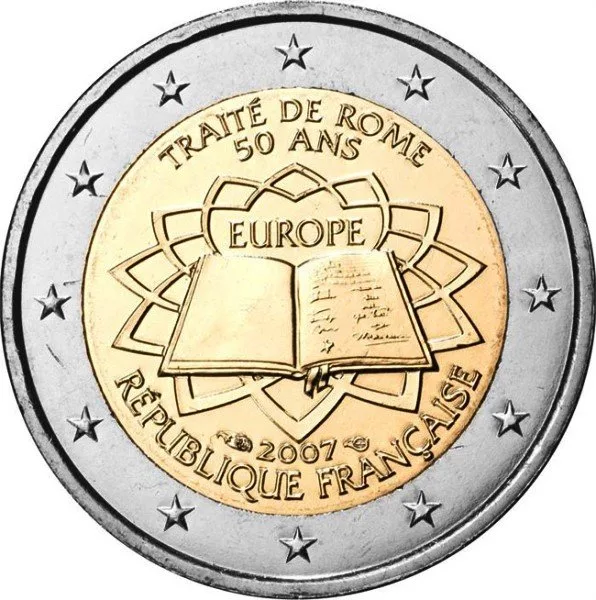
50 Years of the Treaties of Rome
 + Add to collection In collection ★ Wanted
 At a glance
| Country | France |
|---|---|
| Year | 2007 |
| Issue date | 25 March 2007 |
| Coin type | Commemorative coin |
| Mintage | 9.406.875 ( – / – ) |
| Catalogue number | FR-07 G1 |
| Designer | Münze Österreich, Real Casa de la Moneda, Istituto Poligrafico e Zecca dello Stato S.p.A |
| Rarity | €€€€€ what does this mean? |
| Edge lettering |  |
| Market value (approx.) | 5 € · guide price, uncirculated Unlock · for members |
Coin description
At the centre, the treaty document signed by the six founding members, set against the backdrop of the star-shaped paving of the Piazza del Campidoglio in Rome — designed by Michelangelo — where the Treaty was signed on 25 March 1957. The word “Europa” in the respective language appears directly above the document. Above: the commemorative occasion; below: the issuing country in the relevant language(s) and the year 2007.
Note on the coin
First European Union joint issue. All 13 eurozone states issued a coin with the same design on the anniversary date of 25 March 2007. The coins differ only in their inscriptions, which appear in the respective national language.
Further information on the topic
For France, the Treaties of Rome of 25 March 1957 rank among the central milestones of post-war history. As one of the six founding members, France signed in Rome, together with the Federal Republic of Germany, Italy, Belgium, the Netherlands, and Luxembourg, the Treaty establishing the European Economic Community as well as the Euratom Treaty. The negotiations were shaped by the conviction that economic interdependence could secure lasting peace — a view championed in France above all by Foreign Minister Christian Pineau and Economy Minister Maurice Faure. The treaty text aimed at a common market, the reduction of tariffs, and the coordination of economic policy — decisions whose impact extended far beyond the original six-state union.
The signing took place in the Palazzo dei Senatori on Rome's Capitoline Hill, a location chosen for its deliberate historical symbolism. The Piazza del Campidoglio, designed by Michelangelo, lent the occasion a gravity befitting the historic ambition of the treaties. In the decades that followed, the EEC formed the institutional foundation on which the European Communities and later the European Union were built. France has consistently helped shape this integration — from the Common Agricultural Policy to the introduction of the euro. To mark the 50th anniversary of the signing in 2007, all euro states jointly issued a 2-euro commemorative coin, marking the first Europe-wide joint issue with a unified design.
Technical data
| Face value | 2 euro |
|---|---|
| Material | Bimetallic – outer ring: cupronickel; centre: three layers (nickel-brass / nickel / nickel-brass) |
| Weight | 8.5 g |
| Diameter | 25.75 mm |
| Thickness | 2.20 mm |
More 2-euro coins from France
EU Council Presidency France 2008
Commemorative coin
10 Years of Economic and Monetary Union
Commemorative coin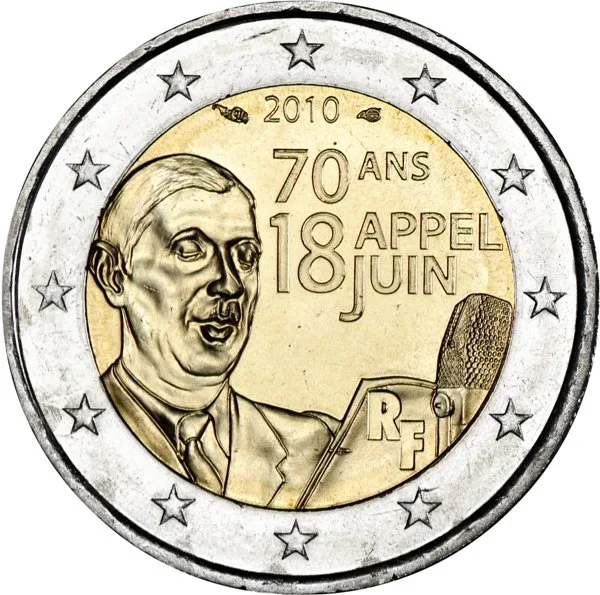
70th Anniversary of the Appeal of 18 June
Commemorative coin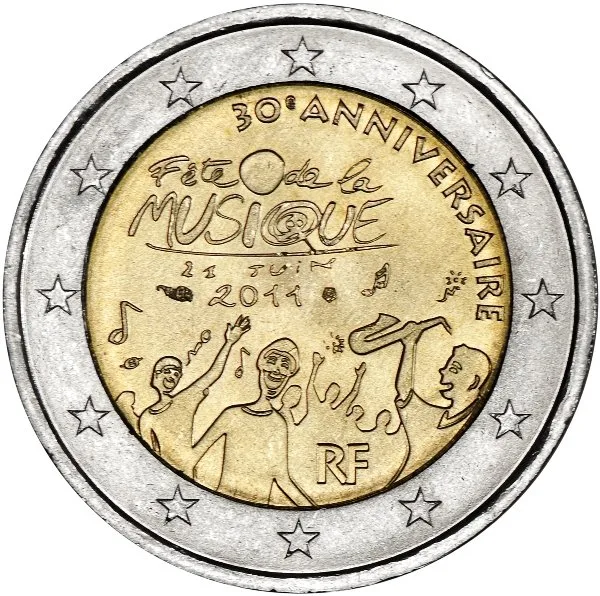
30 Years of the Fête de la Musique
Commemorative coin