30 Years of the European Flag
 + Add to collection In collection ★ Wanted
 At a glance
| Country | France |
|---|---|
| Year | 2015 |
| Issue date | 16 November 2015 |
| Coin type | Commemorative coin |
| Mintage | 4.020.000 (10.000 / 10.000) |
| Catalogue number | FR-15 G3 |
| Designer | Georgios Stamatopoulos |
| Rarity | €€€€€ what does this mean? |
| Edge lettering |  |
| Market value (approx.) | 4 € · guide price, uncirculated Unlock · for members |
Coin description
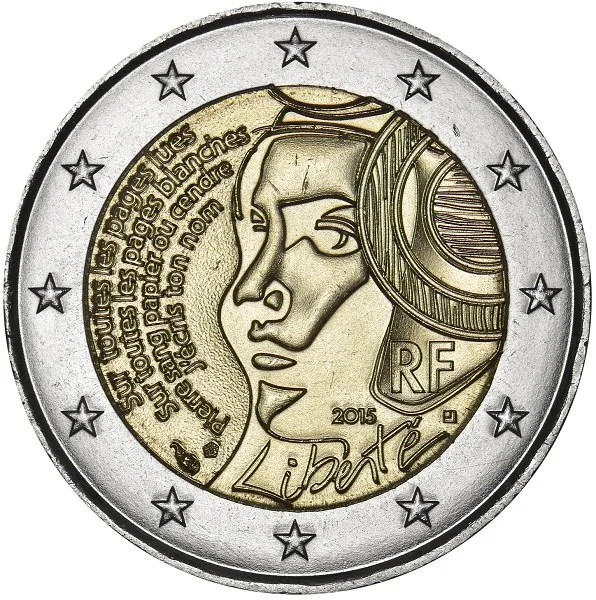
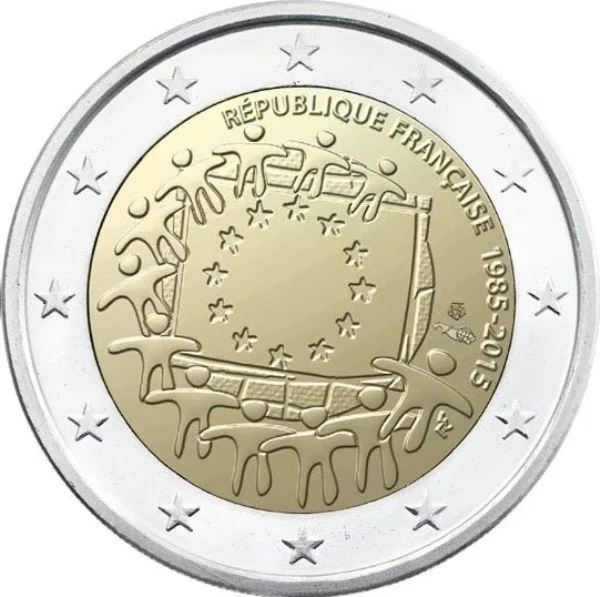
The EU flag as a symbol bringing peoples and cultures together around shared aspirations and ideals for a better future. The twelve stars take on human form, welcoming the birth of a new Europe. Along the upper right of the coin's inner ring appear the issuing country "RÉPUBLIQUE FRANÇAISE" and the dates "1985–2015". The mintmark is positioned to the right between the flag and the dates. The designer's initials (Georgios Stamatopoulos) appear at lower right.
Note on the coin
Fourth European Union joint issue. All 19 eurozone states issued a coin with the same design on various dates. The coins differ only in their inscriptions, which appear in the respective national language.
Further information on the topic
The European flag is one of the best-known political symbols of our time: twelve gold stars on a blue background, arranged in a closed circle. The design was originally created not by the European Union but by the Council of Europe, which adopted it as its own symbol in 1955. The European Community gradually adopted the flag before officially introducing it as the EC's emblem in 1986. The number twelve does not represent the number of members at the time, but is regarded as a symbol of completeness and unity — a deliberate choice that secures the flag's timeless validity. France, as a founding member of the European Communities and one of the driving forces behind European integration, has helped shape the development of this symbol from the very beginning.
Thirty years after the official introduction of the European flag, all euro states jointly issued a commemorative coin in 2015 — one of the rare Europe-wide joint issues in which all participating countries use the same design. The anniversary coincided with a period of intense European debate over solidarity, borders, and shared values, lending the symbol and its history particular relevance. For France, as the République Française, the issue also reflected its own self-understanding as a nation that sees European cooperation not as a constraint but as a project grown out of its own history — from the experience of two world wars and the determination to build lasting structures of peace on the continent.
Technical data
| Face value | 2 euro |
|---|---|
| Material | Bimetallic – outer ring: cupronickel; centre: three layers (nickel-brass / nickel / nickel-brass) |
| Weight | 8.5 g |
| Diameter | 25.75 mm |
| Thickness | 2.20 mm |