10 Years of Euro Banknotes and Coins
 + Add to collection In collection ★ Wanted
 At a glance
| Country | Germany |
|---|---|
| Year | 2012 |
| Issue date | 1 January 2012 |
| Coin type | Commemorative coin |
| Mintage | varies by year & mint – see table below ↓ |
| Catalogue number | DE-12 G1 |
| Rarity | €€€€€ what does this mean? |
| Edge lettering |  |
| Market value (approx.) | 4 € · guide price, uncirculated Unlock · for members |
Coin description
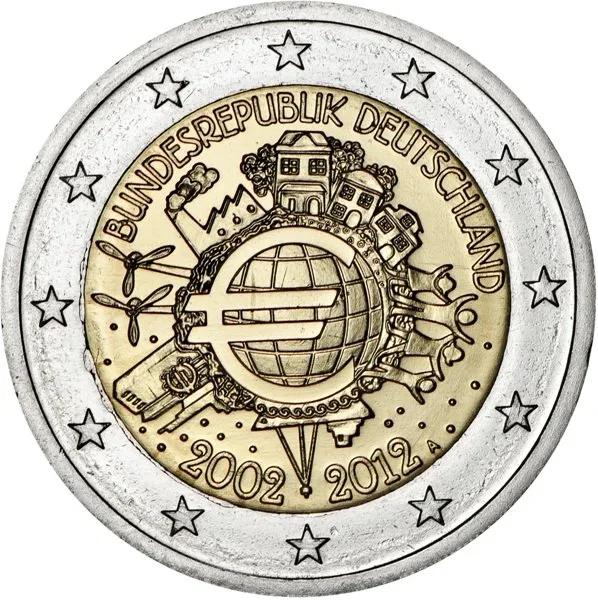
The euro has grown into a major force in Europe and beyond, and a key player in the international monetary system. The elements arranged around the euro sign symbolise what the euro means for people, for finance (the ECB tower), trade (ships), industry (factories), energy, and research and development (wind turbines). The artist's initials 'AH' appear below the ECB tower. The names of the issuing states in their national languages are struck across the centre above the design, with the dates 2002–2012 below.
Note on the coin
Third joint issue of the European Union. All 17 eurozone states issued a coin with the same design on the anniversary date of 1 January 2012. The coins differ only in the legend, which appears in the respective national language. San Marino also issued a coin with the same design, though it is not officially part of the joint issue.
Further information on the topic
On 1 January 2002, the euro entered circulation as cash — in twelve countries simultaneously, for around 300 million people. Its introduction was the result of a decades-long integration process that began with the Werner Plan of the early 1970s and led, via the Maastricht Treaty of 1992, to Economic and Monetary Union. Germany had been one of the driving forces behind the common currency from the outset; the Deutsche Mark, a symbol of post-war economic stability, was given up in favour of the euro. The European Central Bank, headquartered in Frankfurt, took over monetary policy for the entire euro area, deliberately drawing on the stability-oriented tradition of the Bundesbank.
Ten years after the introduction of cash, the euro had established itself as the world's second most important reserve currency and was a fixed part of everyday life in what were by then 17 EU member states. The eurozone had expanded considerably during this period — from the original twelve countries to include Greece, Slovenia, the Baltic states, and eventually Malta and Slovakia. At the same time, the sovereign debt crisis from 2010 onward posed the monetary union's greatest challenge to date, bringing questions of economic convergence and the eurozone's institutional architecture to the forefront. To mark the tenth anniversary of euro cash, all euro states issued a joint commemorative coin in 2012 — one of the few European joint issues in the history of 2-euro commemorative coins.
Official announcement (EU Official Journal): ABl. C 17 vom 20.1.2012, S. 10 (2012/C 17/05)
Mintages by mint
| Mint | Mintage |
|---|---|
| A | 6.000.000 (45.000 / 95.000) |
| D | 6.300.000 (40.000 / 87.000) |
| F | 7.200.000 (40.000 / 87.000) |
| G | 4.200.000 (40.000 / 87.000) |
| J | 6.300.000 (40.000 / 87.000) |
Technical data
| Face value | 2 euro |
|---|---|
| Material | Bimetallic – outer ring: cupronickel; centre: three layers (nickel-brass / nickel / nickel-brass) |
| Weight | 8.5 g |
| Diameter | 25.75 mm |
| Thickness | 2.20 mm |