30 Years of the European Flag
 + Add to collection In collection ★ Wanted
 At a glance
| Country | Germany |
|---|---|
| Year | 2015 |
| Issue date | 5 November 2015 |
| Coin type | Commemorative coin |
| Mintage | varies by year & mint – see table below ↓ |
| Catalogue number | DE-15 G3 |
| Designer | Georgios Stamatopoulos |
| Rarity | €€€€€ what does this mean? |
| Edge lettering |  |
| Market value (approx.) | 4 € · guide price, uncirculated Unlock · for members |
Coin description
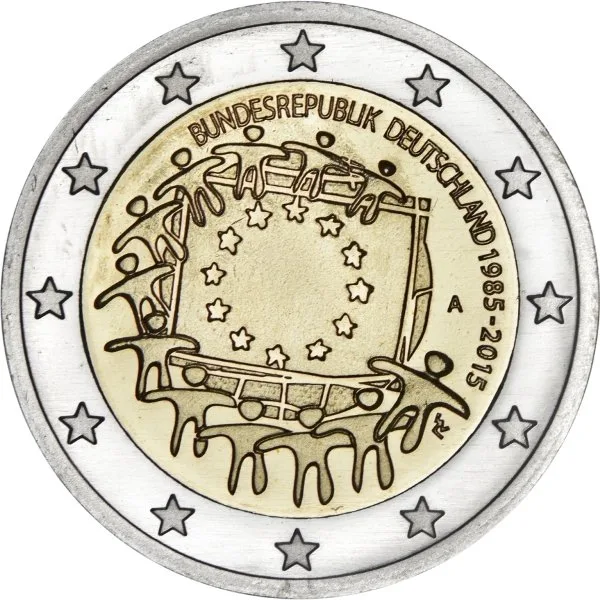
The EU flag as a symbol bringing peoples and cultures together around shared ideals for a better future. Twelve stars take on human form, welcoming the birth of a new Europe. Along the upper right of the inner ring, the issuing state 'BUNDESREPUBLIK DEUTSCHLAND' and the dates '1985–2015'. The mintmark appears to the right, between the flag and the dates. The designer's initials (Georgios Stamatopoulos) are at the lower right.
Note on the coin
Fourth joint issue of the European Union. All 19 eurozone states issued a coin with the same design on different dates. The coins differ only in the legend, which appears in the respective national language.
Further information on the topic
The European flag, with its twelve gold stars on a blue background, is today one of the world's best-known political symbols — yet its origins were anything but straightforward. It was designed under the auspices of the Council of Europe, which officially adopted it in 1955, initially as a sign of the broader idea of European unity rather than of any particular political structure. The number twelve did not stand for a specific number of members but was meant to symbolise completeness and unity — drawing on a widespread cultural motif that spans from antiquity to Christian iconography. It was not until 1985 that the European Community officially adopted the flag as its own symbol, giving it the meaning it still carries today as the emblem of European integration.
The European Community's decision to adopt the flag in 1985 came during a period of political momentum: the single market was being prepared, the circle of members was growing, and the desire for a shared public identity was gaining weight. Since then, the blue-and-gold symbol has represented a project uniting economic integration, freedom of movement, and political cooperation under one roof — one that, despite all tensions, endures to this day. Germany, as a founding member of the European Community, has carried this history from the very beginning. To mark the 30th anniversary of the flag's adoption, the Federal Republic of Germany issued a joint coin in 2015 together with all other euro states, honouring this moment of European self-affirmation.
Official announcement (EU Official Journal): ABl. C 253 vom 1.8.2015, S. 9 (2015/C 253/08)
Mintages by mint
| Mint | Mintage |
|---|---|
| A | 6.000.000 (– / 25.000) |
| D | 6.300.000 (– / 25.000) |
| F | 7.200.000 (– / 25.000) |
| G | 4.200.000 (– / 25.000) |
| J | 6.300.000 (– / 25.000) |
Technical data
| Face value | 2 euro |
|---|---|
| Material | Bimetallic – outer ring: cupronickel; centre: three layers (nickel-brass / nickel / nickel-brass) |
| Weight | 8.5 g |
| Diameter | 25.75 mm |
| Thickness | 2.20 mm |