Lower Saxony
 + Add to collection In collection ★ Wanted
 At a glance
| Country | Germany |
|---|---|
| Year | 2014 |
| Issue date | 6 February 2014 |
| Coin type | Commemorative coin |
| Mintage | varies by year & mint – see table below ↓ |
| Catalogue number | DE-14 G1 |
| Designer | Erich Ott |
| Rarity | €€€€€ what does this mean? |
| Edge lettering |  |
| Market value (approx.) | 4 € · guide price, uncirculated Unlock · for members |
Coin description
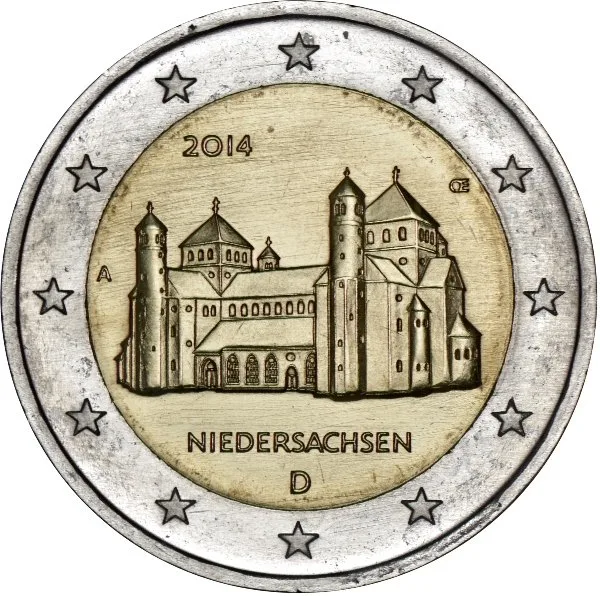
A view from the south-east of St Michael's Church in Hildesheim, Lower Saxony, on UNESCO's World Heritage List since 1985. Above the design: the year '2014'; to the left: the mintmark (A, D, F, G or J). In the lower section: 'NIEDERSACHSEN' and the country code 'D'. Upper right: the designer's initials — 'OE' for Erich Ott.
Further information on the topic
St Michael's Church in Hildesheim is regarded as one of the most significant buildings of Ottonian architecture and thus stands at the starting point of European Romanesque style. Built under Bishop Bernward of Hildesheim at the beginning of the 11th century, the structure follows a strict principle of symmetry with two equal choirs and transepts, a design that proved pioneering for medieval church building in Germany. Bernward, later canonized, understood the building as a comprehensive theological work of art — the surviving interior furnishings, including the bronze Bernward Column and the Bernward Doors, also testify to this ambition. In the early Middle Ages, Hildesheim was a significant episcopal center, and St Michael's still reflects this cultural radiance today. In 1985, UNESCO inscribed the church, together with Hildesheim Cathedral, on the World Heritage List — a recognition that underscores the standing of these Lower Saxon monuments in a European context.
Lower Saxony, Germany's second-largest federal state by area, unites very different historic landscapes: from the North Sea coast across the Lüneburg Heath to the Harz mountains and the low mountain ranges in the south. In the Middle Ages, the region was politically fragmented and volatile — Guelph rule, prince-bishoprics, and Hanseatic towns shaped the picture for centuries before Lower Saxony was newly founded in 1946 as the successor state of several territories. With Hildesheim as its motif, the 2014 issue in the German Federal States series sets a cultural-historical focus that reaches beyond state borders: St Michael's Church stands not only for Lower Saxon heritage but for an era in which what is now northern Germany ranked among the cultural centers of the Western world.
Official announcement (EU Official Journal): ABl. C 417 vom 21.11.2014, S. 6 (2014/C 417/04)
Mintages by mint
| Mint | Mintage |
|---|---|
| A | 6.000.000 (85.000 / 84.000) |
| D | 6.300.000 (80.000 / 77.000) |
| F | 7.200.000 (80.000 / 77.000) |
| G | 4.200.000 (80.000 / 77.000) |
| J | 6.300.000 (80.000 / 77.000) |
Technical data
| Face value | 2 euro |
|---|---|
| Material | Bimetallic – outer ring: cupronickel; centre: three layers (nickel-brass / nickel / nickel-brass) |
| Weight | 8.5 g |
| Diameter | 25.75 mm |
| Thickness | 2.20 mm |