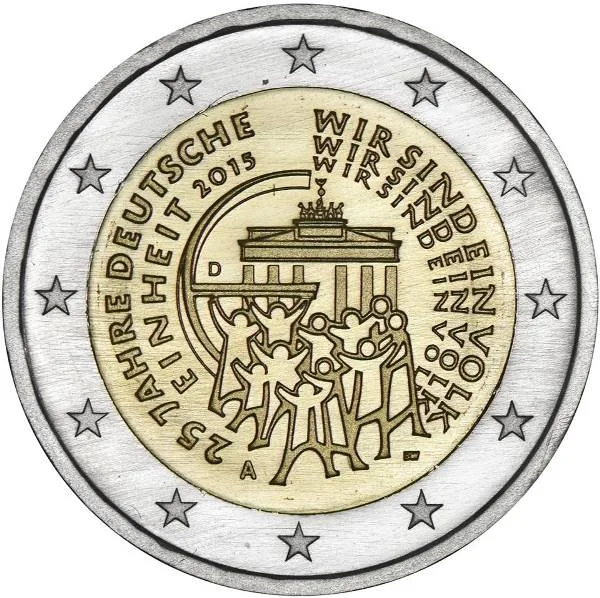
25 Years of German Unity
 + Add to collection In collection ★ Wanted
 At a glance
| Country | Germany |
|---|---|
| Year | 2015 |
| Issue date | 30 January 2015 |
| Coin type | Commemorative coin |
| Mintage | varies by year & mint – see table below ↓ |
| Catalogue number | DE-15 G2 |
| Designer | Bernd Wendhut |
| Rarity | €€€€€ what does this mean? |
| Edge lettering |  |
| Market value (approx.) | 4 € · guide price, uncirculated Unlock · for members |
Coin description
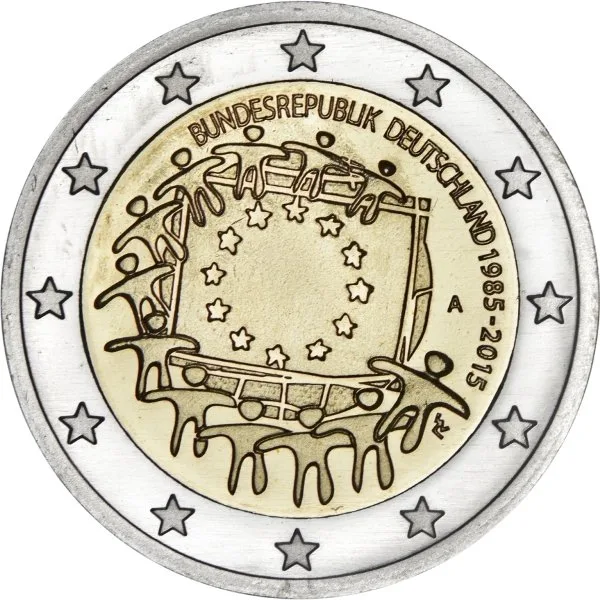
A jubilant crowd symbolising fresh beginnings and a new chapter; the Brandenburg Gate — the enduring symbol of German unity — in the background. The repeated chant 'Wir sind ein Volk' (We are one people) — the collective voice of the German people — evokes the road to reunification. Also struck in the inner circle: the mintmark ('A', 'D', 'F', 'G' or 'J'), the country code 'D', and the engraver's initials ('BW' — Bernd Wendhut).
Further information on the topic
In the autumn of 1989, decades of pent-up pressure erupted in East Germany: mass demonstrations in Leipzig, Dresden, and East Berlin forced the SED leadership to yield, and on 9 November the Berlin Wall fell. What followed was one of the fastest state transformation processes in modern history. Within a few months, the Federal Republic negotiated the terms of reunification with East Germany, the four victorious powers, and its European partners — the Two Plus Four Agreement created the basis under international law, while the Unification Treaty settled the details between the two German states. On 3 October 1990, East Germany joined the Federal Republic of Germany; the day became a national holiday. The Brandenburg Gate, a symbol of division for decades, now stood once again at the heart of a united country.
The 25 years that Germany looked back on in 2015 were also years of profound change: structural convergence of living conditions, economic integration of the new federal states, demographic shifts, and a debate — still lively today — about what unity means for society. Eastern German cities such as Leipzig and Erfurt developed into economically and culturally distinctive centers, while differences in income, infrastructure, and voting behavior remained perceptible. The chant "Wir sind ein Volk" ("We are one people"), heard in the streets in 1989, marked the political will toward unity — what became of it remains a subject of debate that continues to shape reunified Germany today. To mark the 25th anniversary of German Unity, Germany issued a commemorative coin in 2015 keeping this historic moment in circulation.
Official announcement (EU Official Journal): ABl. C 417 vom 21.11.2014, S. 7 (2014/C 417/05)
Mintages by mint
| Mint | Mintage |
|---|---|
| A | 6.000.000 (39.800 / 74.000) |
| D | 6.300.000 (33.825 / 67.000) |
| F | 7.200.000 (33.825 / 67.000) |
| G | 4.200.000 (33.825 / 67.000) |
| J | 6.300.000 (33.825 / 67.000) |
Technical data
| Face value | 2 euro |
|---|---|
| Material | Bimetallic – outer ring: cupronickel; centre: three layers (nickel-brass / nickel / nickel-brass) |
| Weight | 8.5 g |
| Diameter | 25.75 mm |
| Thickness | 2.20 mm |