Thuringia
 + Add to collection In collection ★ Wanted
 At a glance
| Country | Germany |
|---|---|
| Year | 2022 |
| Issue date | 25 January 2022 |
| Coin type | Commemorative coin |
| Mintage | varies by year & mint – see table below ↓ |
| Catalogue number | DE-22 G1 |
| Designer | Olaf Stoy |
| Rarity | €€€€€ what does this mean? |
| Edge lettering |  |
| Market value (approx.) | 4 € · guide price, uncirculated Unlock · for members |
Coin description
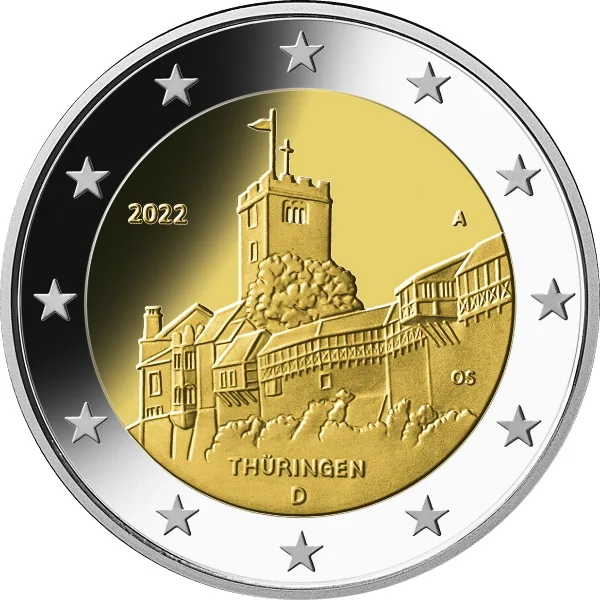
A view of Wartburg Castle in Eisenach from the bridge. At the bottom centre: the name of the federal state 'THÜRINGEN' and the country code 'D'. Above to the left: the year '2022'; to the right: the initials 'OS' of artist Olaf Stoy.
Further information on the topic
Located in the heart of central Germany, Thuringia looks back on more than a thousand years of history. In the Middle Ages, the region was the site of major political and cultural developments — the Landgraves of Thuringia were among the most influential rulers of the Holy Roman Empire. Their seat of power, Wartburg Castle near Eisenach, was founded in 1067 and became a symbol of Thuringian history. It was here that Martin Luther translated the New Testament into German in 1521–1522, an event of almost immeasurable significance for the German language and the Reformation. Later, the castle also became a symbol of the Romantic idealisation of the Middle Ages — Richard Wagner drew inspiration from Wartburg Castle for his opera "Tannhäuser". Since 1999, the castle has been a UNESCO World Heritage Site.
Thuringia shaped German intellectual history far beyond Wartburg Castle. Weimar, the state capital of the Free State of Thuringia, was the working place of Goethe and Schiller, the birthplace of the Bauhaus, and a centre of German Classicism. Erfurt, the state's largest city, boasts a unique urban heritage with its cathedral hill and the medieval Krämerbrücke. As the most populous federal state in the eastern low mountain range region, Thuringia combines dense forest — the Thuringian Forest — with a remarkable cultural density in a small area. As part of the German Federal States series, Germany honoured Thuringia with its own 2-euro commemorative coin in 2022.
Mintages by mint
| Mint | Mintage |
|---|---|
| A | 6.000.000 (23.000 / 30.000) |
| D | 6.300.000 (23.000 / 30.000) |
| F | 7.200.000 (23.000 / 30.000) |
| G | 4.200.000 (23.000 / 30.000) |
| J | 6.300.000 (23.000 / 30.000) |
Technical data
| Face value | 2 euro |
|---|---|
| Material | Bimetallic – outer ring: cupronickel; centre: three layers (nickel-brass / nickel / nickel-brass) |
| Weight | 8.5 g |
| Diameter | 25.75 mm |
| Thickness | 2.20 mm |