
On January 1, 2002, after a lengthy preparatory phase, new cash was issued in twelve member states of the European Union, replacing the respective national currencies within a very short transition period. As a unit of account, the euro had already existed for three years. Only about two weeks earlier, so-called "starter kits" had been issued for the first time to familiarize citizens with the new money. While euro banknotes have a uniform design across all participating countries, the coins are alike only on the value side – the obverse features numerous designs of interest not just to coin collectors. Even for the layperson, it can be quite appealing to trace which country a coin comes from and to ponder the journey it has already made – a journey that may have taken it through many countries over months and years. Longer and rockier still, however, was the road to monetary union and thus to the creation of European money.
Foundations, Ideas and Developments
The foundations for the creation of the monetary union go back a long way and stem from various lines of thought. Economic questions were already at the forefront when the Council of Europe was founded in 1949. Uniting European plurality under one roof consistently included the introduction of a common currency and the leveling of trade barriers. A first major step in this direction was the founding of the European Coal and Steel Community (ECSC, also known as the "Coal and Steel Union") on April 18, 1951, which exempted the designated goods from tariffs among participating countries, partly to support reconstruction and the supply of raw materials after World War II. With the signing of the Treaties of Rome by the ECSC countries Belgium, Germany, France, Italy, Luxembourg and the Netherlands on March 25, 1957, the European Economic Community (EEC) was established, aiming for a common internal market. It paved the way for an EU-specific economic system. Barely two and a half years later, the European Free Trade Association (EFTA) was founded. Denmark, Finland, Greece, the United Kingdom, Ireland, Austria, Portugal, Sweden and Spain subsequently joined the treaties by 1995.
In 1970, Luxembourg's Prime Minister Pierre Werner proposed a European Economic and Monetary Union (EMU) to be introduced in three stages. When the US dollar, then the world's leading reserve currency, became unstable in 1971, the decision was made to create more favorable conditions within Europe and to postpone implementation of the Werner Plan for the time being.
In 1972, the European Exchange Rate Mechanism established its own stability criteria, permitting exchange rate fluctuations of no more than 2.25%. The most significant event in this sequence was the introduction of the European Monetary System (EMS) in March 1979, which traces back to Commission President Roy Jenkins. All member states affiliated at that time participated, with the exception of the United Kingdom. From then on, the system operated using the new monetary unit, the ECU (European Currency Unit). The abbreviation ECU alluded to the French écu, a gold coin established by Louis IX in 1266.
A Fresh Start and Clear Goals
After the three-stage plan (Werner Plan) could not be pursued due to difficult circumstances regarding currency stability, it came back up for discussion in 1988. On April 12, 1989, Commission President Jacques Delors presented a report proposing the introduction of a European common currency in three stages. The central element was the plan to establish the European Central Bank (ECB), where all the threads were meant to come together. The undertaking was formally adopted with the signing of the Maastricht Treaty on February 7, 1992. The ECB's primary mandate was to ensure price stability. Exactly twelve months later to the day, the members of the EU and EFTA agreed on the treaty establishing the European Economic Area (EEA) and prepared for the founding of the ECB. Furthermore, national central banks were to become independent.
In the first stage, from 1990 to 1994, trade barriers were dismantled and a common European internal market was realized. The second stage, from 1994 to 1999, involved preparations for founding the ECB, the decision to introduce the common currency, and the organization of the eurozone. In the final stage, beginning in 1999, binding exchange rates and fixed budgetary rules were established for the participating countries – the so-called Maastricht convergence criteria. Under these strict rules, member states' annual new borrowing may not exceed 3% of GDP. In certain exceptional cases, EMS II also permits fluctuations of up to 15% in currency stability for latecomers with weak currencies.
Cultural Roots: Working Out the Details
Meanwhile, the name of the new currency was determined by the European Council in Madrid on December 16, 1995. With the designation "euro," a proposal by the then German Finance Minister Theo Waigel (CSU) was adopted. Prior to this, numerous terms had been discussed, including "European guilder," "European franc," and also ECU, the name of the monetary unit. Decisive factors were, on the one hand, ease of use across languages, and on the other, the reference embedded in the term "euro" to the currency's intended region and to shared cultural roots in Greek mythology: Zeus, disguised as a bull, abducts the maiden Europa to Crete, where Aphrodite reveals to her that the continent will henceforth bear her name. The currency's name is indeclinable across languages; only when referring to several euro coins does the plural form "euros" apply. As an exception, the plural is "euri" in Slovenia and "euroa" in Finland.
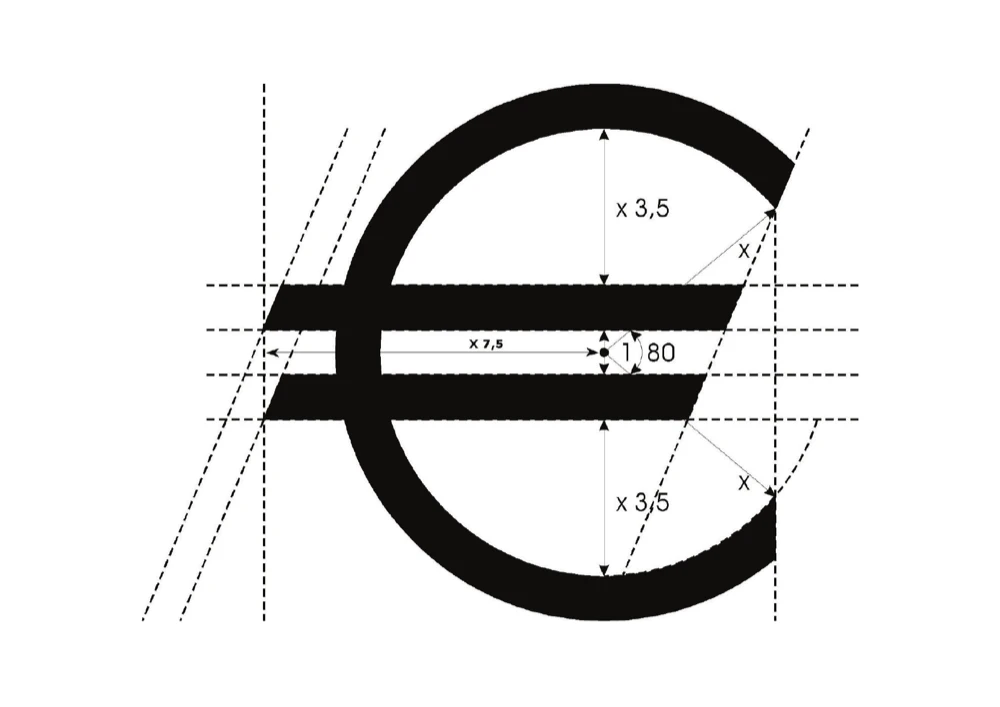
The € symbol used since the currency's introduction was originally designed in 1974 by Arthur Eisenmenger in Luxembourg. Eisenmenger (b. 1914) was the EC's chief graphic designer at the time. The European Commission formally adopted the final version in 1997. It was first presented to the public in December of the previous year. The symbol draws, on the one hand, on other major currency symbols to which it bears a strong resemblance – above all the dollar ($) and the yen (¥). But its resemblance to the Greek letter epsilon (ε) is by no means coincidental either, referencing the mythological origins of the term "euro." The double line, reminiscent of an equals sign, symbolizes stability and strength. The internationally standardized abbreviation under ISO 4217 is EUR.
The Idea Becomes Reality
With nearly four years of lead time, France, as the first country of the monetary union, began production of euro coins on May 11, 1998. The other participating countries followed shortly thereafter. A month later, the European Central Bank began operations in Frankfurt am Main. Fixed exchange rates took effect with the start of the third stage on January 1, 1999; from January 4 onward, the individual currencies were replaced by the euro on stock exchanges. This made the euro the official unit of account in eleven member states – the United Kingdom, Denmark and Sweden had opted out, while Greece did not meet the Maastricht criteria until two years later, joining the eurozone as the twelfth country on January 1, 2001. Several non-EU countries also use the euro, including Andorra, Kosovo, Montenegro, Vatican City, Monaco and San Marino. While Andorra and the latter three are permitted to mint their own euro coins due to earlier currency agreements, in the other countries the euro is used solely as a unit of account.