35 Years of the Erasmus Programme
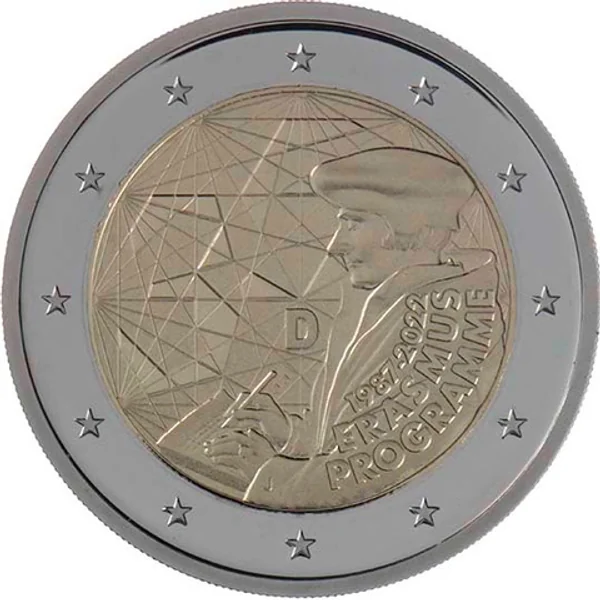 ©Image credit: Numismatische Sammlung der Deutschen Bundesbank + Add to collection In collection ★ Wanted
 At a glance
| Country | Germany |
|---|---|
| Year | 2022 |
| Issue date | ab 1 July 2022 |
| Coin type | Commemorative coin |
| Mintage | varies by year & mint – see table below ↓ |
| Catalogue number | DE-22 G2 |
| Designer | Joaquin Jimenez |
| Rarity | €€€€€ what does this mean? |
| Edge lettering |  |
| Market value (approx.) | 3,5 € · guide price, uncirculated Unlock · for members |
Coin description
A blend of two central elements of the Erasmus programme: its original intellectual inspiration — Erasmus himself — and an allegory of his influence on Europe. The former is represented by one of the most celebrated portraits of Erasmus. The latter is conveyed through a beam of connections arching across the coin from one beacon to another, reflecting the countless intellectual and human exchanges between European students. Some of these connections form additional stars, born from the synergies between countries.
Note on the coin
Fifth joint issue of the European Union. All 19 eurozone states are issuing a coin with the same design on different dates. The coins differ only in the legend, which appears in the respective national language.
Further information on the topic
The European Union's Erasmus programme has existed since 1987 and ranks among the most successful educational initiatives in European history. It enables students, teachers and trainees to study, teach or gain practical experience at institutions abroad in Europe for a limited period. Since its founding, the programme has given well over twelve million people the opportunity to study or further their education abroad in Europe — making a major contribution to fostering a shared European understanding of education and culture. Its name derives from the Dutch scholar Erasmus of Rotterdam, who in the late 15th and early 16th centuries came to symbolise cross-border intellectual exchange.
In 2022, the founding of the Erasmus programme was commemorated for the 35th time — an occasion all eurozone states marked together with a joint issue, in which every country mints the same design and only the national inscription differs. Since 1987, the programme has continuously evolved: what began as a higher-education programme became, with "Erasmus+", a comprehensive education programme that today also covers vocational training, youth work and sport. For millions of young Europeans, it stands for the concrete experience of cross-border learning — through language acquisition, intercultural encounters and academic networks that extend beyond national borders.
Mintages by mint
| Mint | Mintage |
|---|---|
| A | 4.000.000 (26.000 / 29.000) |
| D | 4.200.000 (26.000 / 29.000) |
| F | 4.800.000 (26.000 / 29.000) |
| G | 2.800.000 (26.000 / 29.000) |
| J | 4.200.000 (26.000 / 29.000) |
Technical data
| Face value | 2 euro |
|---|---|
| Material | Bimetallic – outer ring: cupronickel; centre: three layers (nickel-brass / nickel / nickel-brass) |
| Weight | 8.5 g |
| Diameter | 25.75 mm |
| Thickness | 2.20 mm |