Mecklenburg-Vorpommern
 ©Image credit: Numismatische Sammlung der Deutschen Bundesbank + Add to collection In collection ★ Wanted
 At a glance
| Country | Germany |
|---|---|
| Year | 2024 |
| Issue date | 30 January 2024 |
| Coin type | Commemorative coin |
| Mintage | varies by year & mint – see table below ↓ |
| Catalogue number | DE-24 G1 |
| Designer | Michael Otto |
| Rarity | €€€€€ what does this mean? |
| Edge lettering |  |
| Market value (approx.) | 4 € · guide price, uncirculated Unlock · for members |
Coin description
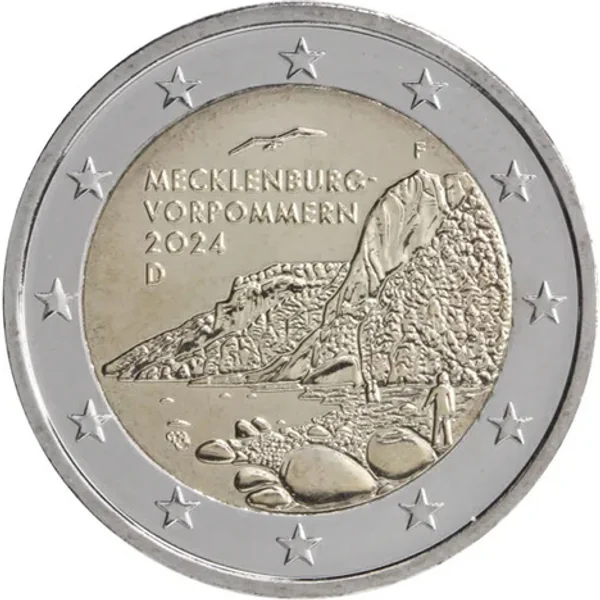
The iconic Königsstuhl chalk cliff — part of the Jasmund National Park — seen from the beach in a perspective that opens up the full monumentality of this unique landmark, framed by beech forest. The country code 'D', the year '2024', the mintmark of the relevant mint, the occasion 'MECKLENBURG-VORPOMMERN' and the initials 'MO' of the artist complete the design.
Further information on the topic
The Königsstuhl on the island of Rügen, at around 118 meters, is the highest chalk cliff formation on Germany's Baltic coast. It lies at the heart of Jasmund National Park, founded in 1990 and, since 2011, part of the UNESCO World Natural Heritage site "Ancient Beech Forests of the Carpathians and Other Regions of Europe" — a designation underscoring the pan-European significance of this natural area. The white cliffs formed at the end of the last Ice Age, as melting glaciers deposited chalk rock from Sweden and the Baltic Sea. Chalk and flint have since been exposed by marine erosion, shaping the dramatic coastal morphology that has made Rügen famous as a natural spectacle for centuries.
The Königsstuhl gained international fame through Romanticism: Caspar David Friedrich's painting "Chalk Cliffs on Rügen" (c. 1818) brought the motif worldwide renown and permanently anchored Mecklenburg-Vorpommern in European art history. Today, Jasmund National Park is among Germany's most visited nature reserves; at roughly 3,000 hectares, Jasmund is the country's smallest national park, yet it harbors one of Central Europe's most significant beech forest habitats. Germany's 2024 2-euro commemorative coin, part of the federal states series, is dedicated to Mecklenburg-Vorpommern and places at its center the Königsstuhl, a natural monument that embodies geology, ecology, and cultural history in equal measure.
Mintages by mint
| Mint | Mintage |
|---|---|
| A | 6.000.000 (19.000 / 21.000) |
| D | 6.300.000 (19.000 / 21.000) |
| F | 7.200.000 (19.000 / 21.000) |
| G | 4.200.000 (19.000 / 21.000) |
| J | 6.300.000 (19.000 / 21.000) |
Technical data
| Face value | 2 euro |
|---|---|
| Material | Bimetallic – outer ring: cupronickel; centre: three layers (nickel-brass / nickel / nickel-brass) |
| Weight | 8.5 g |
| Diameter | 25.75 mm |
| Thickness | 2.20 mm |