10 Years of Economic and Monetary Union
 + Add to collection In collection ★ Wanted
 At a glance
| Country | Greece |
|---|---|
| Year | 2009 |
| Issue date | 2 January 2009 |
| Coin type | Commemorative coin |
| Mintage | 4.000.000 (7.500 / – ) |
| Catalogue number | GR-09 G1 |
| Designer | Georgios Stamatopoulos |
| Rarity | €€€€€ what does this mean? |
| Edge lettering |  |
| Market value (approx.) | 3,5 € · guide price, uncirculated Unlock · for members |
Coin description
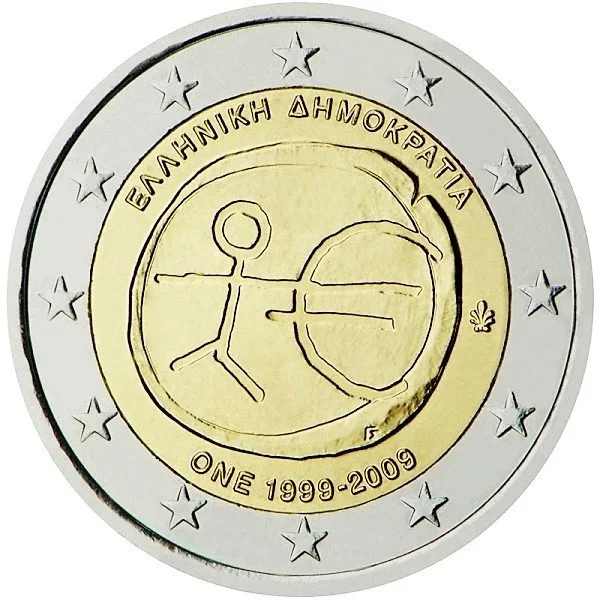
At the centre, a stylised human figure drawn from an ancient coin, with its left arm extended into the euro symbol. The artist's initials ΓΣ appear below the euro symbol. The issuing state's name in the national language runs along the upper edge of the design, while the dates 1999–2009 and the acronym for EMU in the national language appear along the lower edge.
Note on the coin
Second joint issue of the European Union. All 16 euro-area states issued a coin with the same design on the anniversary date of 1 January 2009. The coins differ only in the inscription, which appears in each country's national language.
Further information on the topic
On 1 January 1999, the Economic and Monetary Union entered its third and decisive phase: eleven EU member states irrevocably fixed their exchange rates and transferred monetary policy to the newly established European Central Bank in Frankfurt. Greece was not yet among them at that point — the country met the convergence criteria only later and joined the eurozone on 1 January 2001. The road there was marked by significant budgetary corrections and economic adjustment measures, which Greece implemented under considerable domestic political pressure at times. The EMU itself was the result of a decades-long process of European integration, whose treaty basis was laid by the Maastricht Treaty of 1992.
The Economic and Monetary Union fundamentally changed the economic conditions in Greece. The elimination of exchange-rate risk against its most important trading partners eased capital flows and foreign trade; at the same time, sharply lower interest rates fuelled an investment and consumption boom that kept the Greek economy on a growth path in the first years after joining the euro. At the European level, the euro had established itself as a stable currency by 2009 and had become one of the most heavily traded currencies in the world. In 2009, all eurozone states jointly marked the tenth anniversary of the monetary union with a uniform joint issue, in which Greece also participated.
Technical data
| Face value | 2 euro |
|---|---|
| Material | Bimetallic – outer ring: cupronickel; centre: three layers (nickel-brass / nickel / nickel-brass) |
| Weight | 8.5 g |
| Diameter | 25.75 mm |
| Thickness | 2.20 mm |