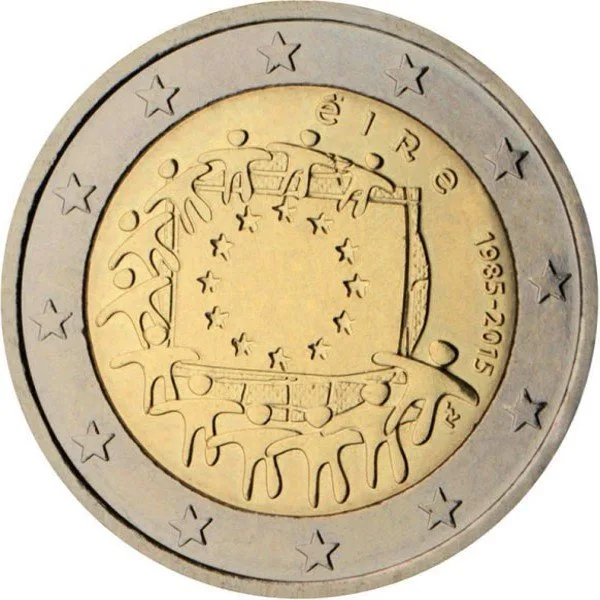
30 Years of the European Flag
 + Add to collection In collection ★ Wanted
 At a glance
| Country | Ireland |
|---|---|
| Year | 2015 |
| Issue date | 16 October 2015 |
| Coin type | Commemorative coin |
| Mintage | 1.000.000 ( – / 1.000) |
| Catalogue number | IE-15 G1 |
| Designer | Georgios Stamatopoulos |
| Rarity | €€€€€ what does this mean? |
| Edge lettering |  |
| Market value (approx.) | 4 € · guide price, uncirculated Unlock · for members |
Coin description
The EU flag as a symbol bringing peoples and cultures together around shared values and ideals in building a better future. Twelve stars take on human form, welcoming the birth of a new Europe. Along the upper right of the coin ring, the issuing state "éire" and the dates "1985–2015" are engraved. The mintmark sits to the right between the flag and the dates. The designer's initials (Georgios Stamatopoulos) appear at lower right.
Note on the coin
Fourth joint issue of the European Union. All 19 euro-area states are issuing a coin with the same design on varying dates. The coins differ only in the inscription, which appears in each country's national language.
Further information on the topic
The European flag, with its twelve gold stars on a blue background, dates back to a design adopted by the Council of Europe in 1955. The number twelve was deliberately chosen not to mirror the number of members but as a symbol of completeness — a meaning rooted in many European cultures. Its designers are credited as Arsène Heitz and Paul Lévy; the motif was meant to create a shared emblem for European institutions that would resonate across national borders. In 1985, thirty years before this issue, the heads of state and government of the European Community officially adopted the flag as their symbol — a visible commitment to an increasingly politically interwoven union.
Ireland joined the European Community in 1973, together with Denmark and the United Kingdom, approving accession by a clear majority in a referendum. For Ireland, EC membership brought not only access to the single market but also gradual economic modernisation: structural funds and agricultural subsidies flowed into an economy that was then still largely agrarian. Support for European integration has remained comparatively high in Ireland over the decades — with the exception of two initially failed referendums on EU treaties, each of which weighed national sovereignty against the European level. To mark the 30th anniversary of the European flag, Ireland issued a commemorative coin with an identical design in 2015, together with all other euro states.
Technical data
| Face value | 2 euro |
|---|---|
| Material | Bimetallic – outer ring: cupronickel; centre: three layers (nickel-brass / nickel / nickel-brass) |
| Weight | 8.5 g |
| Diameter | 25.75 mm |
| Thickness | 2.20 mm |
More 2-euro coins from Ireland
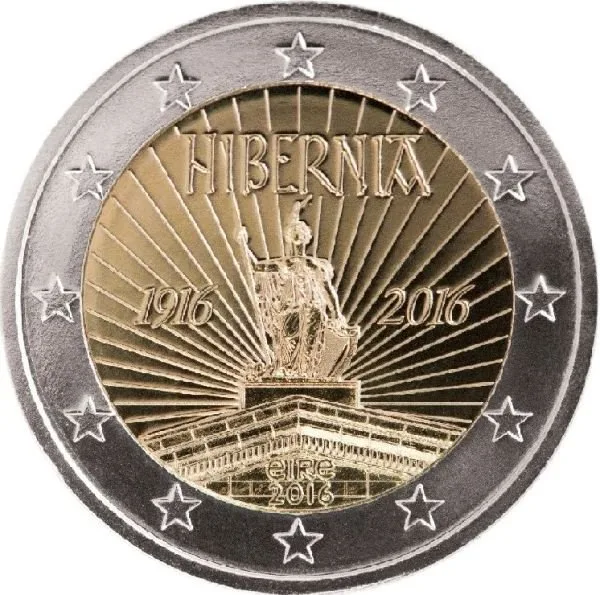
100 Years of the Easter Rising in Ireland
Commemorative coin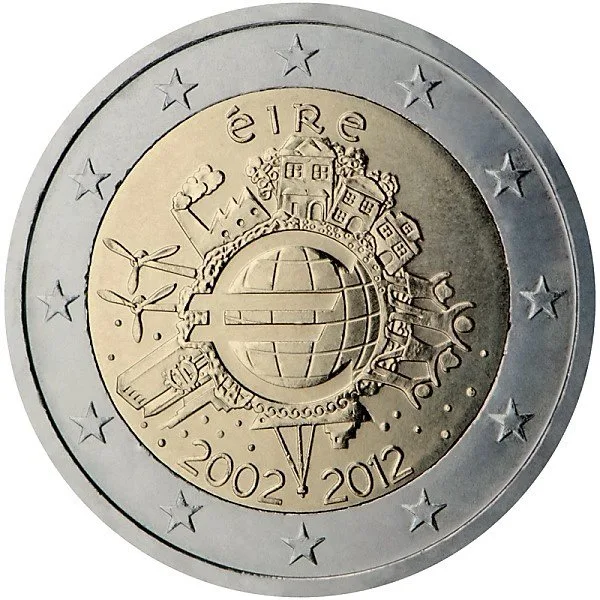
10 Years of Euro Banknotes and Coins
Commemorative coin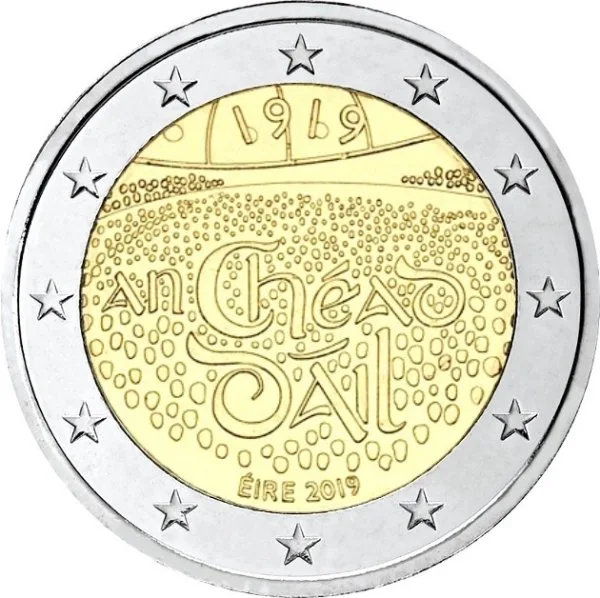
100th Anniversary of the First Sitting of Dáil Éireann
Commemorative coin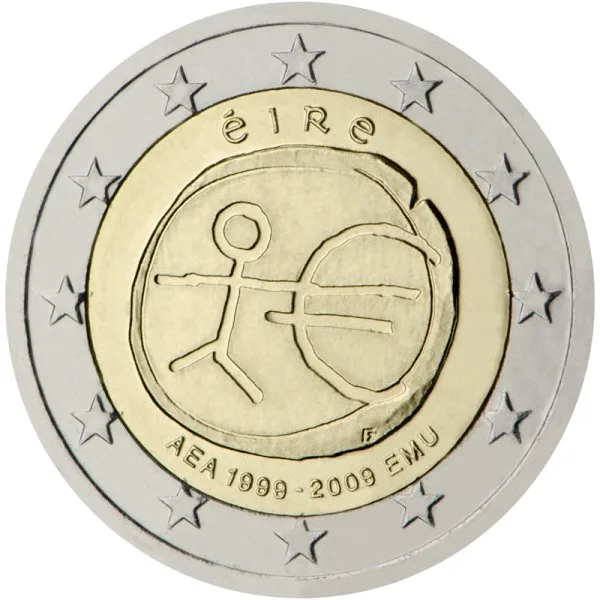
10 Years of Economic and Monetary Union
Commemorative coin