10 Years of Economic and Monetary Union
 + Add to collection In collection ★ Wanted
 At a glance
| Country | Ireland |
|---|---|
| Year | 2009 |
| Issue date | 1 January 2009 |
| Coin type | Commemorative coin |
| Mintage | 3.812.908 ( – / 7.000) |
| Catalogue number | IE-09 G1 |
| Designer | Georgios Stamatopoulos |
| Rarity | €€€€€ what does this mean? |
| Edge lettering |  |
| Market value (approx.) | 3,5 € · guide price, uncirculated Unlock · for members |
Coin description
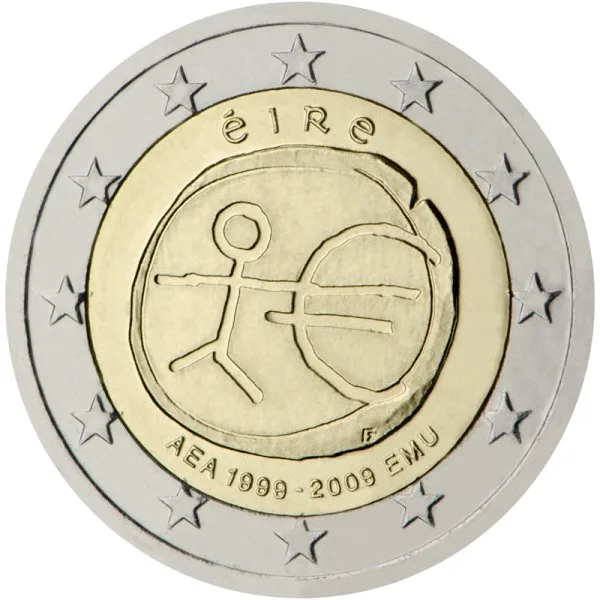
At the centre, a stylised human figure drawn from an ancient coin, with its left arm extended into the euro symbol. The artist's initials appear below the euro symbol. The issuing state's name in the national language runs along the upper edge of the design, while the dates 1999–2009 and the acronyms AEA and EMU in the national language(s) appear along the lower edge.
Note on the coin
Second joint issue of the European Union. All 16 euro-area states issued a coin with the same design on the anniversary date of 1 January 2009. The coins differ only in the inscription, which appears in each country's national language.
Further information on the topic
Ireland was among the eleven founding states of the Economic and Monetary Union in 1999 and, in joining, gave up one of Europe's oldest national currency identities: the Irish pound — Punt in Irish — had existed as an independent currency since the state's independence in 1922 and had been decoupled from the pound sterling in 1979. The step into the eurozone came during a phase of extraordinary economic growth: since the mid-1980s, Ireland had achieved one of the steepest ascents among EU economies through targeted tax reforms, EU structural funding, and export-oriented industrial policy, a rise internationally known as the Celtic Tiger. Low corporate taxes, a well-educated English-speaking workforce, and unhindered access to the European internal market attracted direct investment, particularly from the United States — pharmaceutical companies and tech firms favoured Dublin and its surroundings as the site for their European headquarters.
For Ireland, the common currency was not merely an economic-policy instrument but also a symbol of a changed European positioning: relative to the historically dominant British currency, the euro represented an independent stance within the continent. To mark the tenth anniversary of the Economic and Monetary Union, Ireland took part in the pan-European joint issue of 2009, in which all eurozone states minted the same design simultaneously for the first time. For Irish collectors, the 2009 2-euro commemorative coin thus links the national experience of a profound monetary transformation with the pan-European retrospective on a decade of shared monetary policy.
Technical data
| Face value | 2 euro |
|---|---|
| Material | Bimetallic – outer ring: cupronickel; centre: three layers (nickel-brass / nickel / nickel-brass) |
| Weight | 8.5 g |
| Diameter | 25.75 mm |
| Thickness | 2.20 mm |