10 Years of Euro Banknotes and Coins
 + Add to collection In collection ★ Wanted
 At a glance
| Country | Italy |
|---|---|
| Year | 2012 |
| Issue date | 20 March 2012 |
| Coin type | Commemorative coin |
| Mintage | 15.000.000 (25.000 / 3.990) |
| Catalogue number | IT-12 G1 |
| Designer | Helmut Andexlinger |
| Rarity | €€€€€ what does this mean? |
| Edge lettering |  |
| Market value (approx.) | 4 € · guide price, uncirculated Unlock · for members |
Coin description
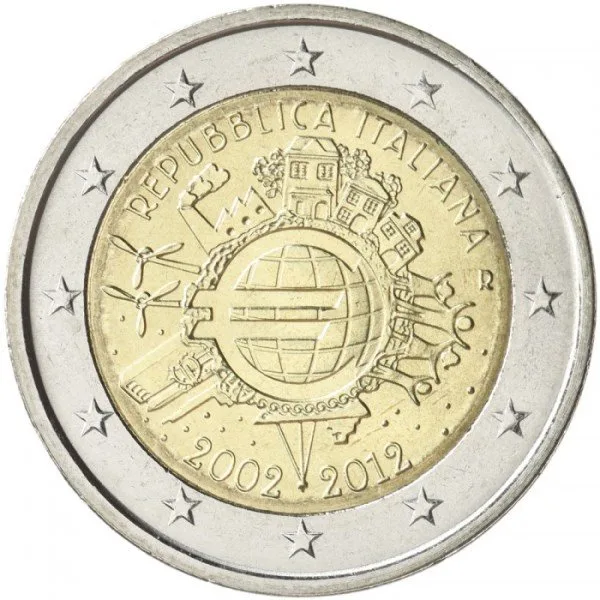
The euro has grown into a major factor across Europe and worldwide, establishing itself as a global player in the international monetary system. The elements arranged around the euro sign symbolise the currency's significance for everyday citizens, the financial world (the ECB tower), trade (ships), industry (factories), the energy sector, and research and development (wind turbines). The artist's initials "AH" appear below the ECB tower. The names of the issuing states in their national languages are engraved centrally above the design, with the dates 2002–2012 below.
Note on the coin
Third joint issue of the European Union. All 17 euro-area states issued a coin with the same design on the anniversary date of 1 January 2012. The coins differ only in the inscription, which appears in each country's national language. San Marino also issued a coin with the same design, which is not officially part of the joint issue.
Further information on the topic
Italy was among the driving forces behind European monetary union — not only politically but also economically. As one of Europe's largest economies and a founding member of the European Community, the country carried considerable weight in the negotiations that ultimately led to the Maastricht Treaty of 1992. The lira, long known for inflation and exchange-rate volatility, was among the currencies absorbed into the euro first as book money on 1 January 1999 and then physically three years later. The transition was also economically significant for Italy: participation in the monetary union required substantial consolidation measures and permanently tied monetary policy to the European Central Bank in Frankfurt.
When the first euro coins and banknotes entered circulation on 1 January 2002, around 57 million people in Italy alone exchanged their lira for the new common currency. In the years that followed, the euro developed into the world's second most important reserve asset and stabilised intra-European trade, from which Italy's export-oriented industries — mechanical engineering, automotive suppliers, fashion — benefited directly. The currency area grew to 17 member states by 2012, encompassing most of the European single market. To mark the tenth anniversary of euro cash, all euro states issued their first joint commemorative coin with an identical design in 2012 — Italy among them, as one of the eurozone's most populous countries.
Technical data
| Face value | 2 euro |
|---|---|
| Material | Bimetallic – outer ring: cupronickel; centre: three layers (nickel-brass / nickel / nickel-brass) |
| Weight | 8.5 g |
| Diameter | 25.75 mm |
| Thickness | 2.20 mm |
More 2-euro coins from Italy
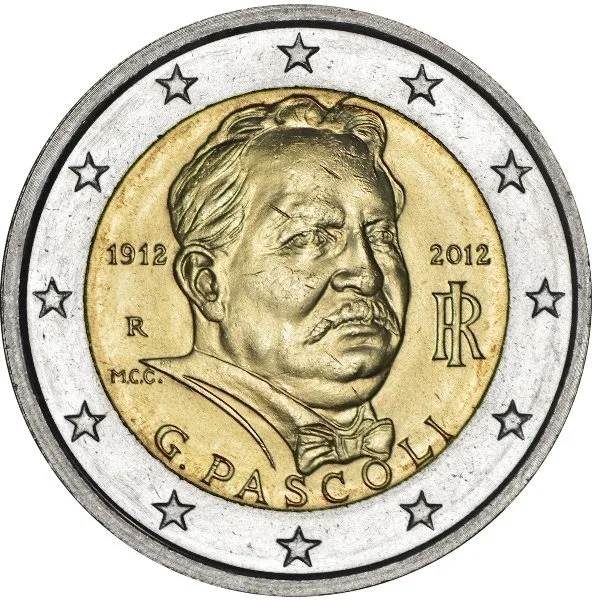
100th Anniversary of the Death of Giovanni Pascoli
Commemorative coin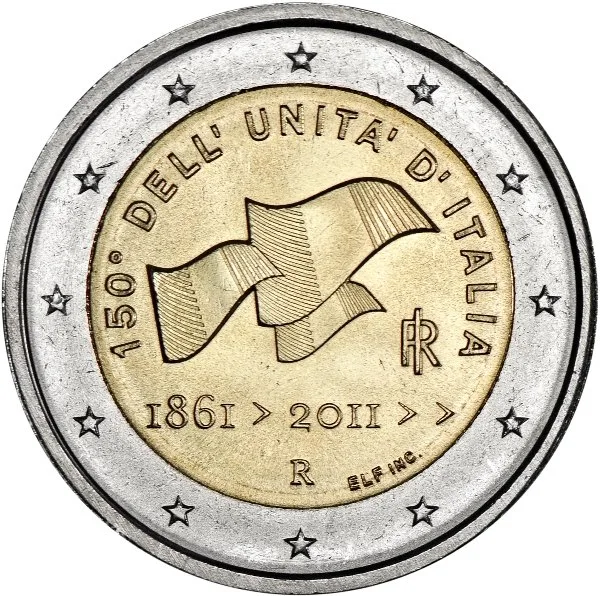
150 Years of Italian Unification
Commemorative coin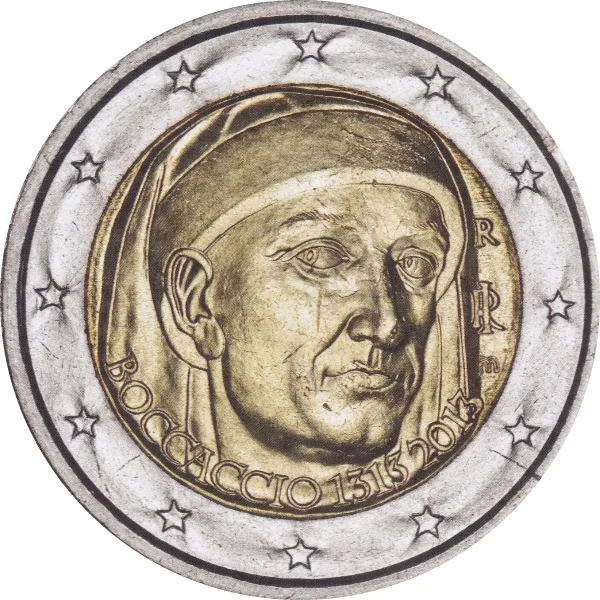
700th Birthday of Giovanni Boccaccio
Commemorative coin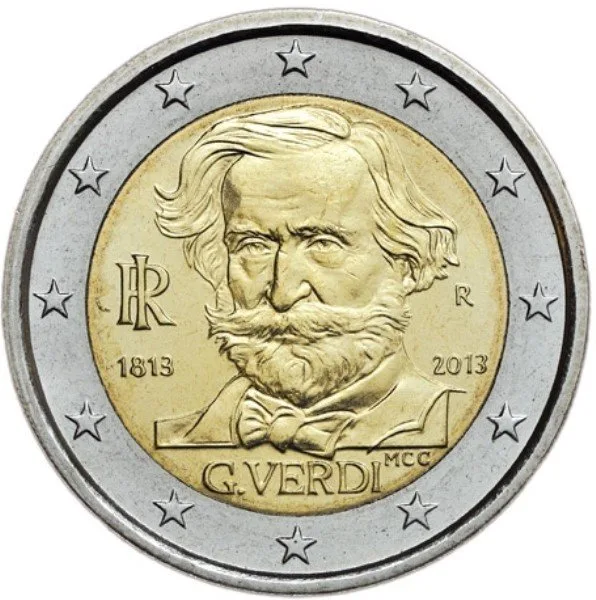
200th Birthday of Giuseppe Verdi
Commemorative coin