150 Years of Italian Unification
 + Add to collection In collection ★ Wanted
 At a glance
| Country | Italy |
|---|---|
| Year | 2011 |
| Issue date | 22 April 2011 |
| Coin type | Commemorative coin |
| Mintage | 10.000.000 (49.850 / 5.500) |
| Catalogue number | IT-11 G1 |
| Designer | Ettore Lorenzo Frapiccini |
| Rarity | €€€€€ what does this mean? |
| Edge lettering |  |
| Market value (approx.) | 4 € · guide price, uncirculated Unlock · for members |
Coin description
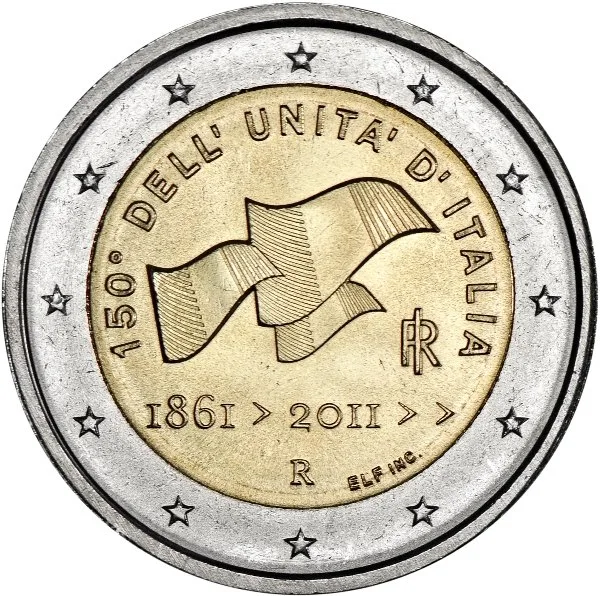
Three waving Italian flags symbolising the three most recent 50-year anniversaries — 1911, 1961 and 2011 — and forging a seamless link between generations: this is the logo of the 150th anniversary of Italian unification. Above the flags, the inscription "150° DELL'UNITA' D'ITALIA" (150th Anniversary of Italian Unification); to their right, the issuing state abbreviation "RI" (Italian Republic). Below the flags, the dates "1861 › 2011 › ›" and, centred beneath them, the mintmark "R". To the right of it, the artist's initials "Ettore Lorenzo Frapiccini", followed by "Incisore" (engraver) in abbreviated form "ELF INC.".
Further information on the topic
The unification of Italy is regarded as one of the defining political events of 19th-century Europe. After centuries of fragmentation into duchies, kingdoms and papal territories, a unified nation-state emerged between 1859 and 1861 through a combination of military campaigns, diplomatic manoeuvring and popular votes. Key figures in this process — the Risorgimento — included Giuseppe Garibaldi, who brought the south of the peninsula under the control of the Kingdom of Sardinia-Piedmont with his volunteer army, Camillo Cavour as the shrewd architect of Piedmontese foreign policy, and King Victor Emmanuel II, who was proclaimed the first King of Italy on 17 March 1861. The capital of the new kingdom was initially Turin, later Florence, before Rome was finally established as the capital in 1871.
For Italy, 17 March 1861 is a national founding date firmly anchored in collective memory — comparable to the German national holiday or French Bastille Day. The political and cultural integration of the previously heterogeneous country, however, remained a slow process: dialects, regional identities and economic disparities between north and south continue to shape Italian society to this day. The anniversaries of the Unità d'Italia — in 1911, 1961 and 2011 — each provided occasions for major state commemorations that repeatedly re-examined the republic's self-understanding. For the 150th anniversary in 2011, Italy issued a 2-euro commemorative coin that makes this long arc visible.
Technical data
| Face value | 2 euro |
|---|---|
| Material | Bimetallic – outer ring: cupronickel; centre: three layers (nickel-brass / nickel / nickel-brass) |
| Weight | 8.5 g |
| Diameter | 25.75 mm |
| Thickness | 2.20 mm |
More 2-euro coins from Italy
200th Birthday of Count Camillo Benso di Cavour
Commemorative coin
100th Anniversary of the Death of Giovanni Pascoli
Commemorative coin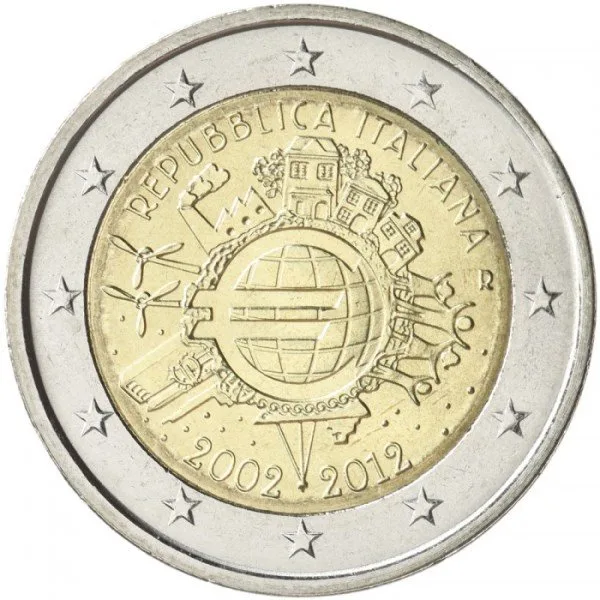
10 Years of Euro Banknotes and Coins
Commemorative coin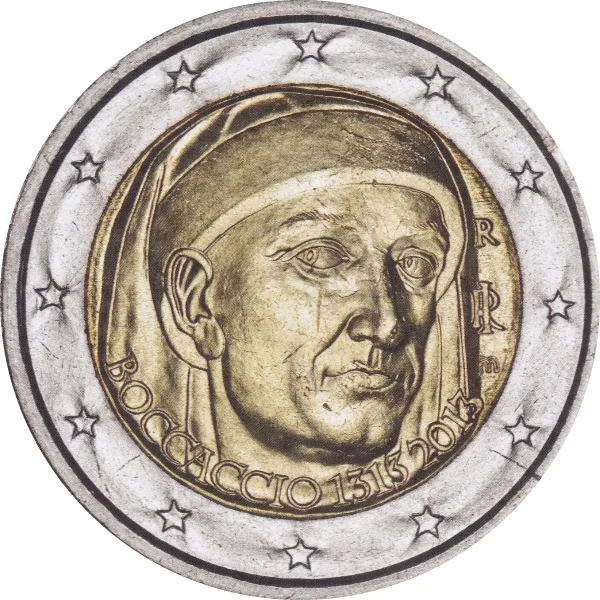
700th Birthday of Giovanni Boccaccio
Commemorative coin