30 Years of the European Flag
 + Add to collection In collection ★ Wanted
 At a glance
| Country | Luxembourg |
|---|---|
| Year | 2015 |
| Issue date | 10 December 2015 |
| Coin type | Commemorative coin |
| Mintage | 510.000 (7.500 / 2.500) |
| Catalogue number | LU-15 G3 |
| Designer | Georgios Stamatopoulos |
| Rarity | €€€€€ what does this mean? |
| Edge lettering |  |
| Market value (approx.) | 4 € · guide price, uncirculated Unlock · for members |
Coin description
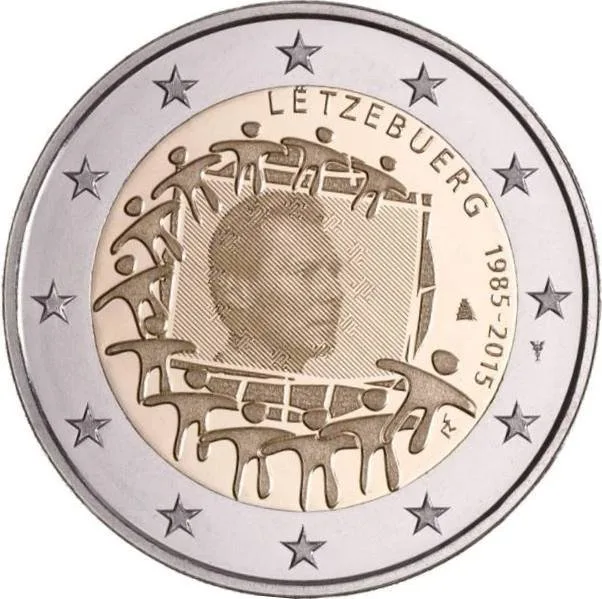
The EU flag as a symbol bringing peoples and cultures together in pursuit of shared ideals and a better future. Twelve stars take on human form, welcoming the birth of a new Europe. To the upper right along the coin ring: the issuing state "LËTZEBUERG" and the years "1985–2015". The mintmark sits between the flag and the dates. The designer Georgios Stamatopoulos's initials appear at lower right.
Note on the coin
In 2015 a retrospective set was issued comprising the Luxembourg €2 commemorative coins of 2013–2015 (LU-13 G1, LU-14 G1, LU-14 G2, LU-15 G1, LU-15 G2, LU-15 G3).
Fourth joint issue of the European Union. All 19 eurozone states issue a coin with the same design on varying dates. The coins differ only in the inscription, which appears in the respective national language.
Further information on the topic
The European flag — twelve gold stars on a blue background — was introduced by the Council of Europe in 1955 and officially declared the flag of the European Community in 1985. The number twelve does not represent the member states but is traditionally regarded as a symbol of perfection and unity. The design was created by Arsène Heitz, a Council of Europe staff member said to have drawn inspiration from medieval depictions of the Madonna. Since then, the blue banner with its ring of stars has remained the most enduring visual symbol of European cooperation — for both the Council of Europe and the European Union, which adopted it in 1986.
Luxembourg, one of the founding members of the European Communities in 1957, has a particularly close relationship with the European integration project: the City of Luxembourg hosts key EU institutions such as the Court of Justice of the European Union and the European Court of Auditors. The Grand Duchy was among those small states that recognised early on that supranational structures offer security and economic stability. To mark the 30th anniversary of the European flag as the EU's official symbol, all euro states jointly issued a 2-euro commemorative coin in 2015 — one of the rare occasions on which the entire eurozone mints the same design.
Technical data
| Face value | 2 euro |
|---|---|
| Material | Bimetallic – outer ring: cupronickel; centre: three layers (nickel-brass / nickel / nickel-brass) |
| Weight | 8.5 g |
| Diameter | 25.75 mm |
| Thickness | 2.20 mm |
More 2-euro coins from Luxembourg
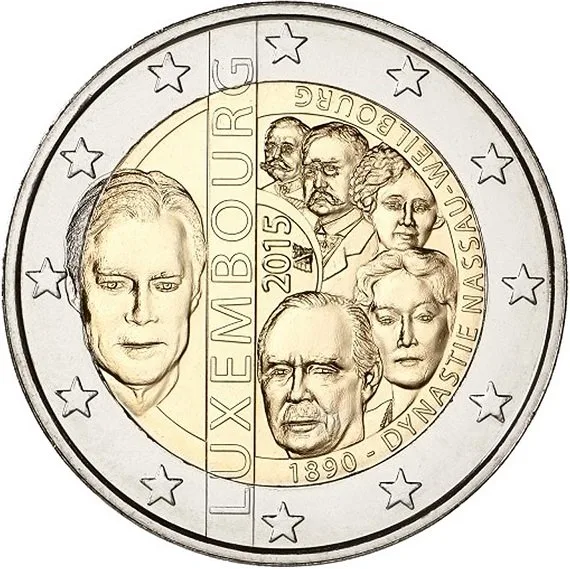
125 Years of the Nassau-Weilburg Dynasty
Commemorative coin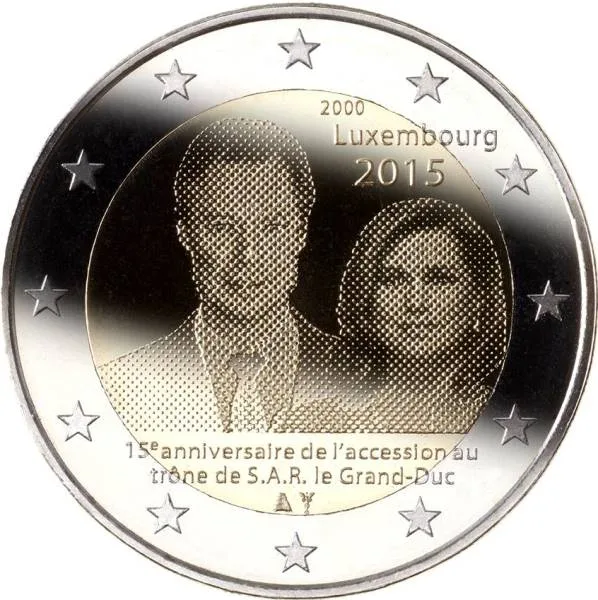
15th Anniversary of Grand Duke Henri's Accession to the Throne
Commemorative coin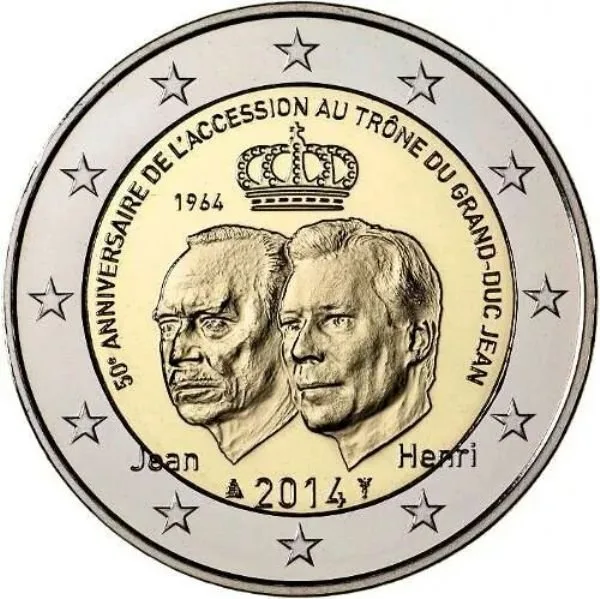
50th Anniversary of Grand Duke Jean's Accession to the Throne
Commemorative coin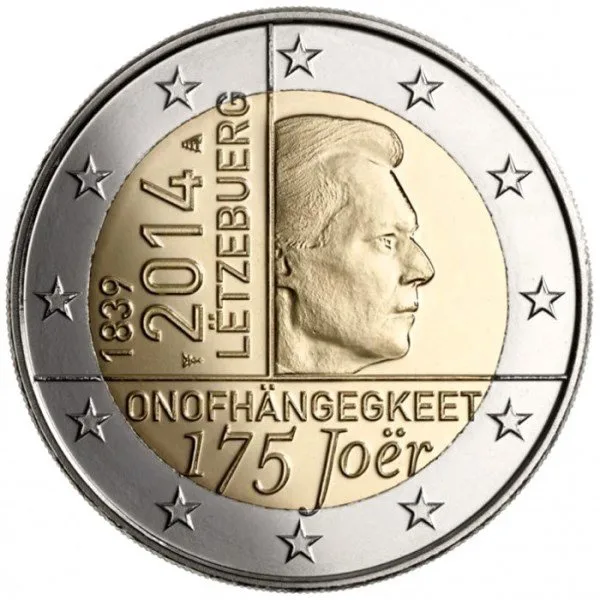
175 Years of Independence
Commemorative coin