10 Years of Economic and Monetary Union
 + Add to collection In collection ★ Wanted
 At a glance
| Country | Malta |
|---|---|
| Year | 2009 |
| Issue date | 5 January 2009 |
| Coin type | Commemorative coin |
| Mintage | 700.000 ( – / – ) |
| Catalogue number | MT-09 G1 |
| Designer | Georgios Stamatopoulus |
| Rarity | €€€€€ what does this mean? |
| Edge lettering |  |
| Market value (approx.) | 4,5 € · guide price, uncirculated Unlock · for members |
Coin description
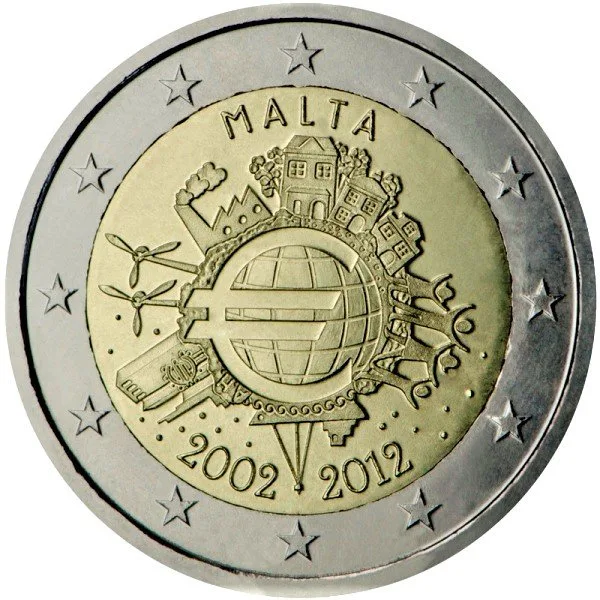
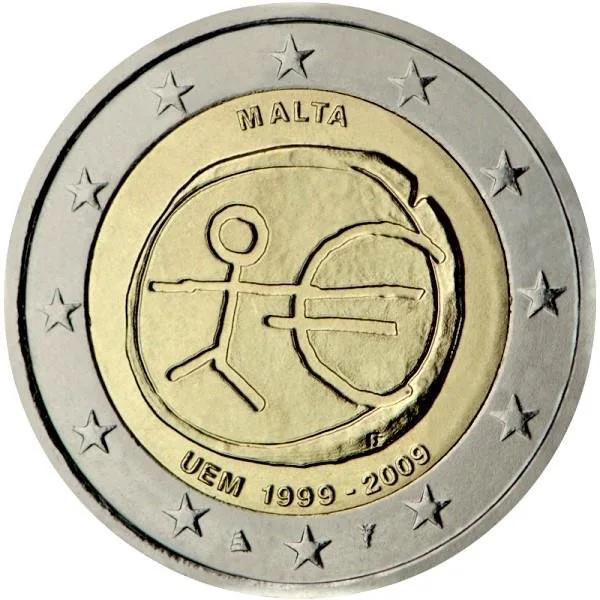
At the centre a stylised human figure on an ancient coin, its left arm extended to form the euro symbol. The artist's initials ΓΣ appear below the euro symbol. The issuing state's name in the national language runs along the upper edge of the design; the dates 1999–2009 and the translated acronym EMU appear along the lower edge.
Note on the coin
Second joint issue of the European Union. All 16 eurozone states issued a coin with the same design on 1 January 2009. The coins differ only in the inscription, which appears in the respective national language.
Further information on the topic
The European Union's Economic and Monetary Union did not emerge overnight: the Maastricht Treaty of 1992 set the roadmap, but the idea reaches further back — to the instabilities following the collapse of the Bretton Woods system and the exchange-rate crises of the 1970s and 80s. On 1 January 1999, eleven states introduced the euro as scriptural money, the European Central Bank took over monetary policy, and national exchange rates were irrevocably fixed. This construct remains, to this day, the EU's most ambitious integration project: a common currency without a common budget, sustained by trust in convergence rules and central bank independence.
Malta joined the eurozone on 1 January 2008 — nearly nine years after its founding — and therefore was not part of the first generation, but experienced the EMU's tenth anniversary as a full member. As a small, open island economy at the centre of the Mediterranean, the Maltese economy has traditionally been strongly oriented towards foreign trade and the services sector; stable exchange rates against its most important European partners therefore carried considerable weight. The euro replaced the Maltese lira, which had been the national currency since independence from Britain in 1964. The Europe-wide joint issue marking the tenth anniversary of the Economic and Monetary Union appeared in 2009 and was issued by all eurozone states, including Malta, with an identical design.
Technical data
| Face value | 2 euro |
|---|---|
| Material | Bimetallic – outer ring: cupronickel; centre: three layers (nickel-brass / nickel / nickel-brass) |
| Weight | 8.5 g |
| Diameter | 25.75 mm |
| Thickness | 2.20 mm |