Prehistoric Sites of Malta – Skorba
 + Add to collection In collection ★ Wanted
 At a glance
| Country | Malta |
|---|---|
| Year | 2020 |
| Issue date | 24 July 2020 |
| Coin type | Commemorative coin |
| Mintage | 200.000 (30.000 / – ) |
| Catalogue number | MT-20 G1 |
| Designer | Noel Galea Bason |
| Rarity | €€€€€ what does this mean? |
| Edge lettering |  |
| Market value (approx.) | 15 € · guide price, uncirculated Unlock · for members |
Coin description
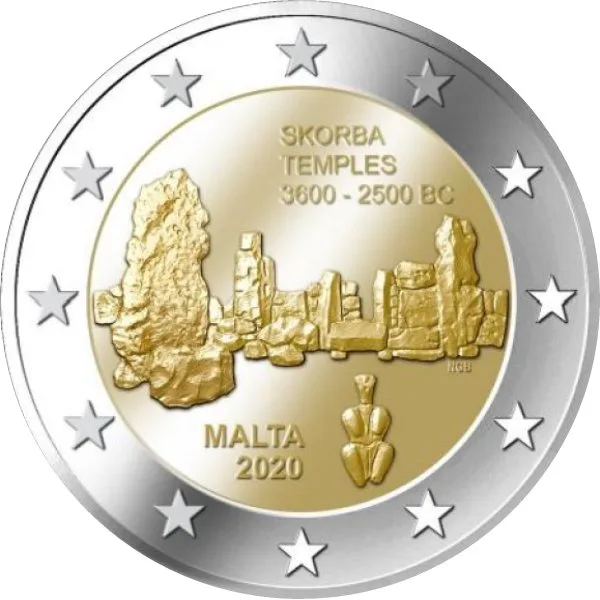
Prehistoric temple of Skorba, part of the UNESCO World Heritage Site. The prehistoric site consists of two temples grouped side by side, located in the northwest of the country near Żebbiegħ. Below them, in the centre, is a depiction of a 'Cycladic idol', an abstract ceramic figure. Along the upper right edge are the inscriptions 'SKORBA', 'TEMPLES' and the dates '3600-2500 BC'. At the lower left edge are the name of the issuing country 'MALTA' and, below it, the year of issue '2020'. At the lower right edge are the initials 'NGB' of the coin designer Noel Galea Bason.
Note on the coin
This 2 euro commemorative coin exists in 3 variants. Those in the brilliant uncirculated coincard were struck in Pessac and bear the mintmark of the mint and of mint master Yves Sampo (MT-20 G2). The coins in the brilliant uncirculated coin set feature an 'F' in the lower star (MT-20 G3). The coins from the rolls carry no mintmark (MT-20 G1).
Further information on the topic
In northwestern Malta, near the small town of Żebbiegħ, stand the remains of Skorba — a temple complex whose settlement history reaches back far earlier than the island's better-known monuments. Excavations in the 1960s uncovered pottery and figurines showing that the site was already in use in the 5th millennium BC, centuries before the freestanding temples of the Maltese megalithic culture were built. Skorba consists of two adjoining temples, the older section of which is assigned to the so-called Ġgantija phase (c. 3600–3200 BC). One find from the site deserves special attention: an abstracted ceramic figure of the so-called Cycladic idol type, pointing to far-reaching cultural connections across the prehistoric Mediterranean.
Malta's prehistoric sites — which besides Skorba also include Ħaġar Qim, Mnajdra and the Ħal Saflieni Hypogeum — have jointly been part of the UNESCO World Heritage since 1980. They are considered the oldest freestanding stone structures in the world and give Malta a special standing within European prehistory. With the 2-euro commemorative coin on Malta's prehistoric sites issued in 2020, the Maltese state honours Skorba as part of this extraordinary cultural heritage — a series that sharpens awareness of the sites' outstanding importance in a European and global context.
Technical data
| Face value | 2 euro |
|---|---|
| Material | Bimetallic – outer ring: cupronickel; centre: three layers (nickel-brass / nickel / nickel-brass) |
| Weight | 8.5 g |
| Diameter | 25.75 mm |
| Thickness | 2.20 mm |
More 2-euro coins from Malta
From Children with Solidarity – Games
Commemorative coin
Heroes of the Pandemic
Commemorative coin
Prehistoric Sites of Malta – Tarxien
Commemorative coin
From Children with Solidarity – Nature & Environment
Commemorative coin