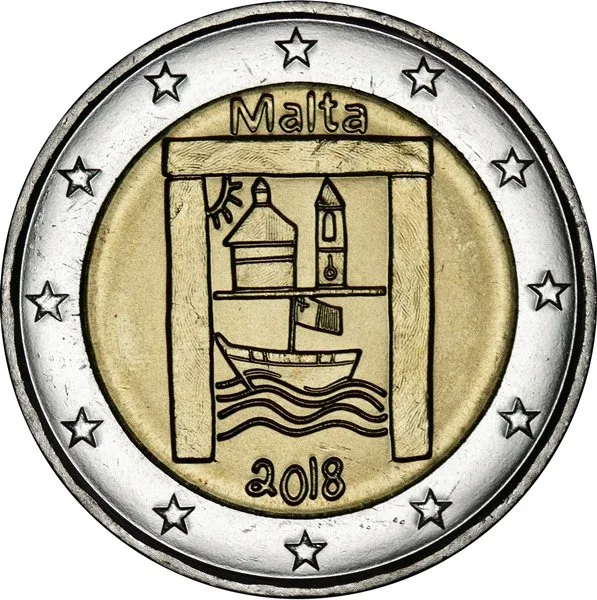
From Children with Solidarity – Cultural Heritage
 + Add to collection In collection ★ Wanted
 At a glance
| Country | Malta |
|---|---|
| Year | 2018 |
| Issue date | 7 November 2018 |
| Coin type | Commemorative coin |
| Mintage | 320.000 (20.000 / – ) |
| Catalogue number | MT-18 G4 |
| Designer | Nicole Dimech |
| Rarity | €€€€€ what does this mean? |
| Edge lettering |  |
| Market value (approx.) | 5 € · guide price, uncirculated Unlock · for members |
Coin description
Stylised depiction of an ancient prehistoric temple, within which the dome and bell tower of the Carmelite Church in Valletta can be seen under a shining sun, together with a depiction of the "Luzzu", a traditional fishing boat, bearing the Maltese flag. Above is the name of the issuing country "MALTA", and below is the year of issue "2018".
Note on the coin
This 2-euro commemorative coin exists in 2 variants. The 2-euro commemorative coins in the brilliant uncirculated coincard were struck at the French mint in Pessac and bear the mintmark of the mint and of mint master Yves Sampo (MT-18 G5). The other coins carry no mintmark (MT-18 G4).
Further information on the topic
Malta is one of the longest continuously inhabited island groups in the Mediterranean. The prehistoric temple complexes such as Ħaġar Qim, Mnajdra and the Hypogeum of Ħal Saflieni were built between roughly 3600 and 2500 BC and are regarded as among the oldest free-standing structures built by humankind. UNESCO added them to the World Heritage list in 1980. Alongside this megalithic past, baroque sacred buildings shape the cityscape of the capital Valletta - above all the Carmelite Church with its distinctive dome and bell tower. Valletta itself was also recognised as a UNESCO World Heritage Site in 1980 and is one of the most densely built capitals in Europe. Malta's identity also includes its maritime tradition: the luzzu, a colourful, high-sided fishing boat with painted eyes on its bow, has been in use in the Mediterranean for centuries and is regarded as a national symbol.
Malta's cultural heritage thus draws on very different eras - prehistoric ritual sites, the knightly fortress architecture of the Order of St John, colonial influence and a distinctive folk culture expressed in language, craft and seafaring. Maltese itself is the only Semitic language with officially recognised EU status and the only one of its kind written in the Latin alphabet, reflecting the island state's unique cultural synthesis. Malta joined the European Union in 2004 and introduced the euro in 2008. The 2-euro commemorative coin from 2018 was issued as part of the series "By Children with Solidarity" and, with its motif of prehistoric temples, Valletta and the luzzu, brings together three defining elements of this multi-layered heritage.
Technical data
| Face value | 2 euro |
|---|---|
| Material | Bimetallic – outer ring: cupronickel; centre: three layers (nickel-brass / nickel / nickel-brass) |
| Weight | 8.5 g |
| Diameter | 25.75 mm |
| Thickness | 2.20 mm |
More 2-euro coins from Malta
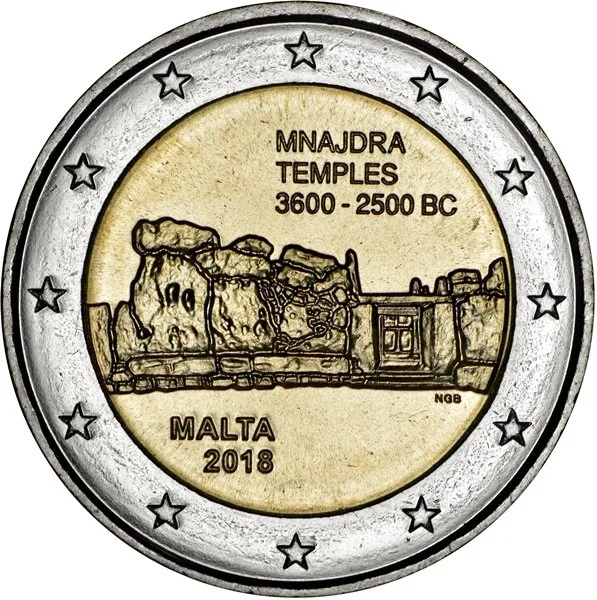
Prehistoric Sites of Malta – Mnajdra
Commemorative coin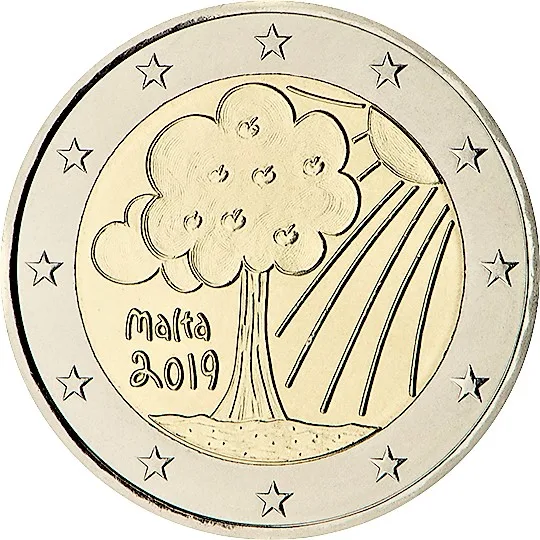
From Children with Solidarity – Nature & Environment
Commemorative coin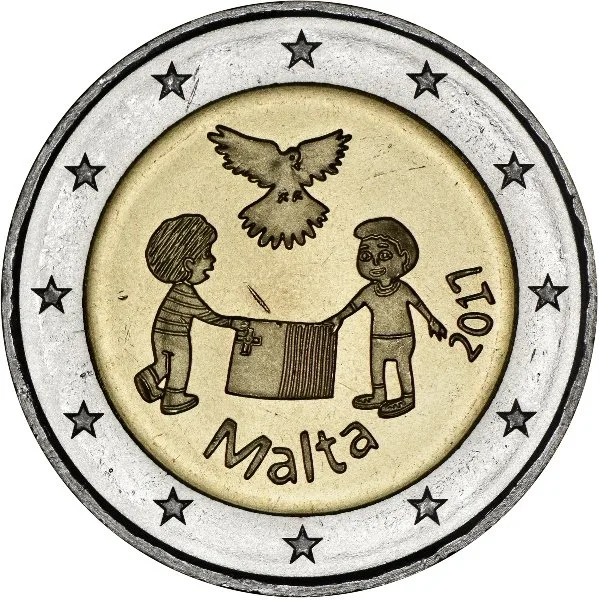
From Children with Solidarity – Peace
Commemorative coin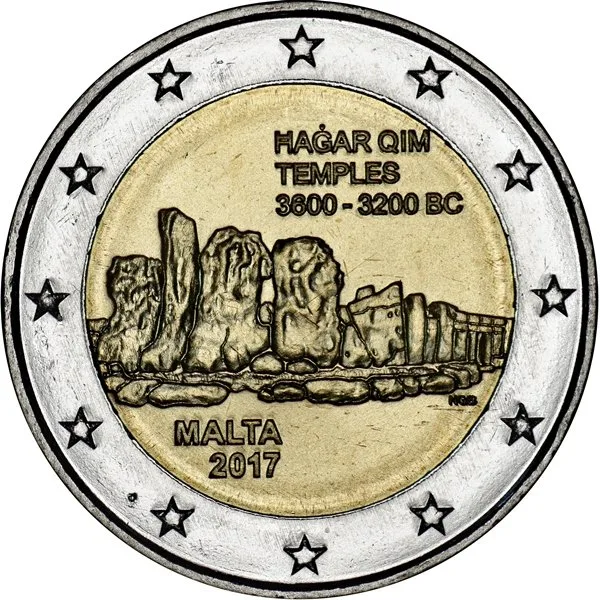
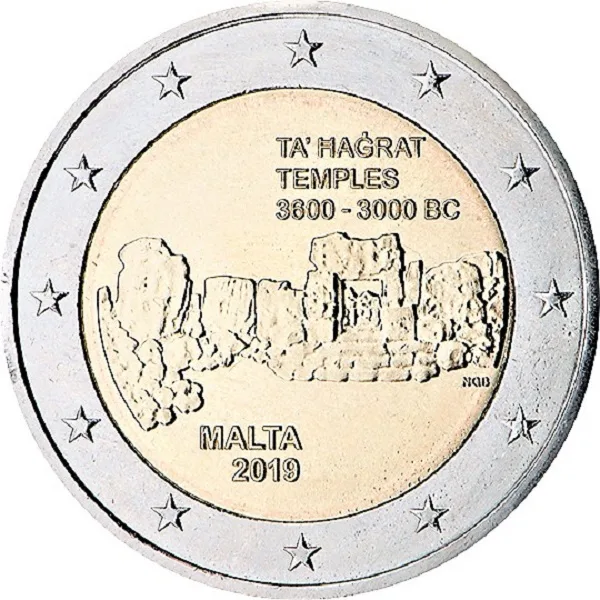
Prehistoric Sites of Malta – Ħaġar Qim
Commemorative coin