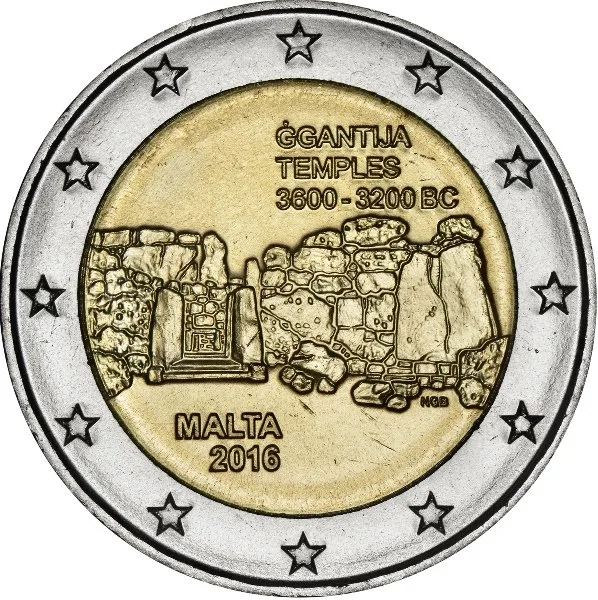
Prehistoric Sites of Malta – Ġgantija
 + Add to collection In collection ★ Wanted
 At a glance
| Country | Malta |
|---|---|
| Year | 2016 |
| Issue date | 22 August 2016 |
| Coin type | Commemorative coin |
| Mintage | 410.000 (60.000 / – ) |
| Catalogue number | MT-16 G1 |
| Designer | Noel Galea Bason |
| Rarity | €€€€€ what does this mean? |
| Edge lettering |  |
| Market value (approx.) | 5 € · guide price, uncirculated Unlock · for members |
Coin description
The centre of the coin shows the Ġgantija temple complex, located on the island of Gozo. On the inner ring, the inscription "ĠGANTIJA TEMPLES" is engraved at the upper right, with the date "3800-3200 BC" beneath it. At the lower left are the issuing country "MALTA" and, below it, the year of issue "2016", flanked by the mint master's mark and the mintmark.
Note on the coin
This 2 euro commemorative coin exists in 3 variants. Those in the brilliant uncirculated coincard were struck in Pessac and bear the mintmark of the mint and of mint master Yves Sampo (MT-16 G2). The coins in the brilliant uncirculated coin set feature an "F" in the lower star (MT-16 G3). The coins from rolls carry no mintmark (MT-16 G1).
Further information on the topic
The Ġgantija temples on the Maltese island of Gozo are among the oldest free-standing structures in human history. Built between roughly 3800 and 3200 BC, they predate the Egyptian pyramids and Britain's Stonehenge by millennia. The complex consists of two interconnected temples built from massive limestone blocks — some weighing several tonnes. That a community achieved such structures without metal tools or the wheel makes Ġgantija one of the most fascinating testimonies to Neolithic building technique and social organisation to this day.
Situated on a plateau above the village of Xagħra in the northeast of Gozo, the temples have been part of the UNESCO World Heritage Site of Malta's prehistoric sites since 1980. For the island nation, they are a central part of collective historical consciousness: nowhere else on Maltese soil does documented settlement reach so far back. In 2016, Malta honoured Ġgantija as the first issue in the seven-part series "Prehistoric Sites of Malta", which has since progressively presented the archipelago's most significant Neolithic monuments. Starting the series with Ġgantija was a natural choice — the Gozo site is not only the oldest in the series but is also considered one of the best-preserved megalithic structures of its era worldwide.
Technical data
| Face value | 2 euro |
|---|---|
| Material | Bimetallic – outer ring: cupronickel; centre: three layers (nickel-brass / nickel / nickel-brass) |
| Weight | 8.5 g |
| Diameter | 25.75 mm |
| Thickness | 2.20 mm |
More 2-euro coins from Malta
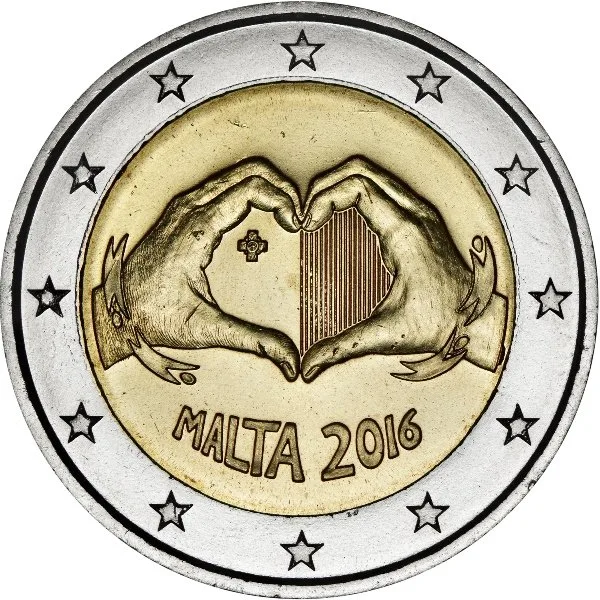
From Children with Solidarity – Love
Commemorative coin
From Children with Solidarity – Peace
Commemorative coin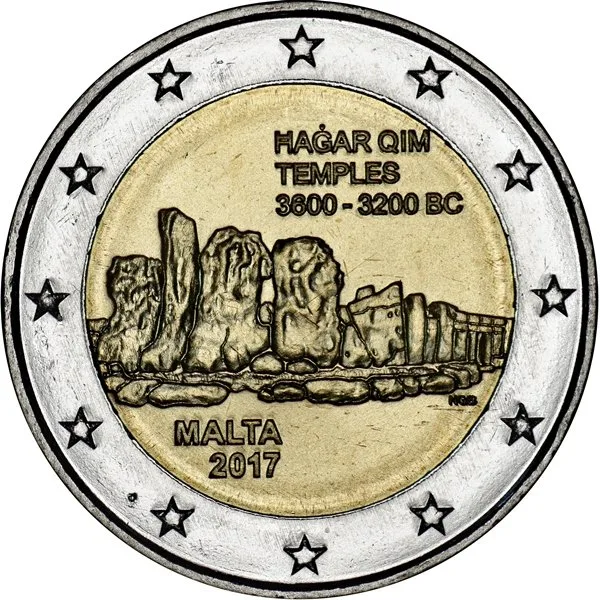
Prehistoric Sites of Malta – Ħaġar Qim
Commemorative coin
Proclamation of the Republic of Malta, 1974
Commemorative coin