
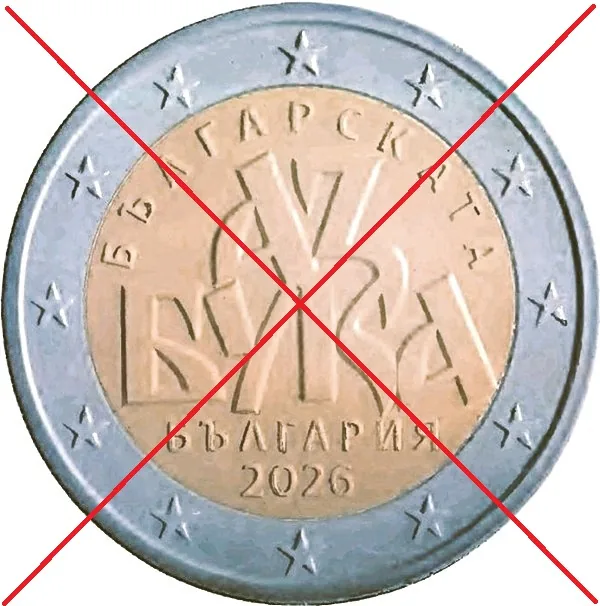
The Official Journal of the European Commission, document 9874/26, has formally rejected the design submitted in document 9435/26. Another EU member state lodged an objection to the Bulgarian 2-euro commemorative coin. It remains unclear at this stage whether the objection concerns the coin's design or its subject matter.
The rejected coin was dedicated to the Bulgarian alphabet, one of the oldest alphabets in Europe. The obverse featured the Cyrillic letter combination "АЗ БУКА" at its centre, forming part of the commemorative inscription "БЪЛГАРCKATA АЗБУКА" (Bulgarian Alphabet) running along the upper rim. The issuing state "БЪЛГАРИЯ" (Bulgaria) and the year "2026" appeared at the lower rim. The twelve stars of the European flag were on the outer ring. Designed by the artist collective of Svetlin Balezdrov and Stoyan Dechev, the coin was planned for the second half of 2026 with an expected mintage of approximately 1 million.
The Bulgarian alphabet is based on the Cyrillic script and currently comprises 30 letters. Developed as early as the 9th century in the First Bulgarian Empire by disciples of Saints Cyril and Methodius, it later spread to other Slavic nations including Russia, Serbia and Ukraine. Bulgarian uses several distinctive letters, such as "ъ," which represents a characteristic Bulgarian vowel. The script is written from left to right and is today the official alphabet of Bulgaria, as well as one of the official writing systems of the European Union.
Source: Official Journal of the European Commission, document 9874/26