40th Anniversary of the Carnation Revolution
 + Add to collection In collection ★ Wanted
 At a glance
| Country | Portugal |
|---|---|
| Year | 2014 |
| Issue date | 23 April 2014 |
| Coin type | Commemorative coin |
| Mintage | 525.000 (15.000 / 10.000) |
| Catalogue number | PT-14 G1 |
| Designer | José Teixeira |
| Rarity | €€€€€ what does this mean? |
| Edge lettering |  |
| Market value (approx.) | 3 € · guide price, uncirculated Unlock · for members |
Coin description
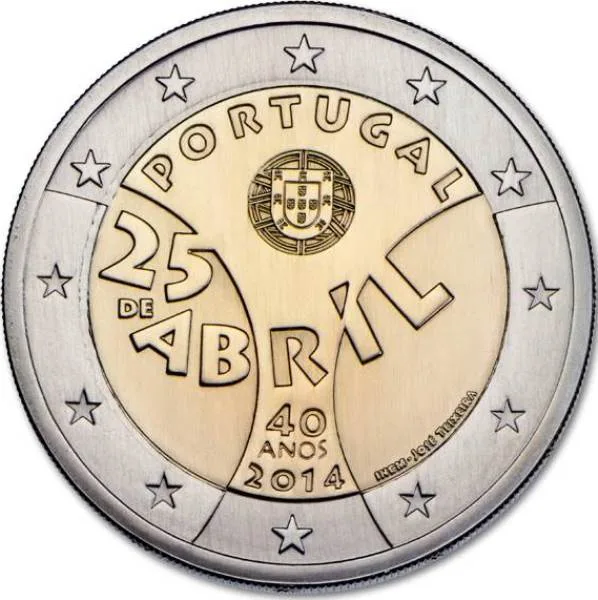
A stylised carnation — the movement's symbol and the flower that gave the revolution its name. In the upper part of the flower: the issuing state "PORTUGAL" and the coat of arms. The inscriptions "25 DE ABRIL" at centre and "40 ANOS" below, together with the year "2014".
Further information on the topic
In the early hours of 25 April 1974, rebel military units in Lisbon ended, after 48 years, the dictatorship of the Estado Novo - the authoritarian regime that had politically paralysed and economically isolated Portugal since Salazar's rise to power in the late 1920s. The Carnation Revolution, as the events soon came to be called, was an almost bloodless military operation that seized state power within a few hours. It owes its name to a spontaneous gesture by the people of Lisbon: civilians placed red carnations in the soldiers' rifle barrels - an image that became a worldwide icon of peaceful revolt. The military movement behind the uprising, the Movimento das Forças Armadas, did not act solely out of domestic political motives. The years-long, exhausting colonial war in Africa - above all in Angola, Mozambique and Portuguese Guinea - had disillusioned large parts of the officer corps and exhausted the country's economic scope.
The consequences of 25 April were transformative for Portugal. Within a few months, political parties were legalised, freedom of the press was introduced, and the African colonies were released into independence - a process that brought hundreds of thousands of returnees to Portugal. The transition to parliamentary democracy did not proceed without turbulence: the revolution was followed by two years of political instability before the democratic constitution, still in force today, came into effect in 1976. Portugal became a member of the European Community (1986) and developed in the following decades into a firm part of the European state order. 25 April is today a national holiday and is regarded as the central reference point of modern Portuguese democracy. To mark the 40th anniversary of this revolution, Portugal issued a 2-euro commemorative coin in 2014 recalling this historic date.
Technical data
| Face value | 2 euro |
|---|---|
| Material | Bimetallic – outer ring: cupronickel; centre: three layers (nickel-brass / nickel / nickel-brass) |
| Weight | 8.5 g |
| Diameter | 25.75 mm |
| Thickness | 2.20 mm |