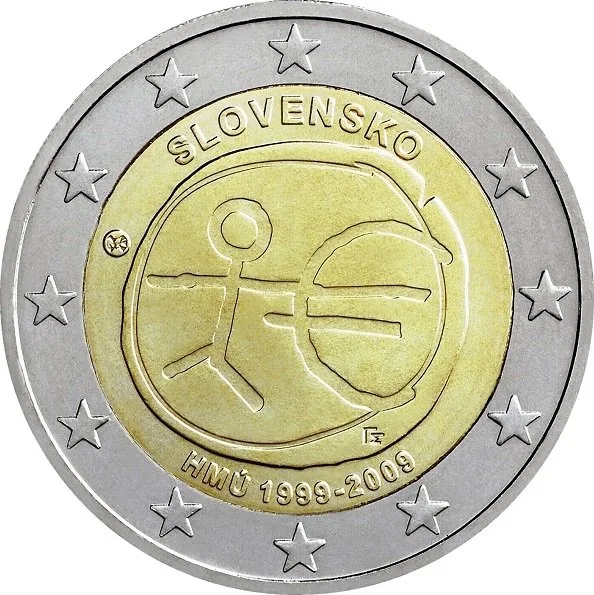
10 Years of Economic and Monetary Union
 + Add to collection In collection ★ Wanted
 At a glance
| Country | Slovakia |
|---|---|
| Year | 2009 |
| Issue date | 7 January 2009 |
| Coin type | Commemorative coin |
| Mintage | 2.500.000 (7.000 / – ) |
| Catalogue number | SK-09 G1 |
| Designer | Georgios Stamatopoulus |
| Rarity | €€€€€ what does this mean? |
| Edge lettering |  |
| Market value (approx.) | 3,5 € · guide price, uncirculated Unlock · for members |
Coin description
At the centre, a stylised human figure drawn from an ancient coin, with the left arm extending into the euro symbol. The artist's initials ΓΣ appear below the euro sign. The name of the issuing state in the national language(s) runs along the upper edge of the design, while the dates 1999–2009 and the local-language acronym for EMU appear along the lower edge.
Note on the coin
Second joint issue of the European Union. All 16 eurozone states issued a coin with the same design on 1 January 2009 to mark the anniversary. The coins differ only in their inscriptions, which appear in the respective national language.
Further information on the topic
The Economic and Monetary Union is among the most far-reaching integration steps in European history. With the introduction of the euro as a common currency on 1 January 1999, twelve states gave up a central expression of national sovereignty and handed monetary policy to the newly created European Central Bank. The EMU was the result of a decades-long process that began with the Werner Plan of 1970, continued through the European Monetary System of 1979, and was finally enshrined as binding in the Maastricht Treaty of 1992. At the core of the system are the convergence criteria, which define price stability, sound public finances and exchange-rate stability as prerequisites for a common monetary policy.
Slovakia was not among the founding states of the eurozone; it first went through the transformation process following the end of Czechoslovakia in 1993. After joining the EU in 2004 and spending several years in the ERM II exchange-rate mechanism, Slovakia introduced the euro on 1 January 2009 — the first country of the Visegrád Group to do so. At the same time, the introduction of the euro as scriptural money was marking its tenth anniversary, which is why all eurozone states jointly issued a commemorative coin with an identical design. For Slovakia, this anniversary coincided with its own accession to the monetary union, marking a double historical milestone.
Technical data
| Face value | 2 euro |
|---|---|
| Material | Bimetallic – outer ring: cupronickel; centre: three layers (nickel-brass / nickel / nickel-brass) |
| Weight | 8.5 g |
| Diameter | 25.75 mm |
| Thickness | 2.20 mm |
More 2-euro coins from Slovakia
Double Cross on Three Hills
Circulation coin
20th Anniversary of the Velvet Revolution
Commemorative coin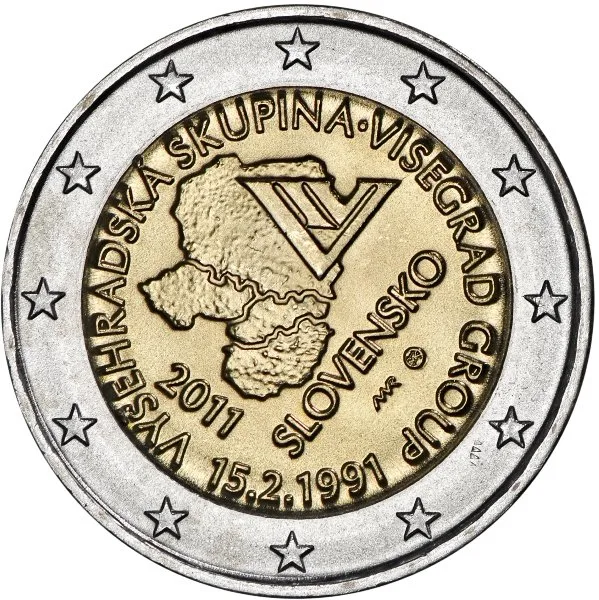
20th Anniversary of the Visegrád Agreement
Commemorative coin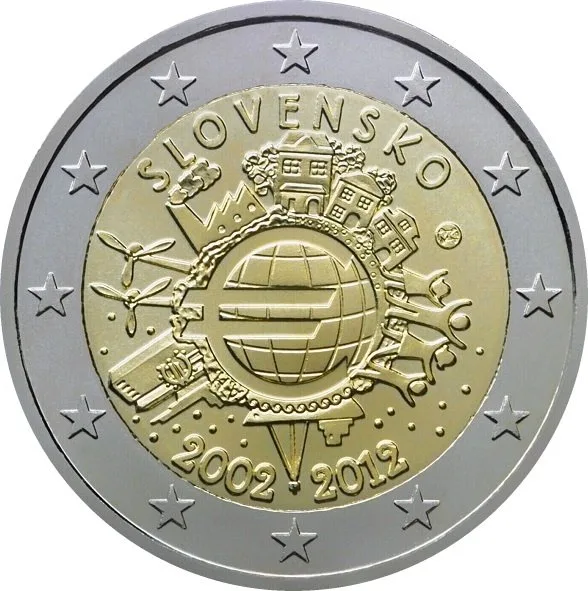
10 Years of Euro Banknotes and Coins
Commemorative coin