20th Anniversary of Slovakia's Accession to the OECD
 + Add to collection In collection ★ Wanted
 At a glance
| Country | Slovakia |
|---|---|
| Year | 2020 |
| Issue date | 11 November 2020 |
| Coin type | Commemorative coin |
| Mintage | 1.000.000 (5.000 / 3.000) |
| Catalogue number | SK-20 G1 |
| Designer | Peter Valach |
| Rarity | €€€€€ what does this mean? |
| Edge lettering |  |
| Market value (approx.) | 4 € · guide price, uncirculated Unlock · for members |
Coin description
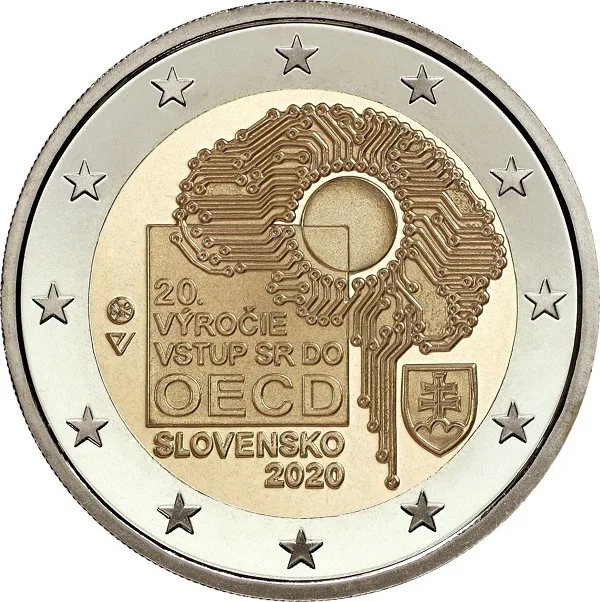
The commemorative inscription '20 VÝROČIE VSTUP SR DO OECD' appears in a box on the left, with the issuing state 'SLOVENSKO' and the year '2020' below it. On the right, the design is dominated by a stylised human brain with abstract circuit-board connections and a centrally placed circle representing a microprocessor — an emblem of the OECD as both a technologically and humanly networked organisation. The silhouette of Slovakia with a textured surface is worked into the design, with the Slovak coat of arms featuring the double cross on three hills shown below.
Further information on the topic
Slovakia is one of the few countries that found its way into the ranks of the world's leading Western economic organisations within just a few years of the end of communism. In September 2000, the Slovak Republic joined the Organisation for Economic Co-operation and Development (OECD) — a step that, following the country's independence from Czechoslovakia in 1993, finally placed it among the ranks of established market economies. Accession was the result of profound structural reforms in the 1990s: privatisation programmes, the establishment of a functioning banking system and the gradual opening of the capital market laid the groundwork. The OECD, founded in 1961 as successor to the OEEC, today brings together around 38 industrialised nations and sets standards worldwide in economic, tax and education policy. Membership gave Slovakia not only access to comparative economic data and policy advice, but also international credibility as an investment-friendly location.
In the two decades following OECD accession, Slovakia developed into one of Central Europe's most dynamic economies. The country established itself as a major automotive manufacturing hub — at times ranking among the world leaders in per-capita car production — and benefited greatly from foreign direct investment, including from Volkswagen, PSA and Kia. At the same time, fiscal consolidation and the adoption of the euro in 2009 delivered macroeconomic stability. The OECD accompanied this process with regular country reviews and recommendations, for example on the education system, the labour market and anti-corruption efforts. On the 20th anniversary of OECD accession, Slovakia commemorated this economic-policy milestone in its recent history with a 2-euro coin in 2020.
Official issues of the coin
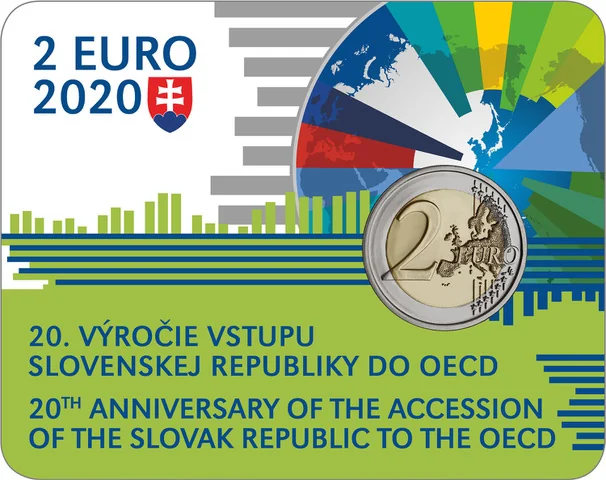 ©Image credit: Mincovňa Kremnica
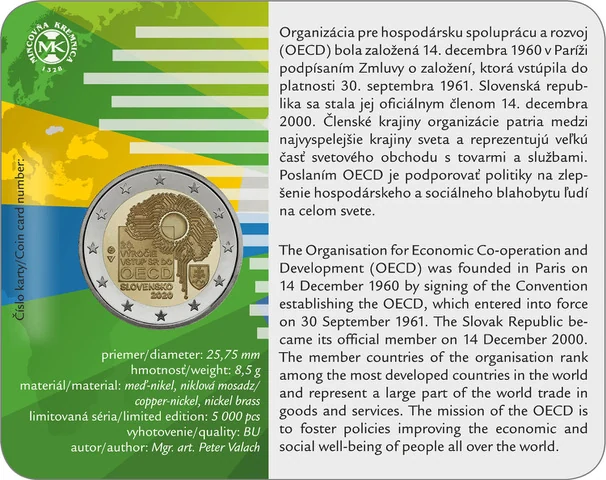 ©Image credit: Mincovňa Kremnica
Technical data
| Face value | 2 euro |
|---|---|
| Material | Bimetallic – outer ring: cupronickel; centre: three layers (nickel-brass / nickel / nickel-brass) |
| Weight | 8.5 g |
| Diameter | 25.75 mm |
| Thickness | 2.20 mm |
More 2-euro coins from Slovakia
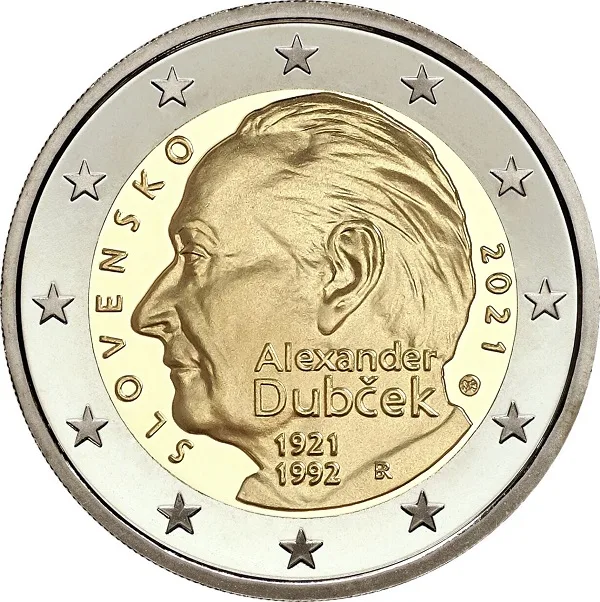
100th Birthday of Alexander Dubček
Commemorative coin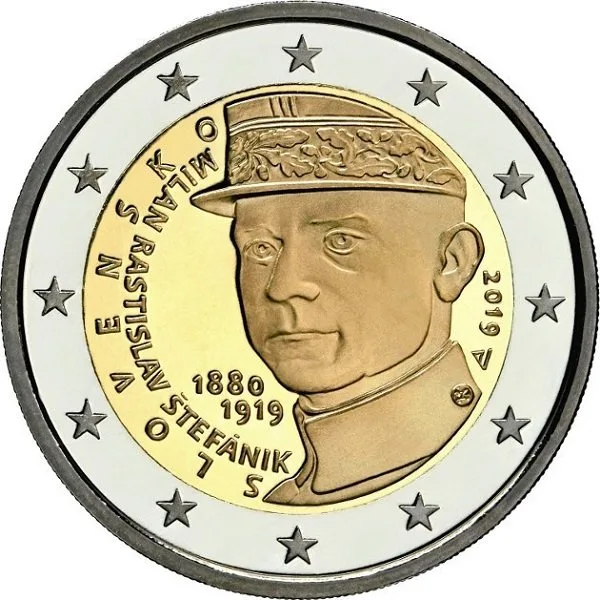
100th Anniversary of the Death of Milan Rastislav Štefánik
Commemorative coin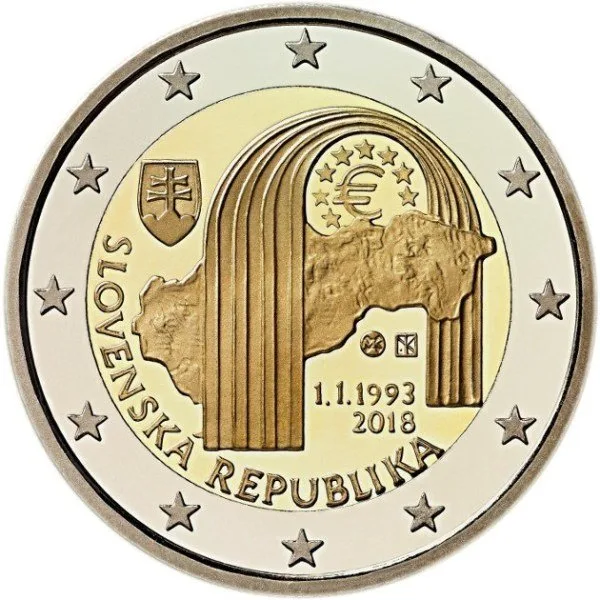
25 Years of the Slovak Republic
Commemorative coin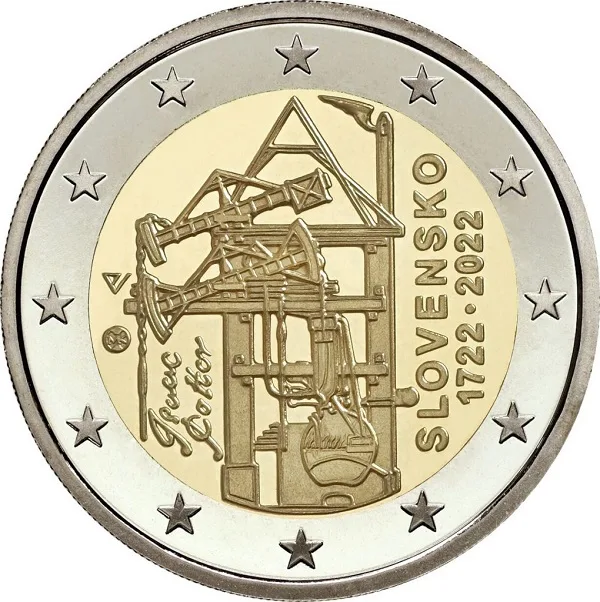
300 Years Since the Construction of the First Atmospheric Steam Engine
Commemorative coin