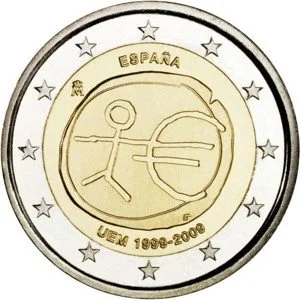
10 Years of Economic and Monetary Union
 + Add to collection In collection ★ Wanted
 At a glance
| Country | Spain |
|---|---|
| Year | 2009 |
| Issue date | 2 March 2009 |
| Coin type | Commemorative coin |
| Mintage | 8.000.000 (96.000 / 3.500) |
| Catalogue number | ES-09 G1 |
| Designer | Georgios Stamatopoulus |
| Rarity | €€€€€ what does this mean? |
| Edge lettering |  |
| Market value (approx.) | 3,5 € · guide price, uncirculated Unlock · for members |
Coin description
At the centre, a stylised human figure drawn from an ancient coin, with the left arm extending into the euro symbol. The artist's initials ΓΣ appear below the euro sign. The name of the issuing state in the national language(s) runs along the upper edge of the design, while the dates 1999–2009 and the local-language acronym for EMU appear along the lower edge.
Note on the coin
Second joint issue of the European Union. All 16 eurozone states issued a coin with the same design on 1 January 2009 to mark the anniversary. The coins differ only in their inscriptions, which appear in the respective national language. This commemorative coin was struck in two variants — with small stars (ES-09 G1) and with large stars (ES-09 G2) — in unknown quantities.
Further information on the topic
When eleven European states irrevocably fixed their exchange rates on 1 January 1999 and the European Central Bank took over monetary policy, a new era of economic integration began — without precedent in the history of modern currency areas. The Economic and Monetary Union, whose foundations had been laid by the Maastricht Treaty of 1992, created not just a common currency but also demanded that member states maintain sound public finances, coordinated fiscal policy, and give up a central instrument of national economic management. Spain was among the founding group: the peseta, the means of payment on the Iberian Peninsula for centuries, was replaced by euro cash on 1 January 2002, when physical coins and notes also entered circulation.
In its first ten years, the eurozone displayed both the strengths and the structural challenges of a monetary union without a complete fiscal union. During this period, Spain initially experienced vigorous growth, driven by low interest rates, a booming property market, and rising domestic demand — a pattern seen in several peripheral states. At the same time, the common currency proved its stability as an anchor for trade and investment within the euro area. To mark the tenth anniversary of the Economic and Monetary Union (1999–2009), all eurozone states jointly issued a 2-euro commemorative coin — one of the few joint issues in which the same design was minted in every member country, in Spain under the name España.
Technical data
| Face value | 2 euro |
|---|---|
| Material | Bimetallic – outer ring: cupronickel; centre: three layers (nickel-brass / nickel / nickel-brass) |
| Weight | 8.5 g |
| Diameter | 25.75 mm |
| Thickness | 2.20 mm |
More 2-euro coins from Spain
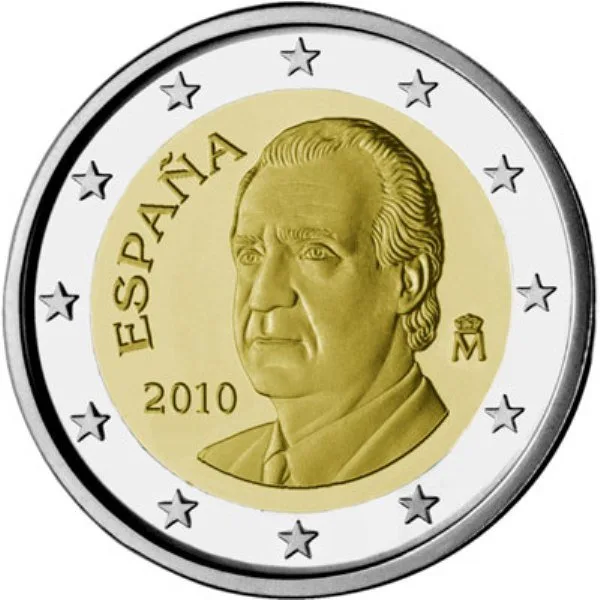
King Juan Carlos I (2010 – 2014)
Circulation coin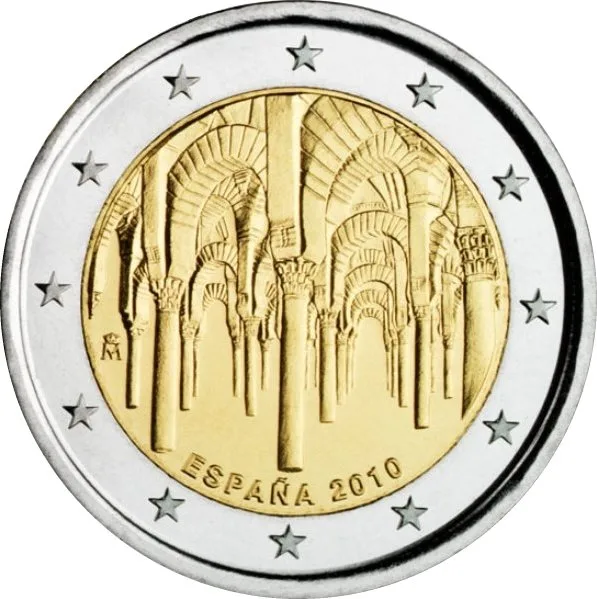
UNESCO World Heritage Site – Historic Centre of Córdoba
Commemorative coin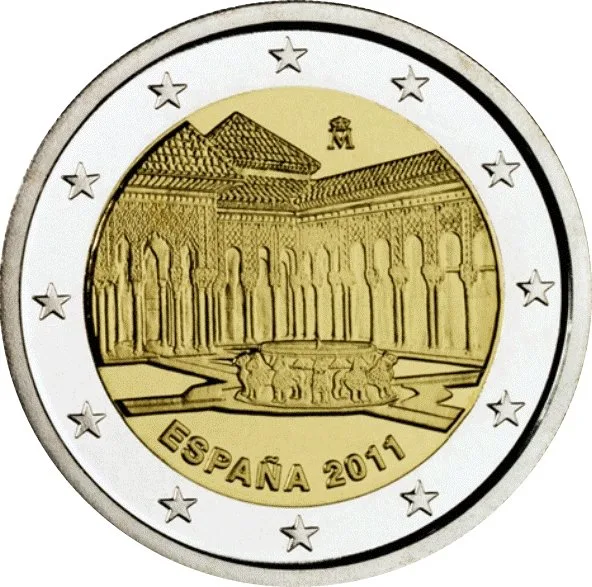
UNESCO World Heritage Site – Alhambra, Generalife and Albaicín, Granada
Commemorative coin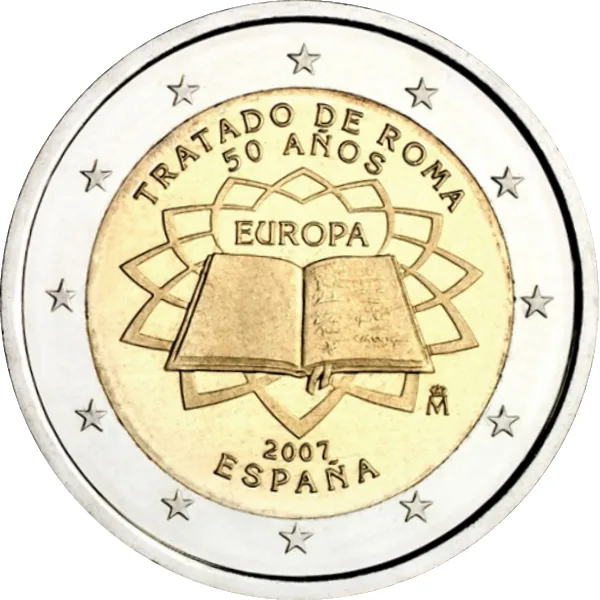
50 Years of the Treaties of Rome
Commemorative coin