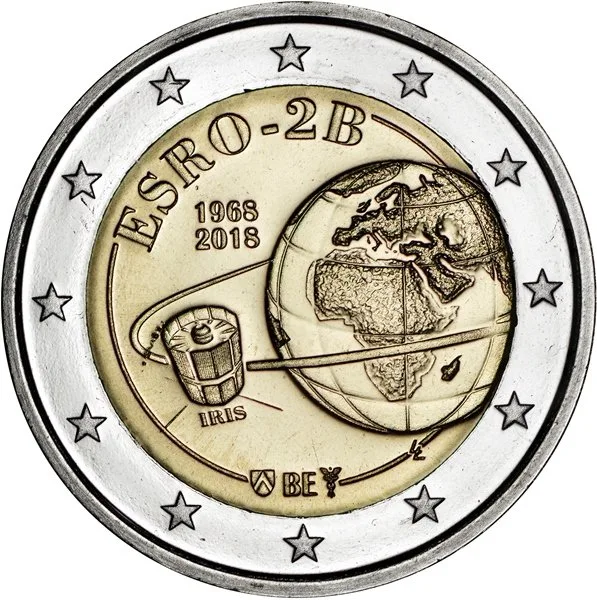
50 Years of the European Satellite ESRO-2B (Iris)
 + Add to collection In collection ★ Wanted
 At a glance
| Country | Belgium |
|---|---|
| Year | 2018 |
| Issue date | 20 September 2018 |
| Coin type | Commemorative coin |
| Mintage | 257.500 (250.000 / 7.500) |
| Catalogue number | BE-18 G2 |
| Designer | Luc Luycx |
| Rarity | €€€€€ what does this mean? |
| Edge lettering |  |
| Market value (approx.) | 9 € · guide price, uncirculated Unlock · for members |
Coin description
The IRIS satellite in orbit around the Earth. Above: the occasion 'ESRO-2B' and the years '1968' and '2018'. Below the satellite, the inscription 'IRIS' (International Radiation Investigation Satellite). The country code 'BE', the mint master's mark of Ingrid Herzele and the Utrecht mintmark round off the lower portion of the design. The initials LL of designer Luc Luycx appear beneath the globe.
Further information on the topic
ESRO-2B, later known as IRIS, was the second research satellite of the European Space Research Organisation and was launched by NASA on 17 May 1968 aboard a Scout rocket from Vandenberg Air Force Base in California. Its main task was to measure cosmic radiation and high-energy solar particles in Earth orbit — data that was fundamental to understanding space physics and the radiation environment in low Earth orbit. ESRO, the precursor organisation to today's ESA, founded in 1964 by ten European states, used the satellite as early proof that Europe was technically capable of carrying out independent space missions. Belgium had been a member of ESRO from the outset and contributed to its programmes both scientifically and financially.
The launch of ESRO-2B marked an important moment in the history of European space cooperation: for the first time, the European partner nations succeeded in transmitting reliable measurement data from orbit using a jointly developed scientific satellite. Belgium, which had been involved in space research early on through institutes such as the Belgian Institute for Space Aeronomy (BIRA-IASB), remains an active ESA partner to this day. With the issue of a Belgian 2-euro commemorative coin in 2018, the country marked the 50th anniversary of this launch and its role in a project that laid the groundwork for Europe's later space infrastructure.
Official announcement (EU Official Journal): ABl. C 401 vom 7.11.2018, S. 5 (2018/C 401/06)
Technical data
| Face value | 2 euro |
|---|---|
| Material | Bimetallic – outer ring: cupronickel; centre: three layers (nickel-brass / nickel / nickel-brass) |
| Weight | 8.5 g |
| Diameter | 25.75 mm |
| Thickness | 2.20 mm |
More 2-euro coins from Belgium
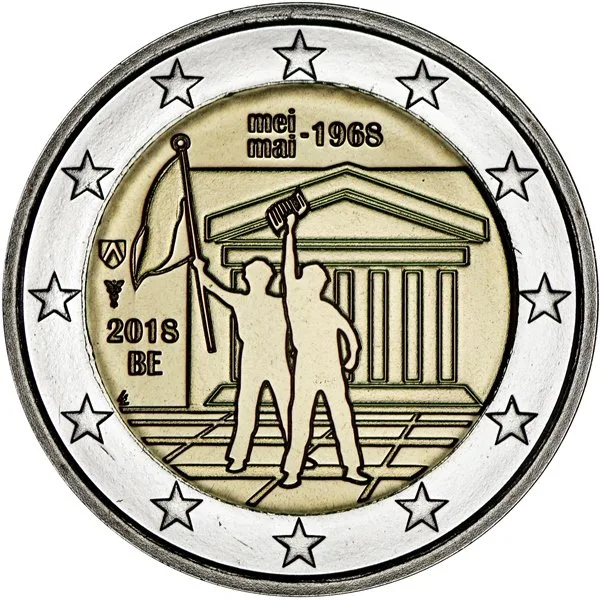
50 Years of the 1968 Student Revolt
Commemorative coin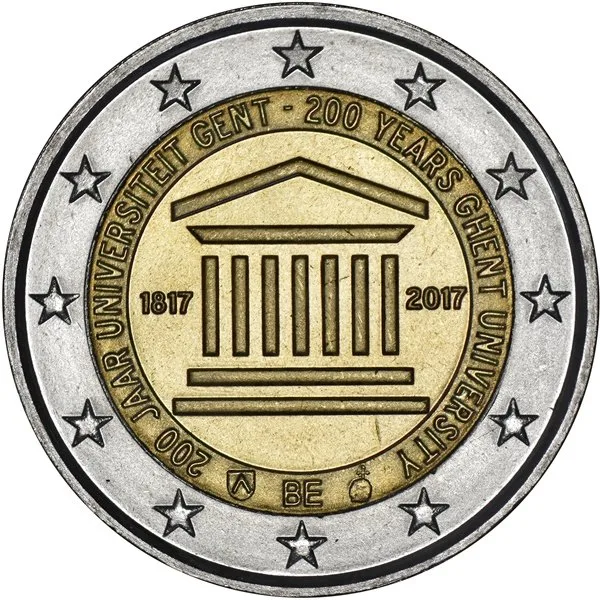
200 Years of Ghent University
Commemorative coin
450th Anniversary of the Death of Pieter Bruegel the Elder
Commemorative coin
25 Years of the Founding of the European Monetary Institute
Commemorative coin