500 Years of the Carolus Guilder
 + Add to collection In collection ★ Wanted
 At a glance
| Country | Belgium |
|---|---|
| Year | 2021 |
| Issue date | . October 2021 |
| Coin type | Commemorative coin |
| Mintage | 155.000 (150.000 / 5.000) |
| Catalogue number | BE-21 G2 |
| Designer | Luc Luycx |
| Rarity | €€€€€ what does this mean? |
| Edge lettering |  |
| Market value (approx.) | 14 € · guide price, uncirculated Unlock · for members |
Coin description
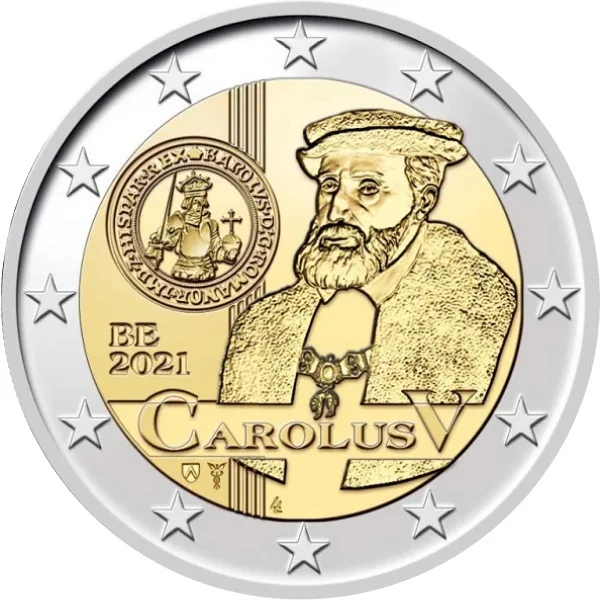
To the right, a portrait of King Charles V wearing the chain of the Order of the Golden Fleece. To the upper left, the obverse of the gold Carolus guilder from the second issue period beginning in 1521. Below, the inscription 'CAROLUS V'; to the left, the country code 'BE' and the year '2021'. Along the lower edge, the mint master's mark of Ingrid Herzele, the mark of the Dutch mint, and the initials 'LL' of designer Luc Luycx.
Further information on the topic
The Carolus florin is one of the most significant currency reforms in European history. Charles V, who as a Habsburg ruled simultaneously over Spain, the Netherlands, large parts of Italy and the Holy Roman Empire, sought a unified gold currency for his vast territories. With the edict of 1521, he created the Carolus d'or, also known as the Carolus florin, intended to serve as a supranational means of payment in western European trade. The coin was based on the weight of the Rhenish gold florin and was designed for the key trade routes between the Habsburg Netherlands, the Iberian Peninsula and the Empire. That a single ruler could push through such a project at all was owed to the unprecedented power structure of Charles V — a circumstance that remained unique in European monetary history.
Charles V reigned as emperor from 1519 to 1556 and shaped an era in which the Habsburg Netherlands — including present-day Belgium — was among the most economically dynamic regions of Europe. Antwerp was then the continent's most important trading centre, and Flemish mints played a central role in striking the Carolus florin. Charles's reign coincided with the Reformation, Magellan's first circumnavigation of the globe, and Spain's rise as a colonial power — political and economic upheavals that fundamentally transformed the flow of coinage between continents. In 2021, Belgium commemorated the 500th anniversary of this groundbreaking currency reform with a commemorative coin, linking back to a chapter of its history as the core of the Habsburg northern realm.
Technical data
| Face value | 2 euro |
|---|---|
| Material | Bimetallic – outer ring: cupronickel; centre: three layers (nickel-brass / nickel / nickel-brass) |
| Weight | 8.5 g |
| Diameter | 25.75 mm |
| Thickness | 2.20 mm |