10 Years of Economic and Monetary Union
 + Add to collection In collection ★ Wanted
 At a glance
| Country | Finland |
|---|---|
| Year | 2009 |
| Issue date | 15 January 2009 |
| Coin type | Commemorative coin |
| Mintage | 1.400.000 (31.100 / 27.500) |
| Catalogue number | FI-09 G1 |
| Designer | Georgios Stamatopoulos |
| Rarity | €€€€€ what does this mean? |
| Edge lettering |  |
| Market value (approx.) | 3,5 € · guide price, uncirculated Unlock · for members |
Coin description
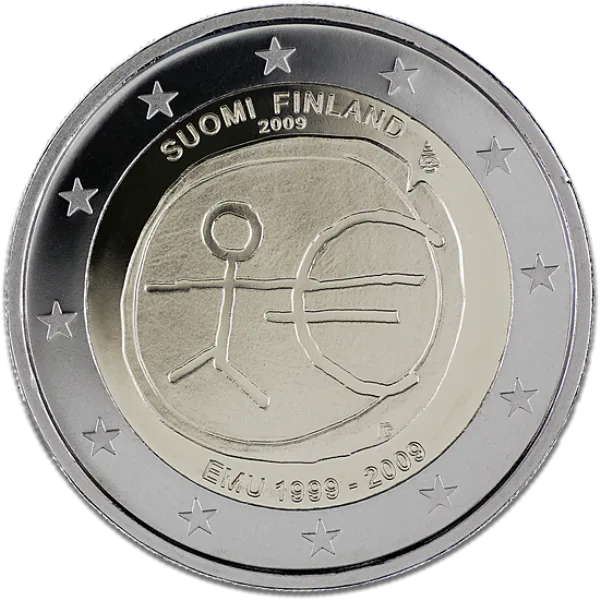
At the centre, a stylised human figure on an ancient coin, its left arm extended into the euro symbol. The artist's initials appear beneath the euro symbol. The issuing country's name in the national language(s) appears along the upper edge of the design, while the dates 1999–2009 and the acronym EMU translated into the national language(s) appear along the lower edge.
Note on the coin
Second European Union joint issue. All 16 eurozone states issued a coin with the same design on the anniversary date of 1 January 2009. The coins differ only in their inscriptions, which appear in the respective national language.
Further information on the topic
The Economic and Monetary Union is regarded as one of the most far-reaching integration projects in European history. With the introduction of the euro as scriptural money on 1 January 1999 and as cash in 2002, the participating states gave up a central pillar of national economic policy: an independent monetary policy. For Finland, which had only joined the European Union in 1995, participating in the eurozone from the outset meant a deliberate choice for close European integration. The European Central Bank took over control of the money supply and the setting of key interest rates for the entire currency area, while national central banks such as Suomen Pankki became part of the Eurosystem.
In its first ten years, the monetary union showed both its strengths and its structural challenges. The common internal market benefited from the elimination of exchange-rate risk, and the euro quickly developed into the world's second most important reserve currency. At the same time, the financial crisis from 2007 onward revealed tensions between economies at different stages of development within the euro area. In 2009, Finland was among the member states that marked the anniversary with a European joint issue — all euro countries issued a 2-euro commemorative coin with an identical design that year, jointly commemorating the founding of the EMU in 1999.
Technical data
| Face value | 2 euro |
|---|---|
| Material | Bimetallic – outer ring: cupronickel; centre: three layers (nickel-brass / nickel / nickel-brass) |
| Weight | 8.5 g |
| Diameter | 25.75 mm |
| Thickness | 2.20 mm |