150 Years of the Finnish Markka
 + Add to collection In collection ★ Wanted
 At a glance
| Country | Finland |
|---|---|
| Year | 2010 |
| Issue date | 29 October 2010 |
| Coin type | Commemorative coin |
| Mintage | 1.600.000 (16.500 / 25.000) |
| Catalogue number | FI-10 G1 |
| Designer | Reijo Paavilainen |
| Rarity | €€€€€ what does this mean? |
| Edge lettering |  |
| Market value (approx.) | 3,5 € · guide price, uncirculated Unlock · for members |
Coin description
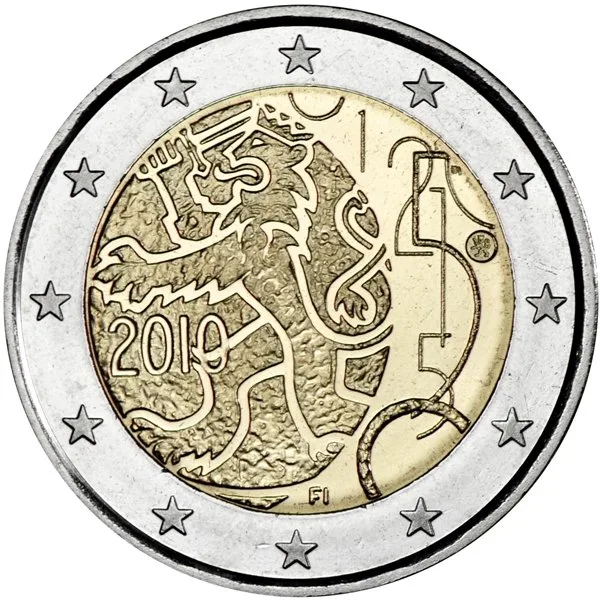
On the left, a stylised lion from the Finnish coat of arms and the year "2010". On the right, the mintmark and a series of numbers representing coin denominations. The issuing country "FI" is struck along the bottom.
Further information on the topic
When Finland introduced the markka in 1860, the country was still an autonomous Grand Duchy under Russian rule. The step of establishing its own currency was thus far more than an economic policy decision: it signaled growing administrative autonomy and strengthened Finnish national sentiment at a time when the question of a distinct identity was gaining increasing social weight. The markka was initially pegged to the Russian ruble but gradually decoupled from it, becoming the Grand Duchy's sole legal tender in 1865. Finland thus possessed an independently administered currency decades before its 1917 independence, one regarded as an early symbol of the state's capacity to act.
The history of the Finnish markka mirrors the political ruptures of the 20th century. After independence, the currency was reformed several times to cope with periods of inflation and the effects of war. With Finland's accession to the EC in 1995, gradual integration into the European economic area began; in 2002, the euro finally replaced the markka as legal tender. The year 2010 marked the 150th anniversary of the markka's introduction — an occasion also understood in Finland as a look back on a long journey from a tsarist administrative unit to a fully integrated EU member. The lion from the Finnish coat of arms, a central national symbol for centuries, stands for continuity across all these changes of system.
Technical data
| Face value | 2 euro |
|---|---|
| Material | Bimetallic – outer ring: cupronickel; centre: three layers (nickel-brass / nickel / nickel-brass) |
| Weight | 8.5 g |
| Diameter | 25.75 mm |
| Thickness | 2.20 mm |