10 Years of Euro Banknotes and Coins
 + Add to collection In collection ★ Wanted
 At a glance
| Country | Finland |
|---|---|
| Year | 2012 |
| Issue date | 12 January 2012 |
| Coin type | Commemorative coin |
| Mintage | 1.500.000 (11.500 / 25.000) |
| Catalogue number | FI-12 G1 |
| Designer | Helmut Andexlinger |
| Rarity | €€€€€ what does this mean? |
| Edge lettering |  |
| Market value (approx.) | 4 € · guide price, uncirculated Unlock · for members |
Coin description
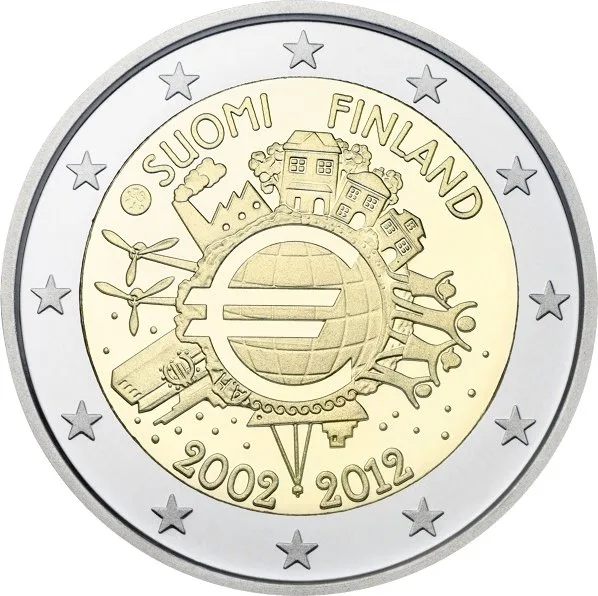
The euro has grown into a major factor in Europe and around the world, and a global player in the international monetary system. The design elements arranged around the euro sign symbolise the currency's significance for citizens, the financial world (the ECB tower), trade (ships), industry (factories), the energy sector, and research and development (wind turbines). The artist's initials “AH” appear below the ECB tower. The names of the issuing states in their national languages are inscribed centrally above the design, with the dates 2002–2012 below.
Note on the coin
Third European Union joint issue. All 17 eurozone states issued a coin with the same design on the anniversary date of 1 January 2012. The coins differ only in their inscriptions, which appear in the respective national language. San Marino also issued a coin with the same design, though it is not officially part of the joint issue.
Further information on the topic
When the first euro banknotes and coins entered circulation simultaneously in twelve countries on 1 January 2002, it was the largest monetary event in European history. Within a few weeks, more than 300 million people exchanged their national means of payment for the new common currency — a logistical and political feat that had required years of preparation. Finland was among the founding members of the eurozone and had already introduced the euro as book money on 1 January 1999, before it replaced the Finnish mark as physical cash in 2002. The euro was the culmination of a long integration process that began with the single market and led to a shared monetary policy under the European Central Bank.
In its first ten years as cash, the euro proved itself as an anchor of stability — even though the financial crisis from 2008 exposed structural weaknesses in the monetary union and sparked debates over transfer mechanisms and fiscal discipline. In foreign trade, the euro quickly became the world's second most important reserve currency, considerably easing cross-border trade in goods and capital. For Finland, whose economy is strongly export-oriented, the common currency meant eliminating exchange-rate risk with its most important trading partners. All euro states marked the tenth anniversary of euro cash in 2012 with a joint commemorative issue.
Technical data
| Face value | 2 euro |
|---|---|
| Material | Bimetallic – outer ring: cupronickel; centre: three layers (nickel-brass / nickel / nickel-brass) |
| Weight | 8.5 g |
| Diameter | 25.75 mm |
| Thickness | 2.20 mm |