100 Years of Finnish Independence
 + Add to collection In collection ★ Wanted
 At a glance
| Country | Finland |
|---|---|
| Year | 2017 |
| Issue date | 1 June 2017 |
| Coin type | Commemorative coin |
| Mintage | 2.500.000 (5.000 / 11.000) |
| Catalogue number | FI-17 G1 |
| Designer | Simon Örnberg |
| Rarity | €€€€€ what does this mean? |
| Edge lettering |  |
| Market value (approx.) | 4 € · guide price, uncirculated Unlock · for members |
Coin description
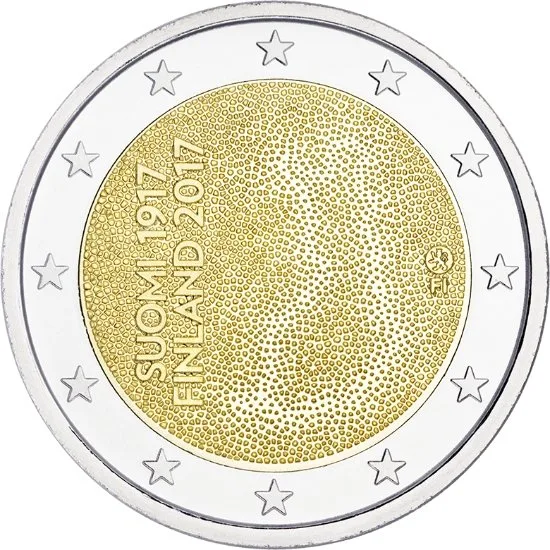
A mosaic whose more loosely spaced elements on the right side trace the outline of Finland. On the left, the text "SUOMI FINLAND", the year of independence "1917", and the year of issue "2017" are arranged vertically beneath one another. The country abbreviation "FI" and the mintmark appear at centre right.
Further information on the topic
Finland is one of Europe's younger nation-states, and its path to independence is closely tied to the upheavals of the First World War. For centuries, the territory of present-day Finland was part of the Swedish realm before falling to the Russian Empire as a Grand Duchy in 1809. The 19th-century Finnish cultural movement — carried by language, literature and the national epic the Kalevala — sharpened a national consciousness that remained politically suppressed for a long time. When the Tsarist empire collapsed in the October Revolution of autumn 1917, the Finnish parties seized the resulting vacuum: on 6 December 1917, the Finnish Parliament in Helsinki declared independence. The Soviet government under Lenin recognised it a few weeks later — an unusual step that secured Finland full international sovereignty as one of the first states in Europe to achieve it.
State consolidation, however, did not proceed smoothly. Immediately after independence, a civil war shook the country, pitting the socialist Red Guards against the bourgeois-nationalist White Guards — a deep social rift that shaped the early republic and was only reckoned with decades later. Later in the 20th century, Finland asserted its independence in an exceptionally difficult geopolitical position: the Winter War against the Soviet Union in 1939/40 and the subsequent Continuation War cost the country significant territory but also strengthened national cohesion. Post-war policy of active neutrality — often called "Finlandisation" — enabled economic growth and social modernisation. With EU accession in 1995 and the introduction of the euro in 2002, Finland firmly anchored itself in the European integration project. On the centenary of independence in 2017, Finland commemorated this historic founding moment with a 2-euro commemorative coin.
Technical data
| Face value | 2 euro |
|---|---|
| Material | Bimetallic – outer ring: cupronickel; centre: three layers (nickel-brass / nickel / nickel-brass) |
| Weight | 8.5 g |
| Diameter | 25.75 mm |
| Thickness | 2.20 mm |