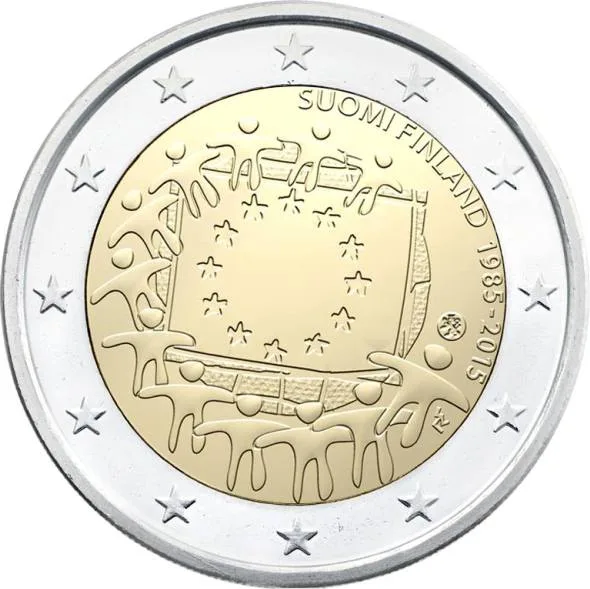
30 Years of the European Flag
 + Add to collection In collection ★ Wanted
 At a glance
| Country | Finland |
|---|---|
| Year | 2015 |
| Issue date | 6 August 2015 |
| Coin type | Commemorative coin |
| Mintage | 500.000 (7.000 / 11.000) |
| Catalogue number | FI-15 G2 |
| Designer | Georgios Stamatopoulos |
| Rarity | €€€€€ what does this mean? |
| Edge lettering |  |
| Market value (approx.) | 4 € · guide price, uncirculated Unlock · for members |
Coin description
The EU flag as a symbol bringing peoples and cultures together around shared aspirations and ideals for a better future. The twelve stars take on human form, welcoming the birth of a new Europe. Along the upper right of the coin's inner ring appear the issuing country "SUOMI FINLAND" and the dates "1985–2015". The mintmark is positioned to the right between the flag and the dates. The designer's initials (Georgios Stamatopoulos) appear at lower right.
Note on the coin
Fourth European Union joint issue. All 19 eurozone states issued a coin with the same design on various dates. The coins differ only in their inscriptions, which appear in the respective national language.
Further information on the topic
The European flag traces back to a decision by the Council of Europe on 8 December 1955 and was initially introduced as the symbol of that intergovernmental organisation before the European Community adopted it as its own symbol in 1985. The design — twelve gold stars arranged in a circle on a blue background — was created by Arsène Heitz and Paul Lévy. The number twelve does not represent the founding members but is regarded as a symbol of completeness and unity, rooted in European tradition and iconography. Since its adoption by the EC, the flag's scope has steadily expanded, and it is today the most widely recognised symbol of the European Union.
Finland joined the European Union in 1995, part of the first major wave of enlargement after the founding phase. As one of the Nordic member states, Finland helped shape the EU's image through its tradition of good governance and education policy. In 2015, marking the 30th anniversary of the flag's adoption by the EC, Finland took part in the Europe-wide joint issue, in which all euro states issued a shared 2-euro commemorative coin with an identical design. This coordinated issue was only the second of its kind in the history of the eurozone, bringing together for the first time all euro countries at the time under a single coin design.
Technical data
| Face value | 2 euro |
|---|---|
| Material | Bimetallic – outer ring: cupronickel; centre: three layers (nickel-brass / nickel / nickel-brass) |
| Weight | 8.5 g |
| Diameter | 25.75 mm |
| Thickness | 2.20 mm |
More 2-euro coins from Finland
150th Birthday of Akseli Gallen-Kallela
Commemorative coin
150th Birthday of Jean Sibelius
Commemorative coin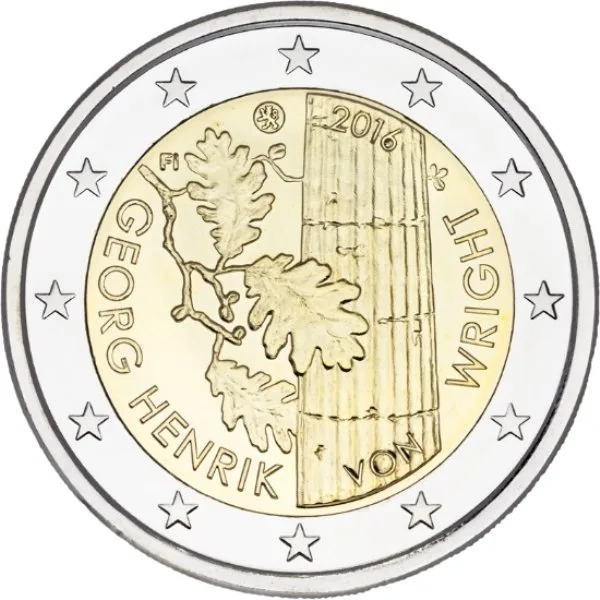
100th Birthday of Georg Henrik von Wright
Commemorative coin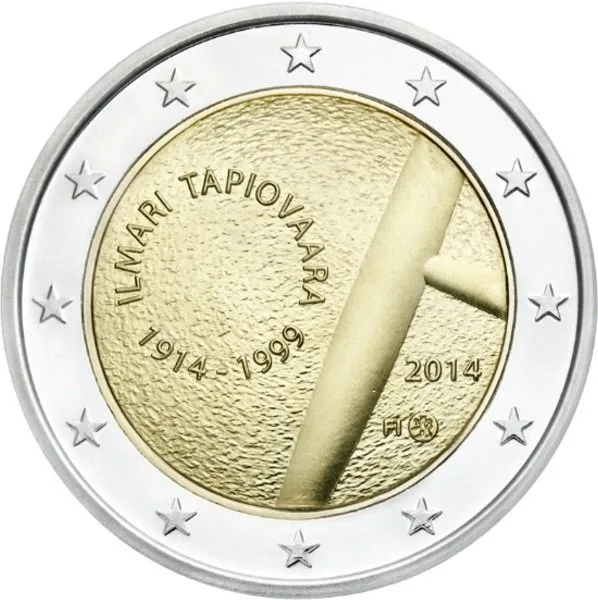
100th Birthday of Ilmari Tapiovaara
Commemorative coin