50 Years of the Élysée Treaty
 + Add to collection In collection ★ Wanted
 At a glance
| Country | France |
|---|---|
| Year | 2013 |
| Issue date | 21 January 2013 |
| Coin type | Commemorative coin |
| Mintage | 10.021.000 (11.000 / 10.000) |
| Catalogue number | FR-13 G1 |
| Designer | Stefanie Lindner |
| Rarity | €€€€€ what does this mean? |
| Edge lettering |  |
| Market value (approx.) | 3,5 € · guide price, uncirculated Unlock · for members |
Coin description
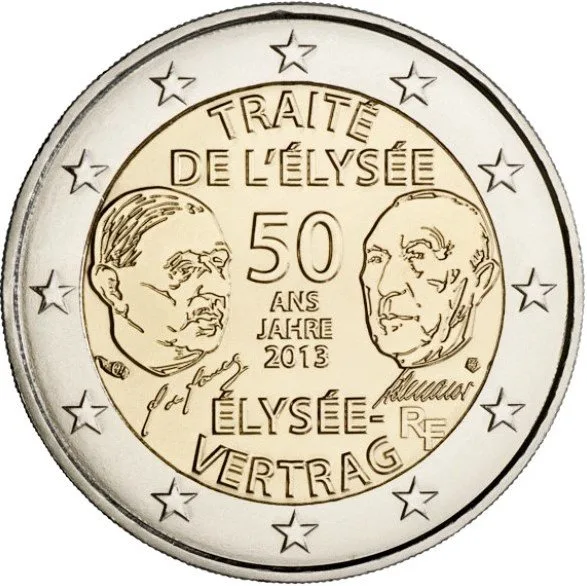
Stylised portraits of the treaty's two signatories — the then Federal Chancellor of West Germany, Konrad Adenauer, and the then President of the French Republic, Charles de Gaulle — with their signatures, the inscription "50 ANS JAHRE" and the year "2013" between them, "TRAITÉ DE L'ÉLYSÉE" along the upper edge, and "ÉLYSÉE-VERTRAG" along the lower edge of the inner field. The mintmark and the issuing country symbol ("RF") appear on the right; the mintmaster's mark — a flower — on the left.
Further information on the topic
For France, the Élysée Treaty marks one of the most consequential foreign-policy steps of its postwar history. Charles de Gaulle and Konrad Adenauer signed the agreement on 22 January 1963 in Paris - after centuries of rivalry, two world wars and deeply rooted mutual hostility. The treaty laid down institutional structures for German-French cooperation: regular consultations between heads of state and government, close coordination on foreign, defence and cultural policy, and a youth exchange programme that gave rise to the Franco-German Youth Office. That it was de Gaulle - whose relationship with Germany was shaped by personal wartime experience - who drove this rapprochement forward gives the treaty its lasting symbolic weight.
The Élysée Treaty is regarded as a foundation of European integration because it proved that historically hostile states can build workable political partnerships. In the decades after 1963, the German-French axis became the driving force behind the deepening of the European Community - from economic and monetary union to a common foreign policy. France marked the treaty's 50th anniversary in 2013 together with Germany; both countries issued a joint 2-euro commemorative coin for the occasion, showing the signatories from both sides. The date remains a fixed reference point in the French debate about what European partnership can achieve and what role Paris should play in it.
Technical data
| Face value | 2 euro |
|---|---|
| Material | Bimetallic – outer ring: cupronickel; centre: three layers (nickel-brass / nickel / nickel-brass) |
| Weight | 8.5 g |
| Diameter | 25.75 mm |
| Thickness | 2.20 mm |