50 Years of the Élysée Treaty
 + Add to collection In collection ★ Wanted
 At a glance
| Country | Germany |
|---|---|
| Year | 2013 |
| Issue date | 22 January 2013 |
| Coin type | Commemorative coin |
| Mintage | varies by year & mint – see table below ↓ |
| Catalogue number | DE-13 G1 |
| Designer | Yves Sampo und Stefanie Lindner |
| Rarity | €€€€€ what does this mean? |
| Edge lettering |  |
| Market value (approx.) | 3,5 € · guide price, uncirculated Unlock · for members |
Coin description
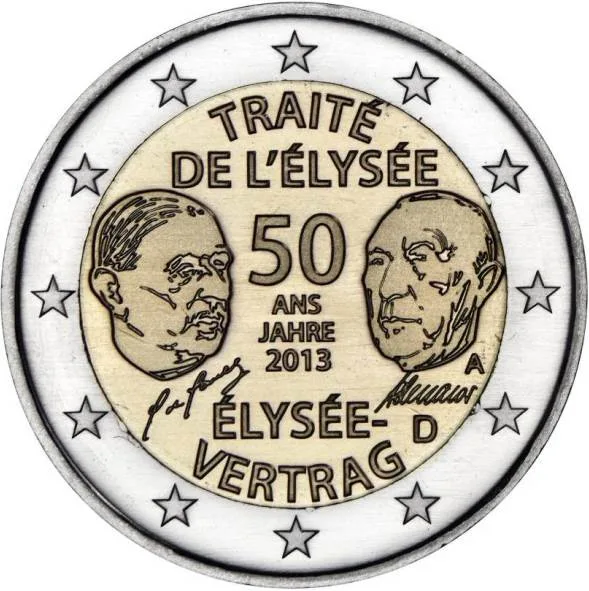
Stylized portraits of the signatories of the Élysée Treaty – the then Chancellor of the Federal Republic of Germany, Konrad Adenauer, and the then President of the French Republic, Charles de Gaulle – along with their signatures. Between them is the inscription „50 ANS JAHRE" and the year „2013", with „TRAITÉ DE L'ÉLYSÉE" along the top edge and „ÉLYSÉE-VERTRAG" along the bottom edge of the coin's inner field. The mintmark („A", „D", „F", „G", or „J") and the issuing country's mark („D") appear along the right-hand edge of the coin's inner field.
Note on the coin
A joint issue by Germany and France. France released a coin with the same design that same year.
Further information on the topic
On 22 January 1963, Konrad Adenauer and Charles de Gaulle signed a treaty of friendship at the Élysée Palace in Paris that placed German-French relations on a contractual footing - a historic turning point after centuries of warfare between the two countries. The treaty established an institutional framework: regular consultations at government level, close coordination on foreign, defence and cultural policy, and youth exchange programmes from which the Franco-German Youth Office emerged that same year. Adenauer, then 87 years old and only months from stepping down as chancellor, and de Gaulle, who wanted to position France as an independent great power, combined national interests with a long-term vision of European stability in this agreement.
The significance of the Élysée Treaty for European integration can hardly be overstated. The German-French axis became the driving force behind the deepening of the European Communities: the common market, the European Monetary System, the Maastricht Treaty - in every major step of integration, Bonn or Berlin and Paris formed the effective centre. More than 200 town twinnings and millions of young people who got to know the neighbouring country through the Youth Office gave the reconciliation a social depth beyond diplomacy. In 2013, on the 50th anniversary of the treaty, Germany issued a joint 2-euro commemorative coin together with France - both countries minted coins with identical designs, a rare mark of symbolic unity even by the standards of European commemorative coinage.
Official announcement (EU Official Journal): ABl. C 21 vom 24.1.2013, S. 10 (2013/C 21/04)
Mintages by mint
| Mint | Mintage |
|---|---|
| A | 2.200.000 (40.000 / 85.000) |
| D | 2.310.000 (35.000 / 80.000) |
| F | 2.640.000 (35.000 / 80.000) |
| G | 1.540.000 (35.000 / 80.000) |
| J | 2.310.000 (35.000 / 80.000) |
Technical data
| Face value | 2 euro |
|---|---|
| Material | Bimetallic – outer ring: cupronickel; centre: three layers (nickel-brass / nickel / nickel-brass) |
| Weight | 8.5 g |
| Diameter | 25.75 mm |
| Thickness | 2.20 mm |