50 Years of the Warsaw Genuflection
 + Add to collection In collection ★ Wanted
 At a glance
| Country | Germany |
|---|---|
| Year | 2020 |
| Issue date | 8 October 2020 |
| Coin type | Commemorative coin |
| Mintage | varies by year & mint – see table below ↓ |
| Catalogue number | DE-20 G2 |
| Designer | Bodo Broschat |
| Rarity | €€€€€ what does this mean? |
| Edge lettering |  |
| Market value (approx.) | 3,5 € · guide price, uncirculated Unlock · for members |
Coin description
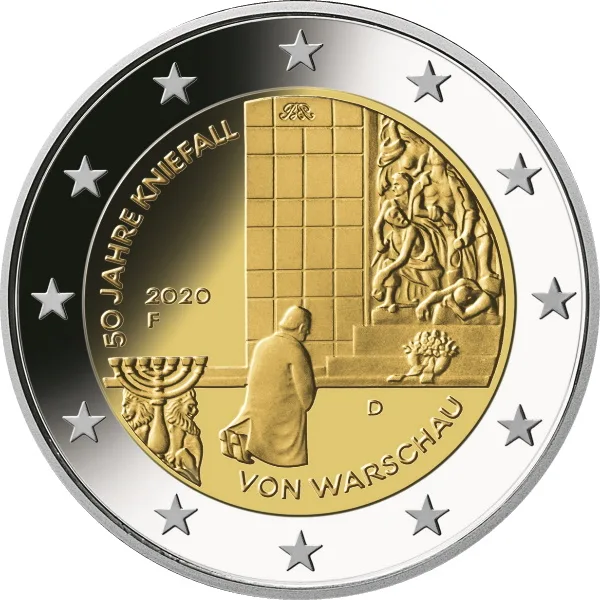
The moment of Federal Chancellor Willy Brandt's genuflection before the memorial to the heroes of the 1943 Warsaw Ghetto Uprising is depicted at the centre. The inscription '50 JAHRE KNIEFALL' and 'VON WARSCHAU' runs along the upper left and lower right edges. The year '2020' and the mintmark ('A', 'D', 'F', 'G' or 'J') are struck above the menorah. The country code 'D' appears below the memorial; the monogram of designer Bodo Broschat at the top centre.
Further information on the topic
The Warsaw Genuflection is regarded as one of the most significant gestures in post-war European history. On 7 December 1970, Chancellor Willy Brandt, during his visit to the memorial for the victims of the 1943 Warsaw Ghetto Uprising, spontaneously knelt down — an unplanned, silent act of humility toward the victims of Nazi terror in Poland. The image travelled around the world and was seen internationally as a signal of Germany's acknowledgment of historical guilt and responsibility. In West Germany itself, the initial reaction was mixed: polls showed that a majority of West Germans considered the gesture excessive. For reconciliation between Germany and Poland, however, it marked a turning point — embedded in Brandt's Ostpolitik, which favoured rapprochement over confrontation with the socialist neighbouring states and was honoured with the Nobel Peace Prize in 1971.
Willy Brandt, born in Lübeck in 1913 and in Norwegian exile during the Nazi era, was Chancellor of the Federal Republic of Germany from 1969 to 1974. His Ostpolitik included, alongside the Moscow and Warsaw treaties of 1970, the Basic Treaty with East Germany and paved the way for the CSCE process. The Warsaw Treaty, signed the same day as the genuflection, recognised the Oder-Neisse line as Poland's western border and was highly controversial domestically. Brandt himself later wrote that he had done what people do when words fail. To mark the 50th anniversary of the genuflection, Germany issued a 2-euro commemorative coin in 2020, honouring this moment and its lasting significance for German-Polish relations and European remembrance culture.
Mintages by mint
| Mint | Mintage |
|---|---|
| A | 6.000.000 (30.000 / 33.000) |
| D | 6.300.000 (30.000 / 33.000) |
| F | 7.200.000 (30.000 / 33.000) |
| G | 4.200.000 (30.000 / 33.000) |
| J | 6.300.000 (30.000 / 33.000) |
Technical data
| Face value | 2 euro |
|---|---|
| Material | Bimetallic – outer ring: cupronickel; centre: three layers (nickel-brass / nickel / nickel-brass) |
| Weight | 8.5 g |
| Diameter | 25.75 mm |
| Thickness | 2.20 mm |