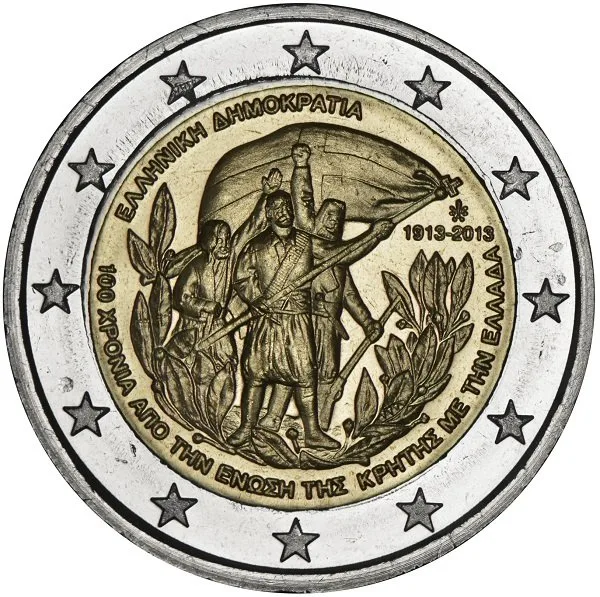
100th Anniversary of the Union with Crete
 + Add to collection In collection ★ Wanted
 At a glance
| Country | Greece |
|---|---|
| Year | 2013 |
| Issue date | 1 October 2013 |
| Coin type | Commemorative coin |
| Mintage | 754.000 (7.500 / 4.000) |
| Catalogue number | GR-13 G2 |
| Designer | Georgios Stamatopoulos |
| Rarity | €€€€€ what does this mean? |
| Edge lettering |  |
| Market value (approx.) | 4,5 € · guide price, uncirculated Unlock · for members |
Coin description
Cretan rebels raising the Greek flag — a symbolic depiction of Crete's struggle for union with Greece. In the upper portion, the name of the issuing state "Hellenic Republic" arcs in capital Greek letters, followed by the inscription "100 Years of Crete's Union with Greece" in Greek, with "1913–2013" to the right and the monogram of the Greek mint alongside the engraver G. Stamatopoulos's initials "ΣΤΑΜ".
Further information on the topic
Crete holds a special place in modern Greek history. The island in the southern Mediterranean was for centuries a bone of contention between great powers: after a long period of Venetian rule, it fell to the Ottoman Empire in 1669, remaining under its control for roughly two and a half centuries. During this time, recurring uprisings shaped the relationship between the Cretan population and the Ottoman administration. Following the Greco-Turkish War of 1897 and the ensuing international pressure, Crete received special status in 1898 as an autonomous principality under Ottoman suzerainty — effectively already on the path to secession. The island thus remained for decades an unresolved yet central chapter of the Greek national movement.
The decisive turning point came with the Balkan Wars: in October 1912, while Greece fought alongside Serbia, Bulgaria and Montenegro against the Ottoman Empire, the Cretan National Assembly formally declared union with Greece. On 1 December 1913, the incorporation was completed under international law — Crete officially became part of Greek state territory. This is the date to which the 100th anniversary of the union refers, which Greece commemorated with a coin in 2013. For the country, this conclusion was more than a territorial gain: it marked the provisional end of a long process of unification and remains to this day a national date of remembrance, understood as shared history both on Crete itself and on the Greek mainland.
Official issues of the coin
 ©Image credit: Νομισματοκοπείο - IETA
Technical data
| Face value | 2 euro |
|---|---|
| Material | Bimetallic – outer ring: cupronickel; centre: three layers (nickel-brass / nickel / nickel-brass) |
| Weight | 8.5 g |
| Diameter | 25.75 mm |
| Thickness | 2.20 mm |
More 2-euro coins from Greece
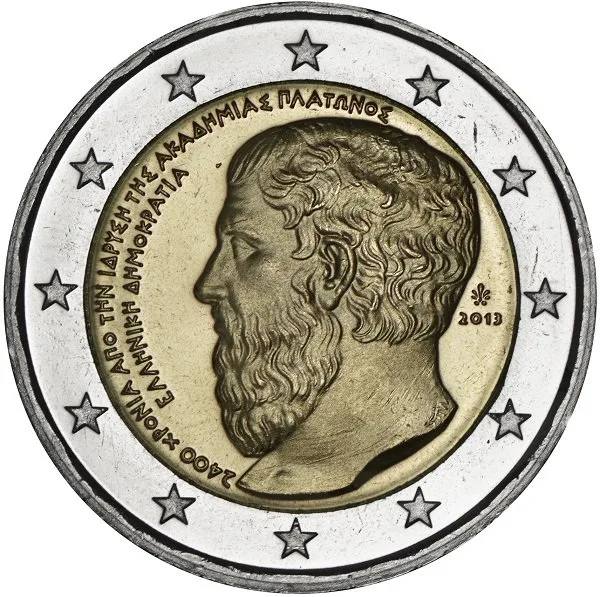
2,400 Years of the Platonic Academy
Commemorative coin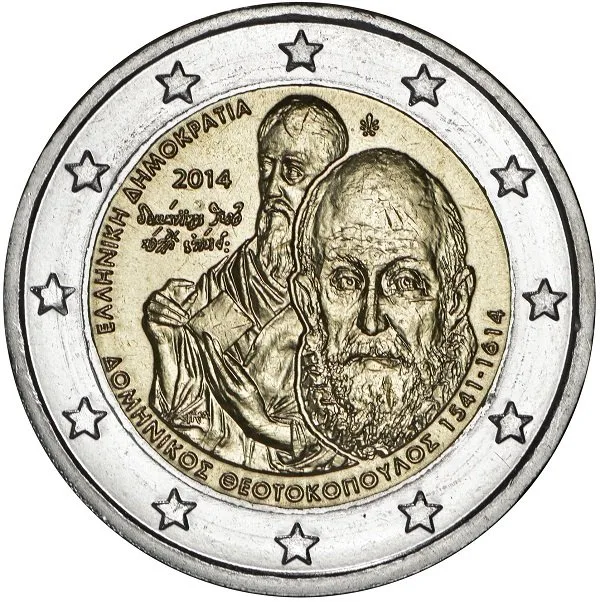
400th Anniversary of the Death of Domínikos Theotokópoulos
Commemorative coin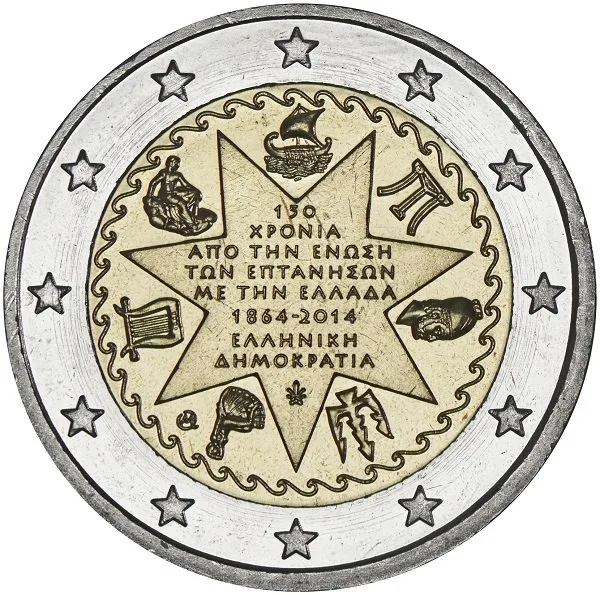
150th Anniversary of the Union with the Ionian Islands
Commemorative coin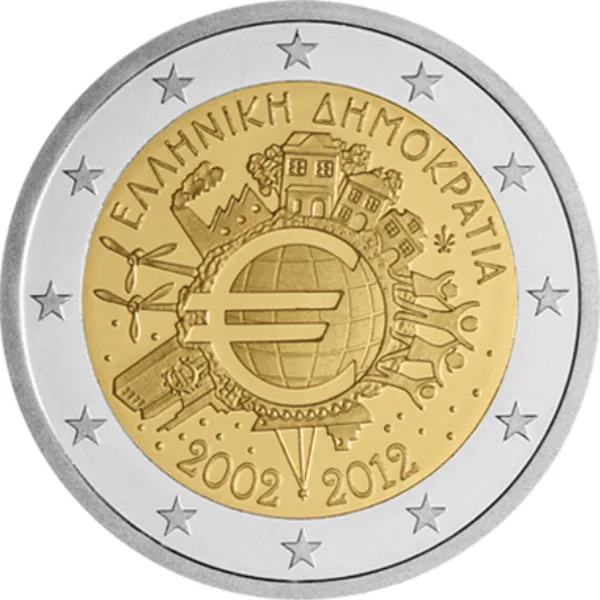
10 Years of Euro Banknotes and Coins
Commemorative coin