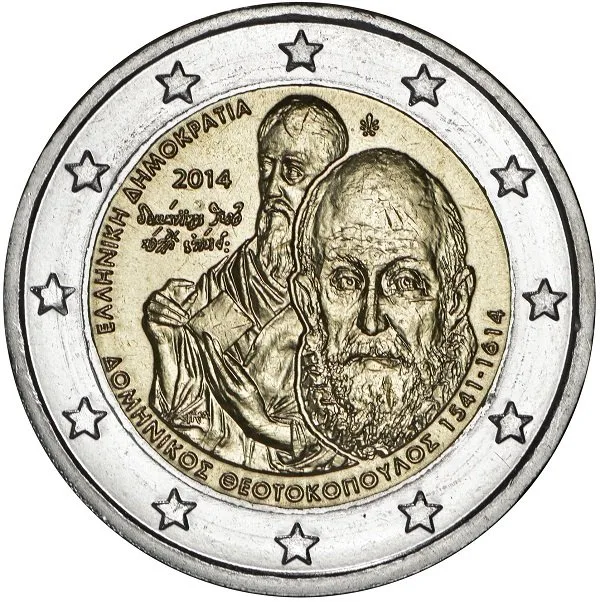
400th Anniversary of the Death of Domínikos Theotokópoulos
 + Add to collection In collection ★ Wanted
 At a glance
| Country | Greece |
|---|---|
| Year | 2014 |
| Issue date | 24 September 2014 |
| Coin type | Commemorative coin |
| Mintage | 752.500 (7.500 / 2.500) |
| Catalogue number | GR-14 G1 |
| Designer | Georgios Stamatopoulos |
| Rarity | €€€€€ what does this mean? |
| Edge lettering |  |
| Market value (approx.) | 4 € · guide price, uncirculated Unlock · for members |
Coin description
Portrait of Dominikos Theotokopoulos. In the background, a figure study characteristic of the painter's technique. On the left, the year 2014 and his signature ("Dominikos Theotokopoulos Epoiei") are engraved; on the right, the mark of the Greek mint. Arranged in a circle around the design, the inscription "DOMINIKOS THEOTOKOPOULOS 1541–1614" and the name of the issuing state "HELLENIC REPUBLIC" appear in Greek.
Further information on the topic
Domínikos Theotokópoulos is one of the most idiosyncratic painters in European art history. Born around 1541 on Crete, then under Venetian rule, he first learned Byzantine icon painting before travelling to Venice and then Rome, where he came into contact with Mannerist painting. He achieved his true fame, however, in Spain: from 1577 he lived and worked in Toledo, where he remained until his death in 1614. There he became known under the nickname "El Greco" — the Greek — a name that preserved his origins while also marking his singular position within late-16th and early-17th-century Spanish painting.
His work bears an unmistakable signature: elongated figures, expressive use of light, intense colour and a spiritual urgency that sets it clearly apart from the naturalistic tendency of his contemporaries. Above all his religious compositions and portraits made him one of the most important representatives of Mannerism in Europe. Long after his death, El Greco fell into obscurity before being rediscovered by modernism — the Expressionists foremost among them — as a forerunner of their own visual language. For Greece, he is a central reference point of national art history: a Cretan whose work mediates between Byzantine tradition and Western European painting, and whose influence extends into the present. In 2014, the 400th anniversary of his death was commemorated.
Technical data
| Face value | 2 euro |
|---|---|
| Material | Bimetallic – outer ring: cupronickel; centre: three layers (nickel-brass / nickel / nickel-brass) |
| Weight | 8.5 g |
| Diameter | 25.75 mm |
| Thickness | 2.20 mm |
More 2-euro coins from Greece
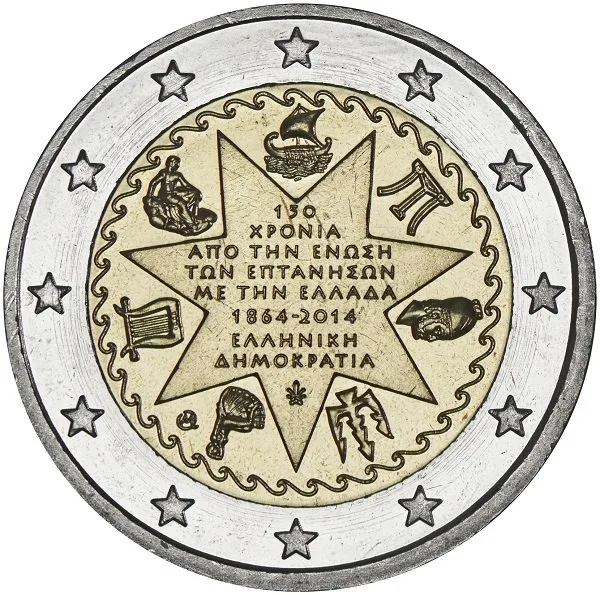
150th Anniversary of the Union with the Ionian Islands
Commemorative coin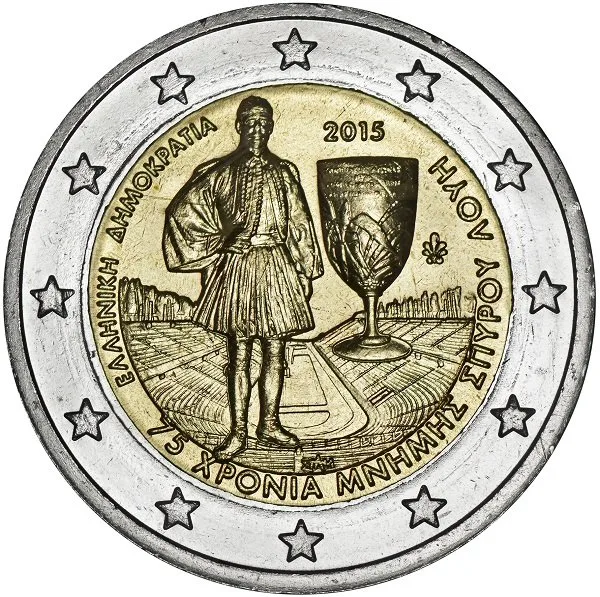
75th Anniversary of the Death of Spyridon Louis
Commemorative coin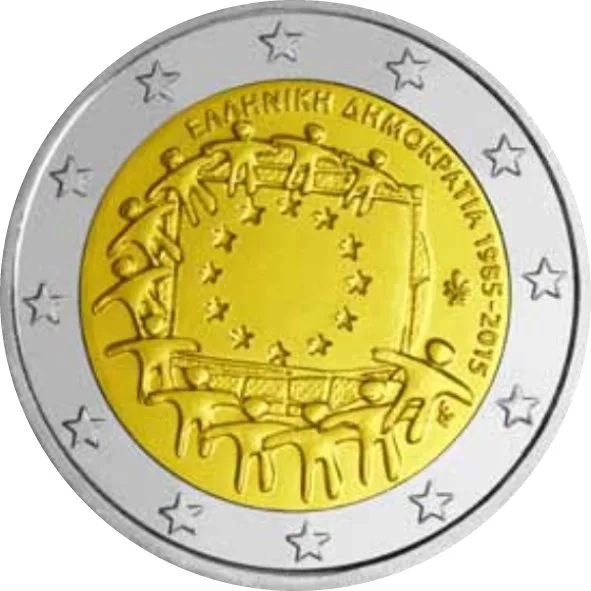
30 Years of the European Flag
Commemorative coin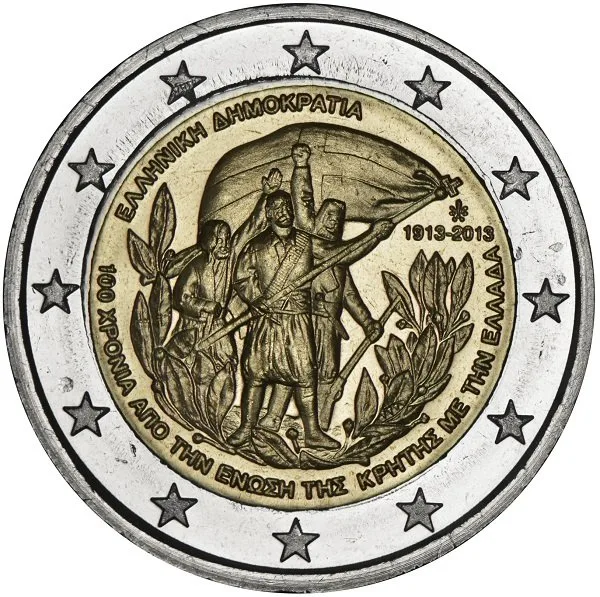
100th Anniversary of the Union with Crete
Commemorative coin