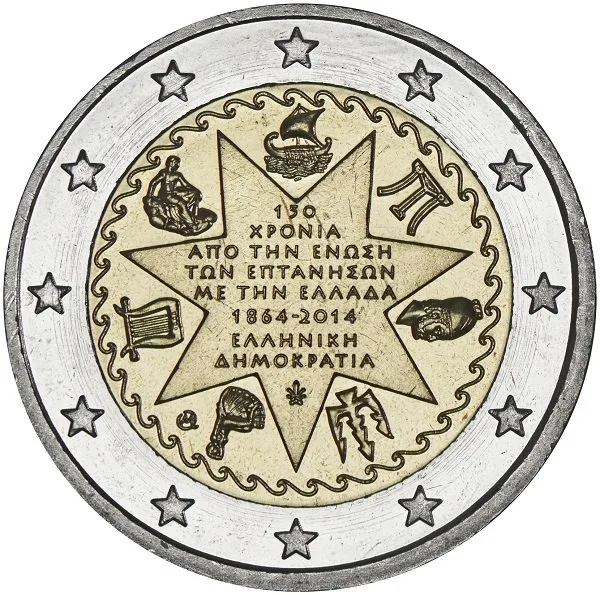
150th Anniversary of the Union with the Ionian Islands
 + Add to collection In collection ★ Wanted
 At a glance
| Country | Greece |
|---|---|
| Year | 2014 |
| Issue date | 24 September 2014 |
| Coin type | Commemorative coin |
| Mintage | 752.500 (7.500 / 2.500) |
| Catalogue number | GR-14 G2 |
| Designer | Maria Andonatou |
| Rarity | €€€€€ what does this mean? |
| Edge lettering |  |
| Market value (approx.) | 3 € · guide price, uncirculated Unlock · for members |
Coin description
A seven-pointed star bearing the Greek inscription "150 YEARS OF THE UNION OF THE IONIAN ISLANDS (HEPTANESE) WITH GREECE 1864–2014" and the name of the issuing state "HELLENIC REPUBLIC", together with the mark of the Greek mint. Between each point of the star are emblematic motifs representing the individual Ionian Islands. The entire design is framed by a decorative stylised wave.
Further information on the topic
In March 1864, the Ionian Islands passed under Greek sovereignty after almost fifty years of British administration — a transfer achieved not through war but through diplomatic negotiation. Great Britain, which had administered the island group as a protectorate since the Congress of Vienna in 1815, ceded the seven islands of Corfu, Kefalonia, Zakynthos, Lefkada, Ithaca, Kythira and Paxi to the Kingdom of Greece. A trade-off of interests was decisive: Greece accepted Prince William of Denmark as king, favoured by the protecting powers, while the so-called Eptanisa received in return the long-desired union. For the islanders, this ended decades of a movement that had drawn significant cultural momentum from local patriots such as Andreas Laskaratos and the poet Andreas Kalvos.
The Ionian Islands brought Greece not only territory but also a distinct cultural tradition. Under Venetian rule, which preceded the British period, the islands had developed a pronounced school culture, a vibrant literary language and their own musical school, whose influence lives on today in Ionian opera and the kantada tradition. The 1864 union integrated this heritage into the Greek nation-state and gave the young republic greater weight, both geographically and culturally, in the eastern Mediterranean. Greece honoured the 150th anniversary of this union in 2014 with the issue of a 2-euro commemorative coin.
Technical data
| Face value | 2 euro |
|---|---|
| Material | Bimetallic – outer ring: cupronickel; centre: three layers (nickel-brass / nickel / nickel-brass) |
| Weight | 8.5 g |
| Diameter | 25.75 mm |
| Thickness | 2.20 mm |
More 2-euro coins from Greece
400th Anniversary of the Death of Domínikos Theotokópoulos
Commemorative coin
100th Anniversary of the Union with Crete
Commemorative coin
30 Years of the European Flag
Commemorative coin
2,400 Years of the Platonic Academy
Commemorative coin