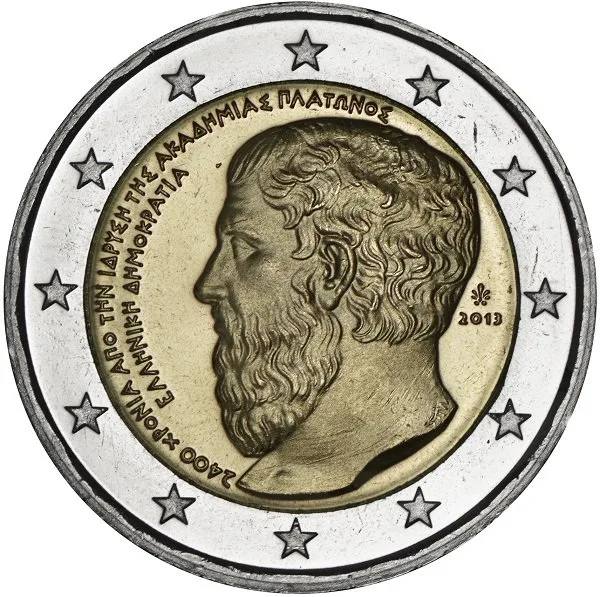
2,400 Years of the Platonic Academy
 + Add to collection In collection ★ Wanted
 At a glance
| Country | Greece |
|---|---|
| Year | 2013 |
| Issue date | 1 October 2013 |
| Coin type | Commemorative coin |
| Mintage | 754.000 (7.500 / 4.000) |
| Catalogue number | GR-13 G1 |
| Designer | Georgios Stamatopoulos |
| Rarity | €€€€€ what does this mean? |
| Edge lettering |  |
| Market value (approx.) | 4,5 € · guide price, uncirculated Unlock · for members |
Coin description
Profile portrait of Plato. To the left, the inscriptions "2400 Years since the Foundation of the Platonic Academy" and "Hellenic Republic" in ancient Greek script; to the right, "2013" and the monogram of the Greek mint, "ΣΤΑΜ" (the engraver G. Stamatopoulos).
Further information on the topic
Plato founded his school around 387 BC in a grove northwest of Athens dedicated to the hero Akademos — hence the name Academy, which to this day characterises all forms of institutionalised scholarship. For almost nine centuries, until its closure by Emperor Justinian I in 529 AD, the Platonic Academy was a central place of philosophical thought in the ancient world. Here, Plato developed his theory of forms, his political theory and dialectic as a method of finding truth — concepts that run through Western philosophy, theology and science to the present day. His most famous student, Aristotle, spent around twenty years there before founding his own influential school tradition.
For Greece, the Platonic Academy is more than a historical relic: it stands for Athens' claim to be the birthplace of European rationality and educational culture. The concept of the academy, the legacy of Socratic dialogue and Plato's dialogues — from the Republic to the Symposium — remain a fixed part of Greek cultural memory and are received worldwide in philosophical and educational discourse. Excavations at the site in the present-day Athens district of Akadimia Platonos have uncovered remains of the ancient grove and early buildings. On the occasion of the 2400th anniversary of its founding, Greece issued a 2-euro commemorative coin in 2013 recalling this legacy.
Official issues of the coin
 ©Image credit: Νομισματοκοπείο - IETA
Technical data
| Face value | 2 euro |
|---|---|
| Material | Bimetallic – outer ring: cupronickel; centre: three layers (nickel-brass / nickel / nickel-brass) |
| Weight | 8.5 g |
| Diameter | 25.75 mm |
| Thickness | 2.20 mm |
More 2-euro coins from Greece
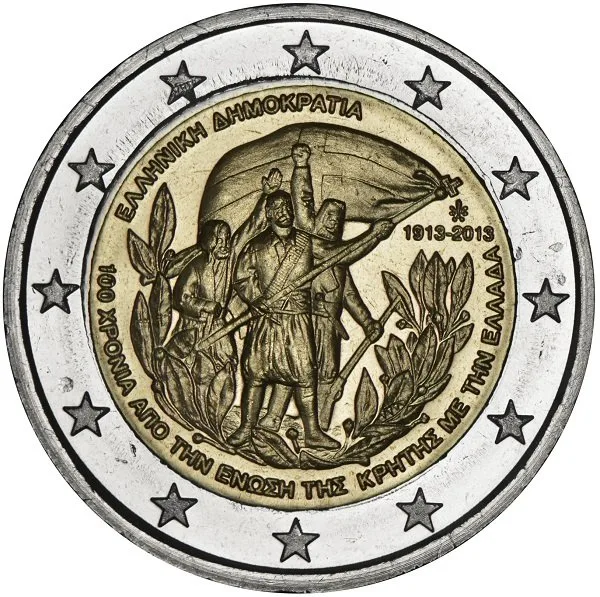
100th Anniversary of the Union with Crete
Commemorative coin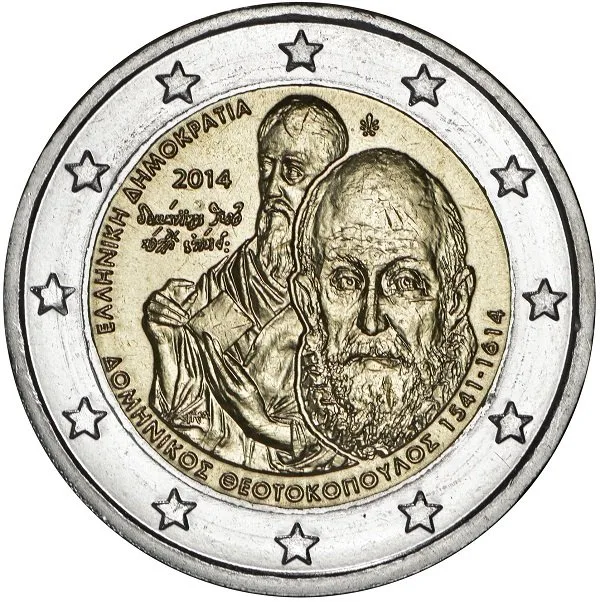
400th Anniversary of the Death of Domínikos Theotokópoulos
Commemorative coin
150th Anniversary of the Union with the Ionian Islands
Commemorative coin
10 Years of Euro Banknotes and Coins
Commemorative coin