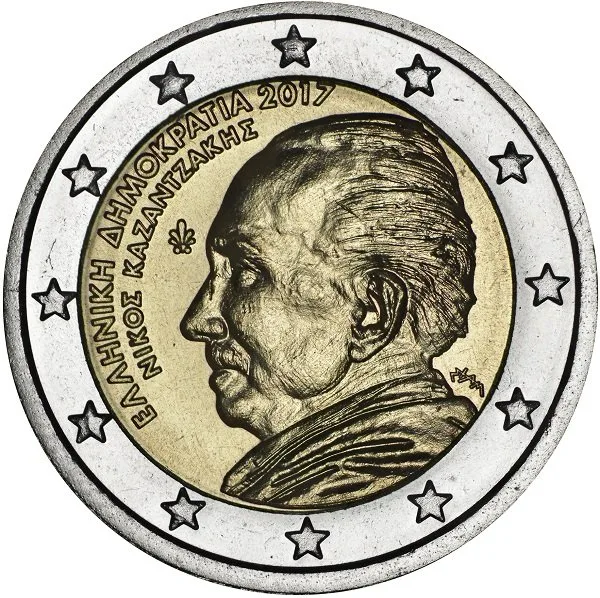
60th Anniversary of the Death of Nikos Kazantzakis
 + Add to collection In collection ★ Wanted
 At a glance
| Country | Greece |
|---|---|
| Year | 2017 |
| Issue date | 10 July 2017 |
| Coin type | Commemorative coin |
| Mintage | 750.000 (4.500 / 1.500) |
| Catalogue number | GR-17 G1 |
| Designer | Georgios Stamatopoulos |
| Rarity | €€€€€ what does this mean? |
| Edge lettering |  |
| Market value (approx.) | 5 € · guide price, uncirculated Unlock · for members |
Coin description
Profile portrait of Nikos Kazantzakis, one of the most important Greek writers of the 20th century. Along the inner circle to the left, the inscriptions "HELLENIC REPUBLIC" and "NIKOS KAZANTZAKIS" (in Greek) are engraved. The issue year 2017 and a palmette — the mintmark of the Greek mint — are engraved at the top and centre-left respectively. The monogram of coin designer Georgios Stamatopoulos appears at lower right.
Further information on the topic
Nikos Kazantzakis is arguably the best-known Greek writer of the 20th century — an author whose work resonated far beyond his homeland and is still read in dozens of languages today. Born in 1883 on Crete, then still under Ottoman rule, he was shaped throughout his life by the island: its history, its people and its love of freedom recur throughout his entire literary output. Kazantzakis studied in Athens, Paris and Berlin, lived at times in Russia, Egypt, Japan and numerous European countries, and considered himself a citizen of the world. Philosophically, he was influenced above all by Friedrich Nietzsche and Henri Bergson, and later also by his engagement with Buddhism and Orthodox mysticism. These tensions — between flesh and spirit, doubt and faith, Greece and the world — run through his entire body of work.
Kazantzakis became internationally known above all through his novel Zorba the Greek, adapted in 1964 into a Hollywood film starring Anthony Quinn under the same title, which has shaped popular perceptions of Greece ever since. His perhaps most personal book, The Last Temptation of Christ, caused considerable controversy for its unorthodox interpretation of the life of Jesus and was placed on the Catholic Church's Index. Kazantzakis himself was buried in 1957 — after first being interred in Freiburg im Breisgau — on the Martinengo Bastion of the Venetian city walls of Heraklion on Crete, in accordance with his wishes. His self-written epitaph reads: "I hope for nothing. I fear nothing. I am free." Greece's 2-euro commemorative coin of 2017 marks the 60th anniversary of the death of this exceptional author, whose grave on Crete remains a much-visited place of pilgrimage to this day.
Official issues of the coin
 ©Image credit: Νομισματοκοπείο - IETA
Technical data
| Face value | 2 euro |
|---|---|
| Material | Bimetallic – outer ring: cupronickel; centre: three layers (nickel-brass / nickel / nickel-brass) |
| Weight | 8.5 g |
| Diameter | 25.75 mm |
| Thickness | 2.20 mm |
More 2-euro coins from Greece
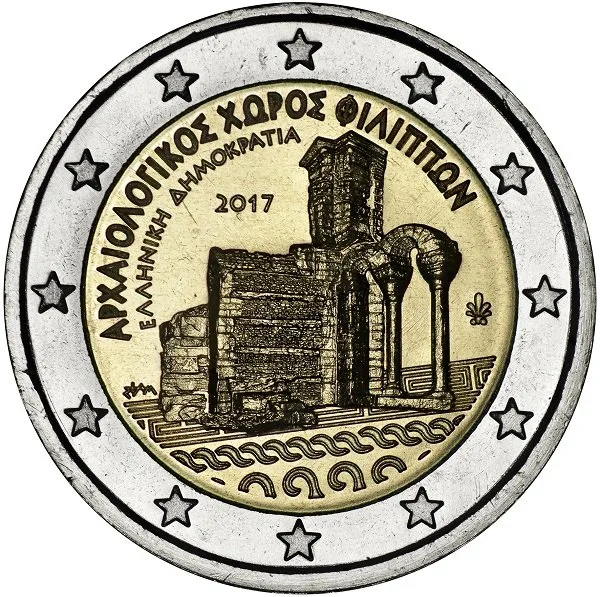
Archaeological Site of Philippi
Commemorative coin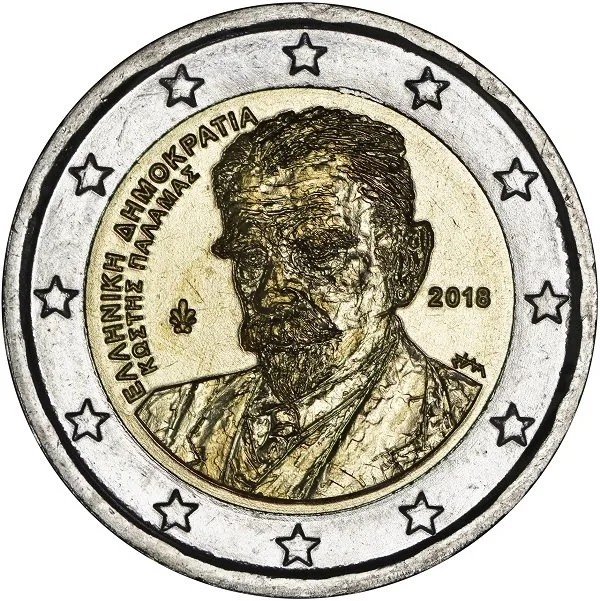
75th Anniversary of the Death of Kostis Palamas
Commemorative coin
70th Anniversary of the Union of the Dodecanese with Greece
Commemorative coin
120th Birthday of Dimitri Mitropoulos
Commemorative coin